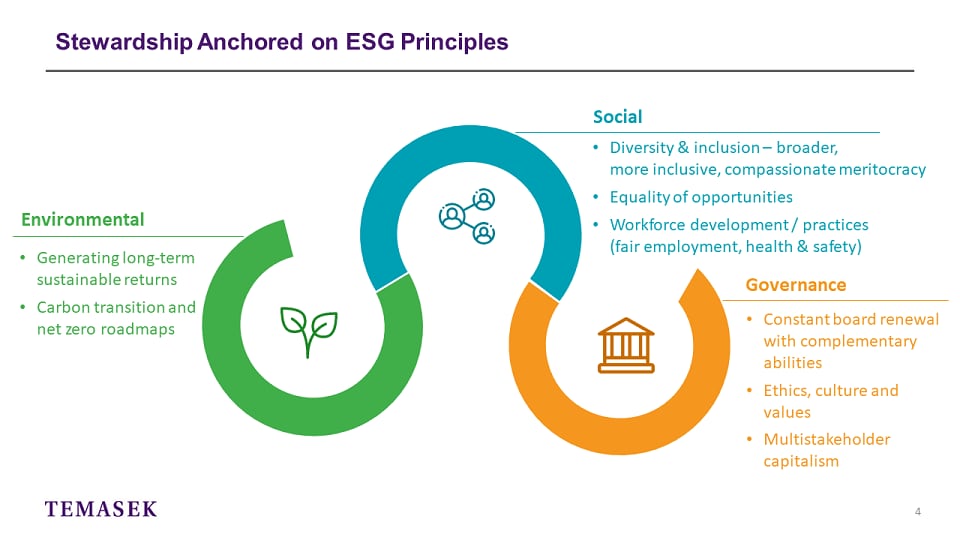
A good framework to operate would be on the basis of the principles of ESG.
- Environmental Sustainability – because it will lead to business sustainability,
- Social Impact – embracing diversity, equity, and inclusion, and
- Good Governance
Let me first deal with environmental sustainability.
Environmental Sustainability
Why is this important? As a result of carbon taxes and the consequential rising cost of capital for companies which failed to transition, we cannot assume that the value of a company today, will grow or even have the same value in future, if we do nothing about climate change as it impacts the company and hence, environmental sustainability.
Addressing environmental sustainability and climate change mitigation, adaptation and transition is an imperative for businesses to generate long term, sustainable returns.
Investors and capital markets are interested in carbon transition and net zero roadmaps that companies have.
Many stock exchanges, including the Singapore Exchange, require listed companies to make disclosures in line with the framework of the Taskforce on Climate-Related Financial Disclosures (TCFD). These require companies to have in place a governance structure, a clear strategy, risk management framework, and also metrics and targets to address the impact of climate change on their businesses.
But in the future, all companies, and not just listed companies, will have to make climate-related disclosures in their financial statements once standards are issued by the recently formed International Sustainability Standards Board (ISSB).
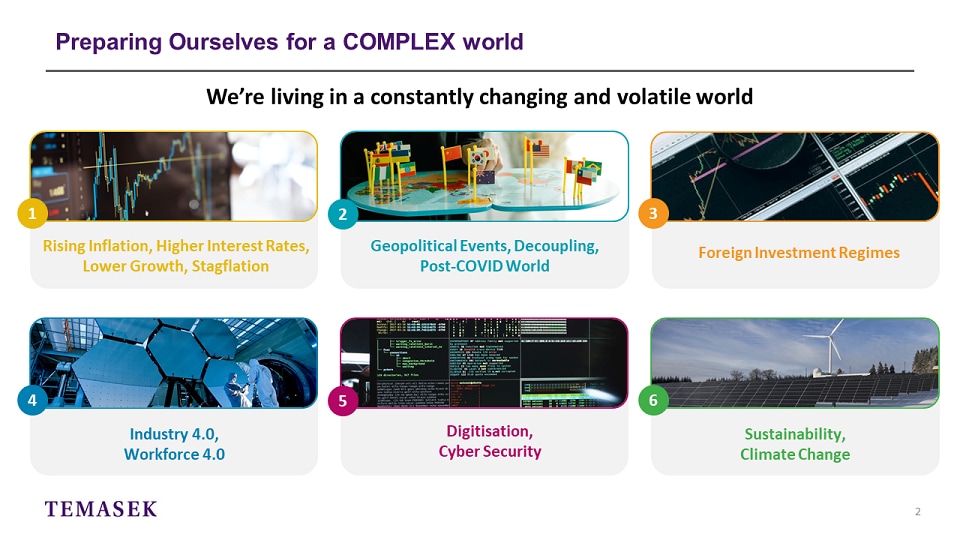
Now with TCFD and ISSB requirements on transition metrics and climate disclosure standards, climate-related financial disclosures are going to become mainstream along with an expectation to report such information with increasingly granular and universal standards
We can expect carbon pricing regimes to proliferate globally. For companies which fall behind in their transition plans, the impact of such regimes, or carbon taxes, will have a direct impact on the financial value of such companies.
We will see an increase credit spreads for financial instruments, increase insurance premium where you have stranded assets – and all of these will impact the asset pricing model for equity value.
There will be increasing shareholder activism, with investors expecting to hear what plans companies have to address and mitigate climate change through their business activities
At Temasek, we have publicly shared that we have achieved carbon neutrality as a company for the last two years. Together with our portfolio, we are targeting to halve our net carbon emissions by 2030 from 2010 levels, and we have the ambition to achieve net zero by 2050. It is not easy when we own an airline.
We have also set an internal carbon pricing of US$42 per tonne of carbon dioxide equivalent, which we factor into all our existing investments and all new investments, with the intention to increase this periodically to US$100 within the next decade.
We should not just think, though, of the “costs” of climate change, but also the opportunities it presents through a shift to a greener economy.
We have seen rapid capital allocation, or reallocation, towards sustainable assets focused on mitigation, adaptation and transition.
Sustainability-focused business models will have a lower cost of capital over the longer run, when compared to business models which do not focus on sustainability.
At Temasek, we are actively investing in sustainable solutions in the food, water, waste, energy, materials, clean transportation and built environment, just to name a few. We have set up an investment platform with BlackRock called Decarbonization Partners, to be able to invest in promising decarbonisation solutions for hard-to-abate sectors.
We have a debt financing platform with HSBC for sustainable infrastructure projects in Southeast Asia.
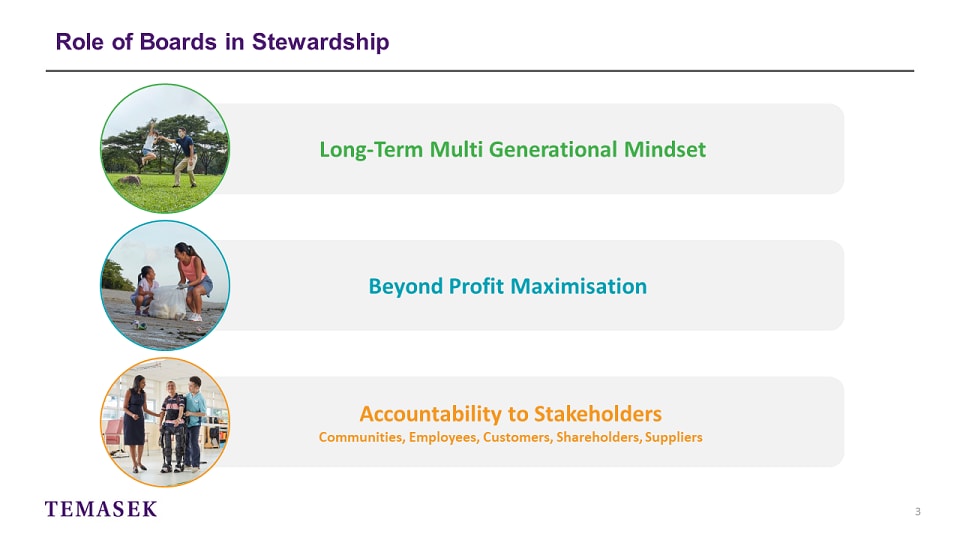
Ultimately, a focus on sustainability and climate change is not a light switch that can simply be turned on or off. It will be a journey over time, and this also ties into having a multi-generational mindset, ensuring a more livable world and safeguarding the future of humanity.
Social Impact
Diversity, equity and inclusion is key and should not be seen as an opposing force to meritocracy, but rather as efforts that will improve meritocracy. As Ravi Menon has said in his IPS lectures, we should strive for a broader, more inclusive and compassionate meritocracy
This entails, amongst other things, fair employment through diversity, proactively bringing in employees with diverse skills, even those that may have disabilities, to provide for equality of opportunities and fair wages for all.
This will contribute to ameliorating the widening income gaps and inequality of opportunities that have risen in recent years.
Good Governance
Boards must have the skills and capabilities for a multi-generational approach towards stewardship.
A managed renewal process within Boards is an imperative, so that Boards have complementary abilities, requisite skills, competencies, and experiences to navigate this VUCA world and address multi-stakeholder capitalism which will improve decision-making and outcomes.
Board members need to think of ourselves as owners of the firm, not just managers – ensuring that a company is ready to thrive in the hands of their next generation of leaders.
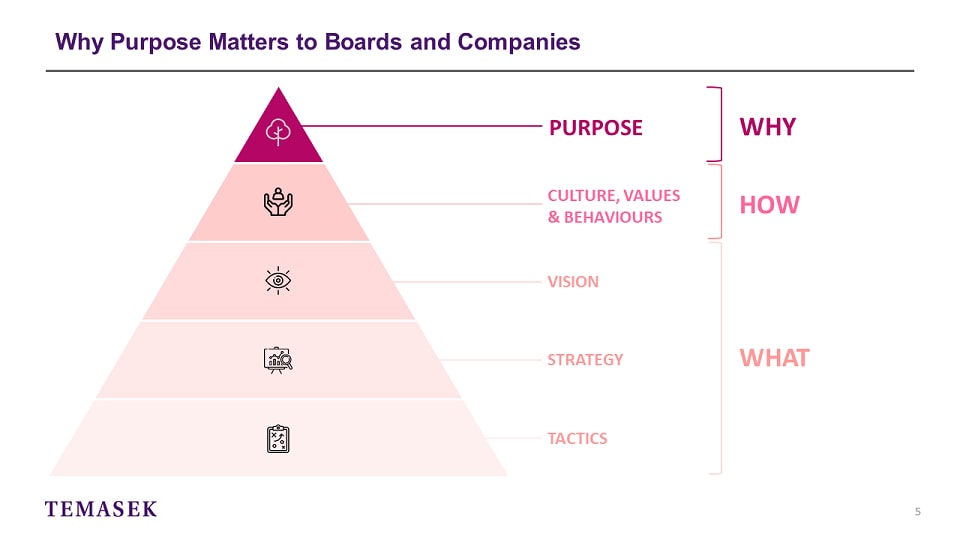
In this regard, it behooves all of us to ensure that the company is purpose-driven with the right values, culture, and behaviours.