We embed sustainability in how we deploy capital, manage risks, and create enduring value across our three portfolio segments.
Sustainability at the Core is one of four key pillars of our T2030 strategy, anchoring how we build a resilient institution and portfolio to deliver good sustainable returns over the long term. It embeds sustainability considerations into how we deploy capital, assess risk, steward our portfolio, develop organisational capabilities, and engage partners. This reflects our conviction that long-term value creation depends on resilient businesses, economies, societies, and ecosystems.
With effect from 1 April 2026, Temasek manages its investments through the following wholly-owned entities — Temasek Singapore (TSG), Temasek Global Investments (TGI), and Temasek Partnership Solutions (TPS). Temasek International (TI) continues to house the firm’s group and corporate functions, providing enterprise-wide governance, strategic, and operational support to these entities.
TSG focuses on the active portfolio management and stewardship of our Singapore-based Temasek Portfolio Companies (TPCs) to enhance value and enable them to be globally competitive while staying rooted in Singapore. As an active shareholder, our TSG team closely engages and partners with our TPCs to drive transformation, capital discipline, and value creation.
TGI focuses on Global Direct Investments (GDIs) in emerging and established market leaders across minority equity positions, co-investments, public markets, and selective control transactions. Our investment activities are guided by structural trends as we seek out resilient compounders and higher-growth opportunities across focus sectors and markets.
TPS focuses on managing capital allocation to funds, building strategic relationships with partners and co-investors, and working with Seviora Holdings as our main Asset Management Platform, to deepen and grow asset management capabilities, scale capital, and access specialised strategies.
Resilience also demands confronting global events with a sense of realism. Climate and nature-related risks are intensifying, and the path ahead is becoming increasingly uncertain. With no clear consensus on the best way forward, future outcomes could range from an orderly transition to a disorderly shift, or even a hot house world marked by severe global warming.
These divergences arise as policy coordination, technology deployment, and societal behaviours evolve unevenly. Recent assessments1 indicate that global progress is falling short of a smooth, orderly transition, increasing the likelihood of delayed action and temperature overshoot pathways. This uncertainty reinforces why sustainability must anchor how we manage risk, invest, and steward businesses — keeping us resilient even when the world is off target2, while sharpening downside risk management and positioning the portfolio to capture structural tailwinds from the transition.
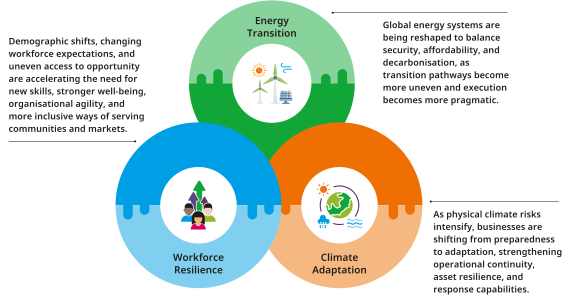
In this context, we focus on three interrelated transitions that are becoming increasingly material to resilient growth, and on the enabling role of Artificial Intelligence in accelerating these shifts and amplifying their impacts. This aligns with insights from the double materiality assessment we conducted in 2025.