Close

Towards Net Zero, Nature Positive, and Inclusive Growth

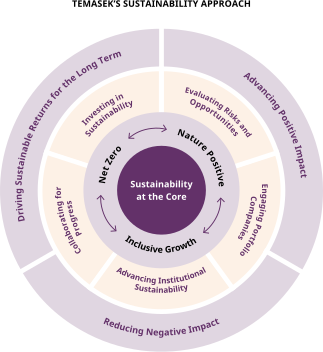
We pursue net zero, nature positive, and inclusive growth in a disciplined and resilient manner through investing, stewardship, portfolio engagement, and collaboration, adapting as transition pathways evolve.

illustration of Temasek's Sustainability approach

A World of Transitions Without Consensus Pathways  

The strategic context for sustainability is shifting. The average global temperature exceeded 1.5°C of warming above pre-industrial levels for the first time over 2023-20251.

As the risk of a more sustained temperature overshoot rises, we believe that businesses need to broaden their focus beyond emissions reduction toward adaptation and long-term resilience. This requires recognising that both positive and negative tipping points may accelerate faster than markets expect — from technology inflections that rapidly improve the economics and adoption of low-carbon solutions, to geopolitical shocks and extreme events that heighten physical risks and can trigger stronger policy responses.

For long-duration portfolios and assets, this uncertainty is itself a strategic reality. We must be prepared for a wider spectrum of outcomes: rapid, policy-driven transition in some markets; slower, more disorderly ones in others; and escalating physical risks across all.

Our strategy therefore balances ambition with resilience: we pursue decarbonisation and sustainability outcomes with conviction, while maintaining the institutional strength and portfolio robustness to invest through cycles, support real economy transition, and deliver good sustainable returns over the long term.

Net Zero

Net zero remains an important global aspiration — both to limit the physical and economic costs of climate change and to support a more resilient long-term growth model. The case for action is clear: the costs of inaction are already visible and measurable, with climate-related extreme weather events causing more than US$2 trillion in global economic losses over the 10-year period from 2014 to 20232.

At the same time, the pathway to net zero is becoming more uncertain. The energy transition is unfolding against a sharper energy trilemma: balancing sustainability, affordability, and availability. While this tension is not new, concerns around energy availability and affordability have become more pronounced in today’s context — driven by rising electricity demand, including from digitalisation and Artificial Intelligence (AI), as well as energy security risks and supply disruptions. As these pressures intensify, decarbonisation can at times appear to be a less immediate priority. This is contributing to a more uneven transition, particularly for hard-to-abate sectors and long-life infrastructure, where technology readiness, cost, and social considerations associated with a just transition remain critical.

Against this backdrop, we remain focused on progressing across three dimensions: 


Icon for low-carbon economy

Investing for a Low-Carbon Economy

Investing in opportunities that support both the growth of the green economy and the transition of high-emitting sectors.

Icon for decarbonisation efforts

Encouraging Decarbonisation Efforts in Our Portfolio Companies

Engaging portfolio companies in their business transformation and climate transition readiness.

Icon for carbon markets

Enabling Carbon Markets Solutions

Scaling high-integrity carbon markets to mobilise capital towards climate solutions.

Enabling Carbon Markets Solutions

Carbon markets can be an important financing mechanism to help close the climate funding gap by mobilising capital towards decarbonisation solutions. When underpinned by high integrity, they can help reduce the green premium for emerging low-carbon technologies while supporting nature-based projects that deliver broader environmental and community benefits.

Carbon markets have faced headwinds in recent years, including weak demand, a constrained supply of high-integrity credits, and underdeveloped market infrastructure. Even so, regulatory and policy support is building, with momentum coming from initiatives such as the Coalition to Grow Carbon Markets, Singapore’s Carbon Markets Cooperation, and continued efforts to operationalise Article 6 of the Paris Agreement.

Against this backdrop, Temasek adopts a whole-of-system approach to help scale credible carbon markets as a complementary enabler of real-economy decarbonisation.

  • Demand lever: We help strengthen demand visibility through the purchase of carbon credits for our institutional emissions and participation in relevant buyers’ coalitions.
  • Supply lever: We continue to scale investments in high-integrity carbon projects and enabling solutions through GenZero, our investment platform focused on accelerating decarbonisation.
  • Ecosystem lever: We support the development of high-integrity, liquid, and transparent carbon markets through targeted thought leadership efforts.

Nature Positive

Global biodiversity loss is increasingly impacting economic value and long-term operational continuity — disrupting water, food and health systems, supply chains, and physical risk buffers. Rising global policy and disclosure momentum around nature-related risk management signals a structural shift: nature-related considerations will increasingly shape how companies identify risks, build resilience, and create value over time.

We are advancing our Nature Roadmap to deepen our understanding of dependencies and impacts across our portfolio — strengthening due diligence in nature-sensitive sectors, and engaging portfolio companies on nature risk management and opportunity creation.

Inclusive Growth

Resilient growth must be inclusive. Inequalities, skills gaps, workforce disruption, and trust erosion translate directly into business risks through labour constraints, greater regulatory pressure, and weakened social licence to operate.

These pressures are likely to intensify. Significant job disruption is anticipated by 2030, driven by technological change, geoeconomic fragmentation, economic uncertainty, demographic shifts, and the green transition3

Workforce exposure to generative AI will vary significantly across occupations and sectors, reinforcing the need for workforce transformation to be human-centred and human-led, grounded in reskilling and upskilling, so that AI benefits both our portfolio companies and the ecosystems in which they operate.

We aspire to help tackle these issues through our Social Roadmap across our ecosystem. We have set clear baseline expectations for social practices and embedded them in due diligence and engagement. Across our portfolio and non-profit ecosystem, we support targeted initiatives to strengthen workforce skills and drive inclusive workplace practices. 

How We Deliver

In a world of complex sustainability transitions and uncertain pathways, resilience matters. By investing through volatility, we advance sustainability with conviction — protecting and compounding long-term value across cycles.

1Copernicus Climate Change Service (C3S), Global Climate Highlights, 2025.
2International Chamber of Commerce, The Economic Cost of Extreme Weather Events, 2024.
3World Economic Forum, Future of Jobs Report 2025.
Top

Subscribe to our newsletter

Stay up to date with our latest news, insights and stories

Select a type of content
    Please select Stories you are interested in.
    Please give us your consent.
    Please confirm that you are not a robot.