Close

Portfolio Performance

As owners of our portfolio, we aim to deliver good sustainable returns over the long term.

We have evolved from a Singapore holding company into a global investment company rooted in Singapore. Today, our diversified and balanced portfolio is anchored by three segments — Singapore-based Temasek Portfolio Companies (TPCs), Global Direct Investments (GDIs), and Partnerships, Funds, and Asset Management Companies (PFAs). 

Together, these segments serve as a strong foundation for sustainable and resilient growth.

As a generational investor, we take a long-term view of our portfolio construction and investment decisions. We focus on delivering good sustainable returns over time, while continuing to sharpen our tools and capabilities over the shorter term.

Valuing our portfolio

We have fully transitioned to a mark-to-market (MTM) basis for our portfolio and performance reporting and have been disclosing the MTM value uplift for our portfolio since 2022. 

Under MTM reporting, we value our unlisted investments using market-based approaches, such as recent funding rounds and the market multiples of comparable companies. For investments with high certainty on future cash flow, discounted cash flow analysis may be used. This means our valuations are updated as market conditions change. 

The valuation basis is unchanged for listed investments that are valued at market prices, and unlisted funds and co-investments that are already marked to market.

MTM reporting gives a more representative view of the current value of our portfolio, better reflecting its risk and volatility. This in turn enhances our risk management, performance measurement, and investment decision-making, and aligns us with global peers.

What is Net Portfolio Value?

Net Portfolio Value (NPV) represents the net value of our portfolio — the total market value of our investments, after accounting for liabilities.

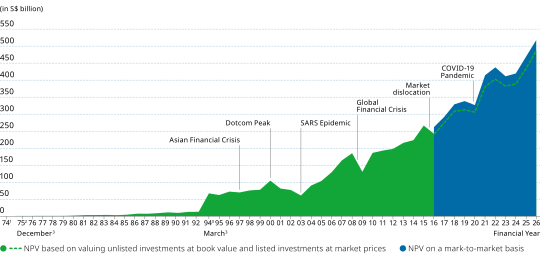
On an MTM basis, our NPV as at 31 March 2026 was S$518 billion, representing a doubling of our portfolio over the past decade. 

During the financial year ended 31 March 2026, we invested S$51 billion and divested S$31 billion, resulting in a net investment of S$20 billion.

Portfolio figures from the financial year ended 31 March 2016 onwards have been restated to value our unlisted investments on an MTM basis. Our prior reporting basis valued our unlisted investments at book value. The valuation basis is unchanged for listed investments that are valued at market prices, and unlisted funds and co-investments that are already marked to market. 

Learn more about how our portfolio has evolved over time.

Temasek Net Portfolio Value (NPV) since Inception

Chart “Temasek Net Portfolio Value”
1 Incorporation of Temasek on 25 June 1974.
2 Financial year 75 began on 25 June 1974 and ended 31 December 1975.
3 Financial year-end was changed from 31 December before 1993 to 31 March from 1994 onwards.

What is Total Shareholder Return?

Total Shareholder Return (TSR) is a compounded and annualised measure, which includes dividends paid to our shareholder and excludes investments made by our shareholder in Temasek’s shares. 

We report our TSR in Singapore dollars, which serves as our currency of account.

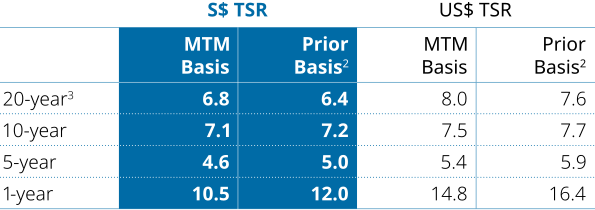
As at 31 March 2026, our long-term returns remained resilient with 20-year TSR at 6.8% and 10-year TSR at 7.1%, demonstrating our portfolio’s ability to perform through market cycles. Five-year TSR was lower at 4.6%, weighed down by headwinds in China’s capital markets from 2021 to 2024.

One-year TSR was 10.5% and our NPV increased by S$49 billion against the last financial year. This was largely due to the strong performance of listed Singapore-based Temasek Portfolio Companies, as well as realised gains from key divestments.

We also provide our TSR in US dollar terms to facilitate benchmarking with global peers. In US dollar terms, our one-year TSR would be 14.8%.

When the Singapore dollar strengthens against other currencies, the Singapore dollar value of our overseas investments declines when translated from the local currency. During periods of foreign exchange volatility, reporting returns on a constant currency basis can provide a clearer view of underlying performance. On a constant currency basis, our one-year TSR would have been 12.9% (about two percentage points higher).

Our TSR over different time periods is a snapshot of our performance, with the longer time periods being more representative of our performance as a long-term investor.

Learn more about our investment framework and how we assess performance against our cost of capital.

Total Shareholder Return1 (TSR, %)

(as at 31 March 2026)
Diagram “Total Shareholder Return”
1 TSR has been restated to reflect the move to mark-to-market (MTM) reporting, except for periods prior to 31 March 2016.
2 Unlisted investments valued at book value, which refers to Temasek’s cost of investment plus our share of the investee company’s profits or losses, changes in other equity reserves, minus write-downs (if any).
3 From the financial year ended 31 March 2026 onwards, the 1, 5, and 10-year portfolio performance will be reported on an MTM basis. Due to historical data constraints, MTM valuation prior to 31 March 2016 is not available. Hence, the 20-year MTM TSR includes a one-time NPV uplift in March 2016 due to the transition in valuation of unlisted investments from a book value basis to an MTM basis.
Top

Subscribe to our newsletter

Stay up to date with our latest news, insights and stories

Select a type of content
    Please select Stories you are interested in.
    Please give us your consent.
    Please confirm that you are not a robot.