Close

Engaging Our Portfolio Companies

As an asset owner, we depend on the success of our portfolio companies — their success underpins ours. We view sustainability as a key lever of long-term portfolio resilience and value creation, as well as an integral aspect of our ownership responsibilities.

As a long-term owner, we take an active stewardship approach with our Singapore-based Temasek Portfolio Companies, supporting them in embedding sustainability into how they build resilience and adapt for the future. In doing so, we help position them to manage emerging risks, seize transition opportunities, and create enduring value over the long term.

PNG Chin Yee
Chief Financial Officer, Temasek International
President, Temasek Singapore

Our Engagement Philosophy​

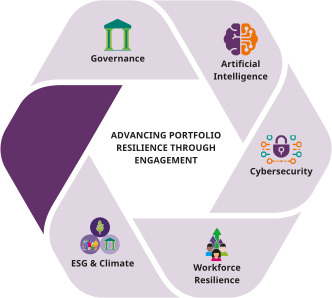
Engaging our portfolio companies is central to strengthening resilience across our portfolio. We take a holistic view of resilience that extends beyond financial performance to include governance, Artificial Intelligence, cybersecurity, workforce resilience, and environmental, social, and governance (ESG) and climate considerations.

This perspective is particularly relevant for our Singapore‑based Temasek Portfolio Companies (TPCs), where our long‑term ownership means we bear long‑tail risks. For these companies, resilience encompasses not only financial outcomes, but also operating capabilities, business model evolution, talent development, and labour relations.

Our portfolio companies operate across diverse sectors and geographies and are at different stages of their sustainability journeys. Accordingly, our engagement approach is tailored to each company’s context, taking into account its environmental and social positioning, sustainability maturity and practices, the sustainability value propositions of its products and services, and the material risks and opportunities most relevant to its business.

We do not direct the day-to-day business decisions or operations of our portfolio companies. However, as an engaged owner and shareholder, we communicate our expectations on sustainability and encourage the adoption of practices that strengthen resilience and long-term performance. Ultimately, a company’s board is accountable to its shareholders for overall performance, encompassing business growth, financial outcomes, and sustainability considerations that are material to the company’s long‑term success.

Governance

How We Engage and Add Value

Consistent with our governance model, we engage our portfolio companies primarily through their boards and management teams. Our sustainability engagements are purpose-driven and context-specific, reflecting each company’s starting point and the sustainability-related risks and opportunities most relevant to its business.

Where companies have clear sustainability value propositions in their products and services but are at earlier stages of developing their internal practices, our engagement focuses on strengthening sustainability governance, management systems, and execution capabilities. This includes discussions on accountability, oversight, and the integration of sustainability considerations into long-term strategy.

Where companies have established sustainability practices, our engagement may focus on advancing sustainable products or services, and supporting innovation, transition efforts, and business models that contribute positively to long‑term environmental and social outcomes.

We add value as a shareholder by exchanging ideas and sharing perspectives on sustainability-related topics relevant to long-term value creation. This includes convening discussions and forums focused on areas around climate transition planning, sustainability governance, environmental and social risk management, and evolving sustainability-related regulations, standards, and investor expectations. We also facilitate the sharing of practical insights and experiences across our portfolio to support learning and capability building.

Voting and Accountability on Sustainability

As a shareholder, we exercise our voting rights to express our views on how a portfolio company should be governed and led, and to hold its board and executives accountable for their actions, decisions, and performance. Voting serves as an important mechanism to reinforce accountability and signal our expectations to boards and management teams. Through voting, we seek to promote sound governance, protect our interests as an investor, and support long‑term value creation, including the adoption of sustainable and responsible business practices where relevant to the company’s long‑term success. This enables us to apply our governance and sustainability principles consistently across our global portfolio, while reflecting the regulatory requirements, market practices, and sustainability standards of the different markets in which we invest.

Artificial Intelligence (AI)

Temasek engages its portfolio companies on AI as a strategic lever for long-term value creation and resilience. We take a portfolio-wide view that AI adoption is increasingly integral to competitiveness, while tailoring our engagement to each company’s starting point, sector context, and business priorities.

Our approach combines setting clear expectations with targeted enablement. AI transformation is led by portfolio company boards and management teams, with Temasek supporting through strategic guidance, capability building, and access to a broader ecosystem of partners and expertise. A joint effort across our investment, AI and portfolio development teams enables us to identify opportunities, share leading practices, and accelerate adoption across the portfolio.

We support portfolio companies through targeted transformation engagements, while also driving AI diffusion and capability uplift at the portfolio level. This includes supporting leadership teams in shaping AI strategies and roadmaps, strengthening organisational readiness through talent and operating model development, and facilitating the deployment and scaling of AI use cases that drive operational efficiency, revenue growth, and new business models.

In parallel, we promote AI diffusion across the portfolio to uplift collective capability and readiness. This includes convening executive immersion programmes and sectoral forums, facilitating access to frontier AI technologies and ecosystem partners, and advancing workforce AI fluency and organisational readiness to support adoption at scale. We also advance AI accelerator initiatives through strategic partnerships, curated toolkits, and joint capability development, enabling faster adoption and scaling of AI.

Finally, we emphasise responsible AI adoption, including in the areas of cybersecurity, governance, and workforce readiness, to ensure that AI is deployed in a secure, ethical, and sustainable manner. Through these efforts, we aim to strengthen the long-term resilience and value creation potential of our portfolio.


Cybersecurity

Temasek continues to engage its portfolio companies through targeted cyber initiatives and regular knowledge sharing sessions to champion cybersecurity best practices and elevate our respective cyber defence and resilience capabilities against the backdrop of increasing AI adoption. Our engagement is calibrated to each company’s context, maturity, and risk profile, with a focus on practical improvements that support long-term portfolio resilience, responsible business practices, and sustained value creation. We promote clear accountability at board and senior management levels and encourage our portfolio companies to elevate cyber as a strategic risk and an enabler for sustained business value.

To uplift capability across the portfolio, we facilitate trusted and confidential peer learning among security leaders to share insights on emerging threats, leading practices, and common implementation challenges. We complement this with leadership dialogues and targeted briefings to support risk-informed decision making, strengthen governance oversight, and enable timely escalation, where needed. We also reinforce crisis preparedness through scenario-based simulations that allow companies to test their decision making, cross-functional coordination, and stakeholder communications under realistic conditions. These efforts are reinforced by our cybersecurity capabilities within our portfolio through ISTARI and Ensign, which combine strategic insights, operational expertise, and access to innovative solutions to support resilience across the portfolio.

In addition, we maintain a structured view of our portfolio cyber readiness to support objective, risk-based conversations with management teams, help prioritise areas for uplift, and track progress over time. Recognising the value of collective defence, we share timely threat advisories and enable trusted information sharing to strengthen detection and response capabilities across the portfolio. Through these combined efforts — underpinned by assurance in our own practices and practical, scalable engagement with portfolio companies — we aim to strengthen cyber resilience, reinforce trust, and support well-governed, resilient businesses across our ecosystem.

Workforce Resilience

Workforce disruption is accelerating. Skills are becoming obsolete more quickly, new technologies are redefining roles, and regulatory and societal expectations continue to rise. Addressing these shifts company by company risks duplication, fragmented responses, and slower adaptation. As a long-term investor, we seek to strengthen the resilience and competitiveness of our TPCs by fostering an agile, inclusive, and future-ready workforce. This is also a strategic priority for our TPCs, and leveraging our unique ecosystem networks allows us to amplify our collective impact in building workforce resilience.

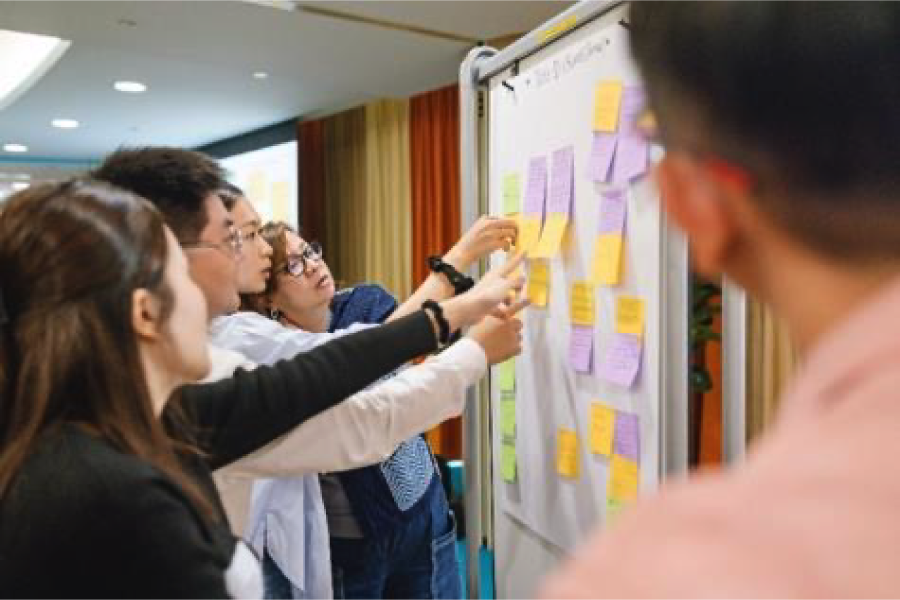
HR-Focus Corporate Ideathon for TPCs

HR-Focus Corporate Ideathon for TPCs, April 2025.

Convening for Collective Progress

To strengthen engagement on workforce resilience across TPCs, we convene quarterly forums for their Chief Human Resource Officers to exchange perspectives and deepen their understanding of shared workforce challenges. These sessions promote cross-industry learning and surface practices that can be scaled across the ecosystem. We also invite external thought leaders — consultancies and academic experts — to provide global perspectives on emerging workforce trends.

Our engagements in recent years have revolved around the topic of AI. In 2025, the HR-Focus Corporate Ideathon we co‑organised with AI Singapore brought together over 100 Human Resource (HR) leaders to explore, test, and refine ideas for strengthening AI capabilities.

Advancing AI Fluency at Scale

We seek to harness the strength of our ecosystem to build workforce capabilities in AI, with a vision of supporting sustainable AI-driven value creation for TPCs. A key way we are doing this is through the TPC Ecosystem Workforce AI Fluency Programme launched in 2026. The programme seeks to elevate workforce AI readiness across TPCs, recognising AI fluency as a critical enabler of organisational confidence and capability.

As part of this programme, we are co-developing a Workforce AI Fluency Playbook with TPCs. This Playbook outlines practical, implementation-ready principles to build an AI-first mindset among employees. The playbook draws on best practices within and beyond our ecosystem to offer recommendations on training strategy and learning programmes. It also addresses common organisational barriers to scaling workforce AI fluency, such as frontline workforce enablement and persistent skill gaps.

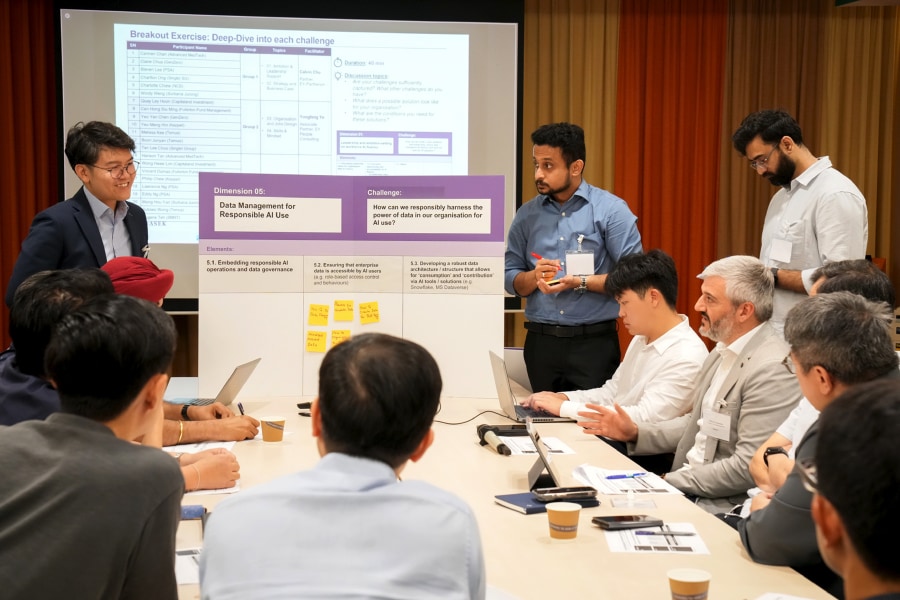
TPC Ecosystem Workforce AI Fluency Programme

Cross-sector TPC leaders discussed how to shape responsible and impactful AI adoption at the TPC Ecosystem Workforce AI Fluency Programme in April 2026. 

Our Ecosystem Workforce Resilience (EWR) team works hand in hand with government agencies, the Labour Movement, and employers to build a future-ready workforce across our portfolio. The objective of the EWR team is clear: to leverage our tripartite relationships to help our TPCs enable their workforces to adapt to and thrive amidst technological and macroeconomic disruptions, and strengthen their long-term resilience.

A cornerstone of this effort is the Temasek Tripartite Conversations. Held annually, the Temasek Tripartite Conversations brings together unions, employers, and government leaders to address the most pressing workforce transformation priorities. Over the past three years, our focus has sharpened around one defining force: AI and its implications for jobs and skills.

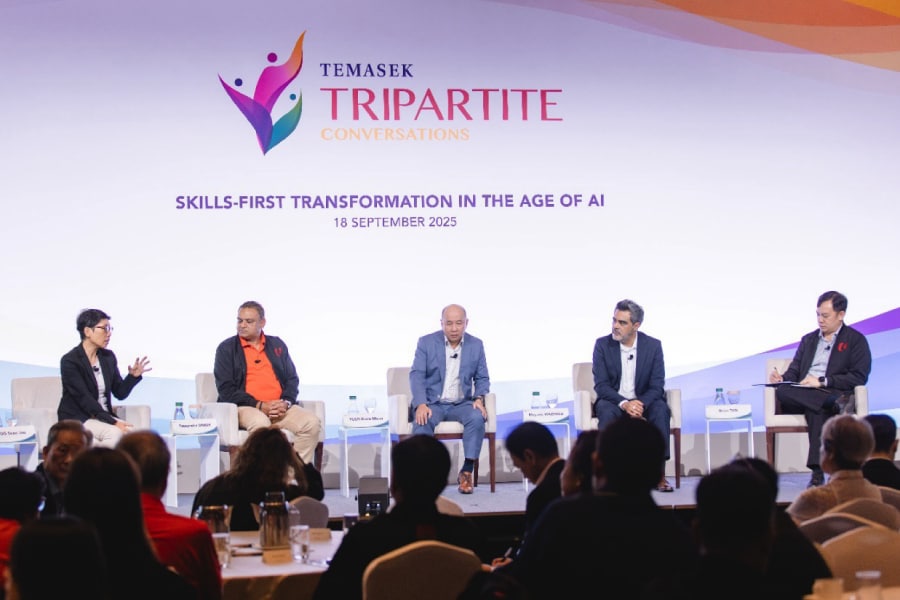
Temasek Tripartite Conversations 2025

Panel Discussion at Temasek Tripartite Conversations 2025. From left to right: Ms Gog Soon Joo (former Chief Skills Officer, SkillsFuture Singapore), Mr Thuvinder Singh (General Secretary, Union of Telecoms Employees of Singapore), Mr Yuen Kuan Moon (Group CEO, Singtel), Mr Mayank Wadhwa (President, ASEAN, Microsoft), and Mr Brian Tan (then Deputy CEO of e2i, Employment and Employability Institute).

In 2025, the Temasek Tripartite Conversations homed in on the importance of entrenching a skills-first approach as a key workforce strategy. Three imperatives emerged from the 2025 Conversations.

First, Singapore’s tripartite model is a structural advantage for AI diffusion. Continued collaboration among unions, employers, and the Government will be critical to diffusing AI responsibly and supporting workers through technological transition.

Second, AI must be treated as a complement to human capability, not a substitute. A skills-first approach should anchor workforce development, with leaders and employees sharing responsibility for continuous upskilling.

Third, as AI adoption risks widening existing skills gaps, stakeholders must act collectively to promote inclusive growth and broad-based opportunity.

We addressed these three imperatives by refining our workforce AI agenda. This culminated in the launch of the TPC Ecosystem Workforce AI Fluency Programme in 2026.

Our role does not end with convening dialogue. We also translate insights from Temasek Tripartite Conversations into concrete initiatives across our portfolio ecosystem.

Leveraging our tripartite partnerships, we work alongside the Government, the Labour Movement, and industry partners to drive practical outcomes that enhance organisational readiness and workforce capability. To do this, we conduct knowledge sharing and exchange sessions with TPCs and these stakeholders on a regular basis.

To support TPCs in navigating the opportunities and implications of emerging technologies, we facilitate leadership-level learning on AI adoption and governance. In partnership with the Labour Movement and a global cloud infrastructure and services provider, we introduced AI fundamentals to business and union leaders. This session provided a structured understanding of AI applications, governance considerations, and implementation pathways, equipping leaders to scope and deploy AI initiatives with greater confidence and organisational preparedness.

We also seek to accelerate practical learning across the portfolio by sharing Temasek’s own experiences in applying AI. We conducted sharing sessions on how AI has enhanced our corporate functions in Temasek and exchanged ideas with TPCs on practical use cases.

To help our TPCs remain aligned with evolving workforce regulations and tripartite expectations, we facilitate dialogue with key public stakeholders. We organised knowledge sharing engagements with Government and Labour Movement representatives on key workforce policies, including the Tripartite Guidelines on Flexible Working Arrangement Requests and the Workplace Fairness legislation. These sessions help ensure our TPCs remain aligned with regulatory expectations and are equipped to respond in a timely and responsible manner.

Through these sustained engagements, we enable businesses and workers to stay ahead of industry shifts, build the agility required to navigate change, and create pathways for long-term success.

Engaging on ESG Matters

Our engagement with portfolio companies follows an internal prioritisation process. The process begins with identifying opportunities across our portfolio where we can drive the most significant impact. Next, we consider each company’s ESG maturity, ESG relevance, and Temasek’s potential influence. We then prioritise companies that are long-term holds and are earlier in their ESG journey, in addition to companies where we identify strong opportunities for value creation or foresee a clear pathway for ESG transformation.

In identifying engagement priorities, we consider each company’s materiality assessment, together with key industry issues and trends, and assess these against relevant standards, regulations, and leading peer practices. While climate remains a core focus of our engagement, we are also taking a more systematic approach to nature and social topics, informed by portfolio heatmap analyses where relevant.

Our ESG Value Creation Playbook guides our investment teams in identifying opportunities and driving ESG value creation. We seek to identify opportunities to engage and support our portfolio companies to uplift their ESG practices, for example, by accelerating their decarbonisation and driving growth in sustainable products and services. Where relevant, we work with the portfolio companies to establish sustainability-related key performance indicators that can form the basis for outcomes-focused approaches to compensation and financing.

Ultimately, the aim of the ESG Value Creation Playbook is to strengthen the portfolio companies’ resilience, improve their competitiveness, enhance their ability to access capital, and position them for new growth opportunities. We are encouraged by the progress of our portfolio companies in implementing sustainability strategies.

Engaging on Climate

With the global transition to a net zero economy and the increasing physical impact of climate change, it is in our interest to encourage our major portfolio companies to adopt effective climate change mitigation and adaptation measures.

Our engagement on climate transition with portfolio companies is informed by our Climate Transition Readiness Framework. This provides a structured methodology for us to assess the maturity of our portfolio companies when it comes to addressing climate-related risks and opportunities. The framework serves as a starting point for in-depth dialogue to convey our climate expectations, which include setting a 2050 net zero ambition and interim decarbonisation targets. In addition, it is a source of insight on challenges faced and opportunities for further collaboration with our portfolio companies.

We assess our portfolio companies across several dimensions using publicly available sources and information shared through our ongoing engagements with them. The dimensions we consider are:

  • governance and organisational competencies on climate change;
  • climate transition strategy;
  • capital allocation;
  • scenario planning;
  • risk management;
  • GHG reduction targets and progress;
  • advocacy and engagement; and
  • external verification and disclosures.

During the year, we engaged 19 major portfolio companies that constitute 88% of Total Portfolio Emissions1 for the year ended 31 March 2026. Of these, 15 portfolio companies have set targets to achieve net zero by 2050 or earlier.

We engaged members of the senior management teams in these portfolio companies, including the Chief Sustainability Officer and Chief Financial Officer, where appropriate. Initiated at the board and CEO level, these engagements provided an opportunity for us to relay our expectations for climate action and establish the foundation for regular dialogue and collaboration.

Since our initial engagement in 2023, we have seen our major portfolio companies advance in their climate transition readiness in areas like climate scenario planning and the integration of climate risks into their enterprise risk management processes. They also developed more in-depth climate transition plans that include both decarbonisation of value chains and development of new green revenue streams. Many of them have already tied, or are considering tying, climate-related key performance indicators to remuneration.

We set company-specific expectations according to each portfolio company’s maturity level. In terms of priority, we focused on understanding each portfolio company’s progress towards interim milestones and on its decarbonisation pathway to 2030. On an ongoing basis, we continue to encourage portfolio companies to develop climate transition plans, including capital allocation plans, to provide stakeholders with greater clarity on their climate transition strategies.

1 Total Portfolio Emissions reflect the absolute emissions (Scope 1 and Scope 2) associated with our investment portfolio, expressed in tonnes of carbon dioxide equivalent (tCO2e). Our investment positions in private equity funds, credit, and other assets are excluded.
TPC Sustainability Leaders Network

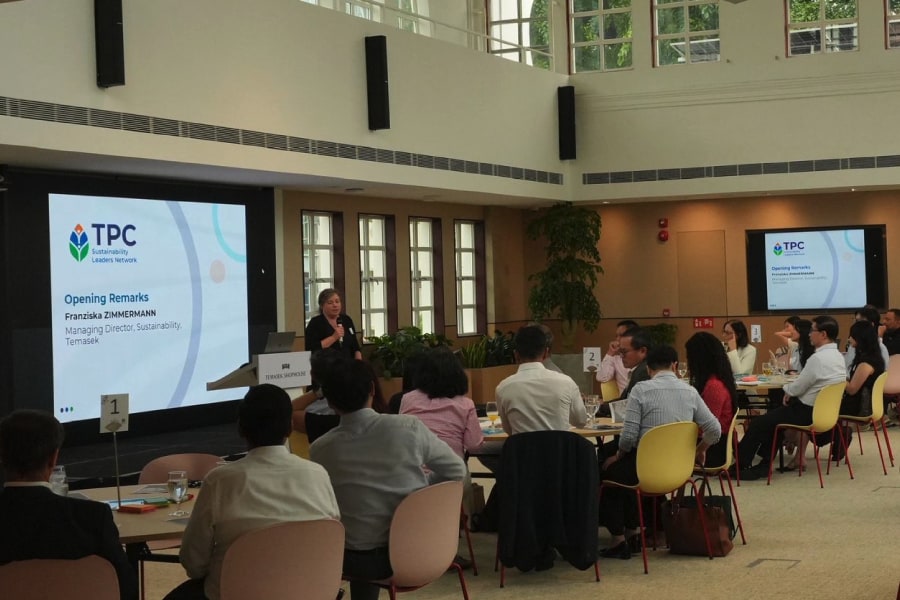
Sustainability leads participating in the TPC Sustainability Leaders Network workshop on tools for climate A&R strategies.

Temasek convenes two key platforms to bring together the CEOs and sustainability leaders of our TPCs on specific sustainability topics where we see the opportunity to build capacity and foster collaboration between the companies.

The annual TPC Sustainability Council brings together CEOs to share successful sustainability strategies and forge potential collaborations on sustainability initiatives. The bi-annual TPC Sustainability Leaders Network focuses on knowledge sharing and capacity building on top-of-mind sustainability topics that are common across our TPCs. It also seeks to foster a strong community of sustainability leaders to advance our shared sustainability agenda.

Given that climate adaptation and resilience (A&R) is a strategic imperative with a clear economic case, we deep dived into the topic of A&R across our two platforms during the year.

The TPC Sustainability Council meeting discussed pricing and managing physical climate risks, the opportunity for value creation through A&R, and the potential for public-private collaboration to build systemic resilience.

The TPC Sustainability Leaders Network workshop built on this conversation by equipping TPCs with the practical tools and frameworks to integrate A&R into business strategy and operations. At the workshop, we explored the financial impact and quantification of physical climate risks, opportunities in A&R, and the role of the public sector in addressing A&R as a systemic challenge, potentially through National Adaptation Plans.

During the year, we also brought the topic of supply chain sustainability to our TPC Sustainability Leaders Network community. In a volatile environment marked by geopolitical shifts and accelerating regulation, sustainable supply chains have become a core driver of business resilience and revenue protection. The community discussed how companies are approaching key social and environmental hotspots in their supply chains, pursuing value creation opportunities, and leveraging enablers to support long-term supply chain resilience.

Through these platforms, we aim to accelerate sustainability leadership in our TPCs and meet the expectations of investors and other stakeholders.

Temasek Sustainability Reporting Workshop

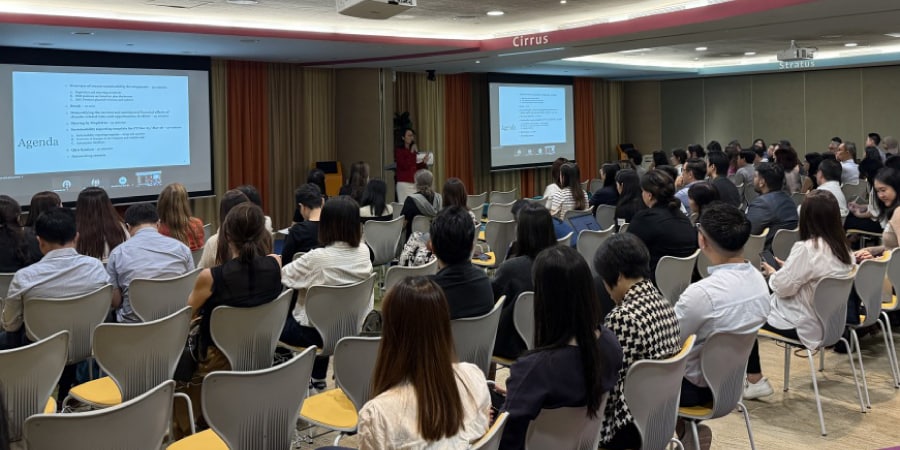
Advancing ISSB-aligned disclosure through dialogue among functional leads on shared reporting challenges at the annual Temasek Sustainability Reporting Workshop in November 2025.

Our annual Temasek Sustainability Reporting Workshop remains a cornerstone for building, elevating, and strengthening sustainability reporting capabilities across the Temasek ecosystem.

The workshop convenes relevant functional leads from TPCs to share global sustainability developments and emerging themes, deliberate on complex reporting topics and implementation considerations, and exchange practical approaches to address common reporting challenges.

This year’s session focused on equipping companies to navigate climate transition disclosure requirements and initiate the measurement of financial impacts arising from climate-related risks and opportunities, drawing on practical perspectives and lessons from early adopters within our portfolio. We expect adoption to broaden across TPCs as mandatory ISSB‑aligned climate reporting requirements take effect in Singapore, beginning with larger listed companies reporting in 2026.

Top

Subscribe to our newsletter

Stay up to date with our latest news, insights and stories

Select a type of content
    Please select Stories you are interested in.
    Please give us your consent.
    Please confirm that you are not a robot.