Singapore Airlines (SIA) is a global company providing passenger and cargo air transportation services. In common with its peers in the hard-to-abate aviation sector, SIA faces decarbonisation challenges arising primarily from its heavy reliance on fossil fuels for flight operations.
A core component of SIA’s climate strategy is to pursue decarbonisation pathways aligned with the International Air Transport Association’s (IATA) Four-pillar Strategy to achieve net zero carbon emissions from its operations by 2050.
SIA advances this goal through four levers. First, it reduces emissions at source by investing in new-generation aircraft that are more fuel-efficient. Second, it adopts SAF, which can reduce life-cycle carbon emissions by up to 80% compared with conventional jet fuel. Third, it improves operational efficiency across engineering, flight, and ground operations to enhance fuel productivity and deliver energy savings. Fourth, for residual emissions that cannot yet be eliminated directly, SIA uses high-integrity carbon offsets, through its participation in Carbon Offsetting and Reduction Scheme for International Aviation (CORSIA), which aims to stabilise international aviation net emissions at 85% of 2019 levels from 2024 to 2035.
During the year, the SIA Group’s total fuel consumption (jet kerosene) for its airline flight operations rose by 3.8% which corresponded to the 3.8% increase in its Direct (Scope 1) GHG emissions. This was largely driven by resilient demand for air travel as overall passenger and cargo operations grew by 3.3%. Longer routings due to airspace restrictions, among other operational factors, also contributed to higher emissions and fuel consumption. Notwithstanding, SIA and Scoot have continued to implement fuel-reduction and efficiency measures across its fleet as part of its climate strategy to reduce GHG emissions.
One of the most effective ways for SIA to significantly reduce its emissions is to operate a younger, more fuel-efficient fleet of new-generation aircraft. The average operating fleet age was 7.8 years as of 31 March 2026, almost half the industry average of 15.6 years.
The deployment of next-generation aircraft for passenger services and freighter operations is projected to improve fuel efficiency by up to 25% and 40%, respectively, relative to the older aircraft they replace. At the end of the financial year, 78% of SIA Group’s operating fleet comprised new-generation aircraft, and this is expected to reach 90% by 2030.
Beyond its fleet renewal programme, SIA enhances operational efficiency across its engineering, flight, and ground operations by using digital insights, advanced technologies, and strategic partnerships. This includes leveraging analytics to optimise aircraft performance (such as aerodynamic configurations and weight) to improve efficiency without compromising flight safety or performance.
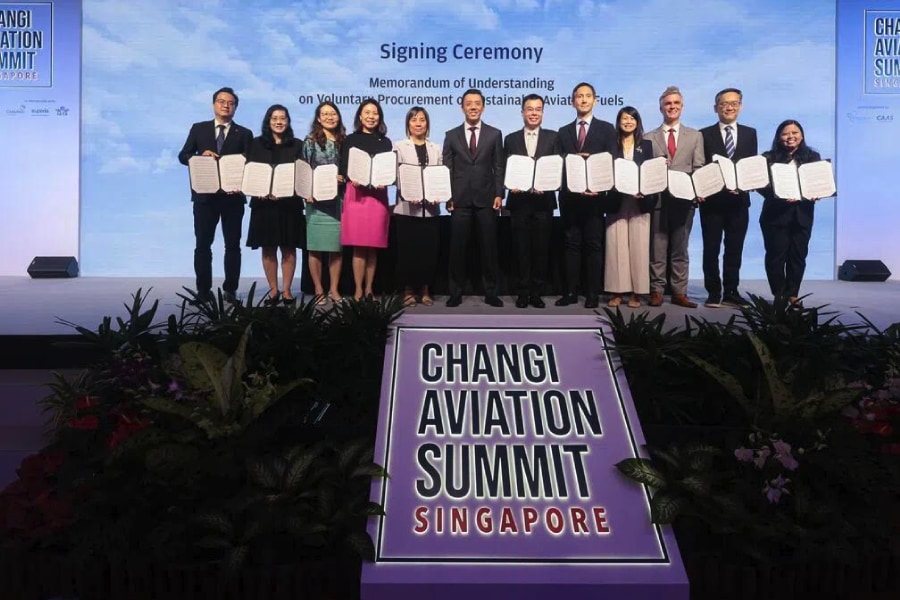
The SIA Group has also identified SAF as the key decarbonisation lever for the airline industry. SIA and Scoot have announced an interim target to replace 5% of total fuel requirements with SAF by 2030, subject to global developments on the availability and adoption of SAF. During the year, the SIA Group announced SAF offtake agreements with World Energy and SkyNRG for approximately 2,500 tonnes of CORSIA-eligible neat SAF, in the form of emissions reductions. The SIA Group also entered into the Memorandum of Understanding to pilot the purchase of voluntary SAF through SAFCo.
SIA offsets residual carbon emissions that cannot be eliminated through technological advancements, operational improvements, or the use of SAF by participating in CORSIA. Since 2019, SIA has adhered to CORSIA’s Monitoring, Reporting, and Verification requirements, acknowledging its role in helping the aviation industry achieve net zero carbon emissions by 2050.
Ultimately, the pace of SIA’s decarbonisation journey will depend not only on its sustained climate action, but also on broader, systems-level enablers across the aviation sector, including the availability of low-carbon fuels, infrastructure and grid build-out, supportive policy and market mechanisms, and technology readiness.
More details on SIA’s decarbonisation journey can be found here.