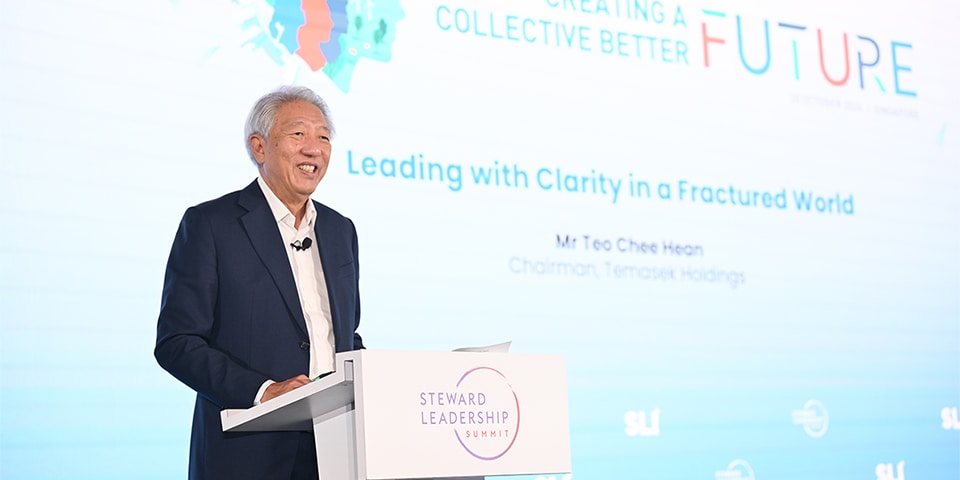
Professor Arnoud De Meyer, Chairman of the Steward Leadership Institute,
Distinguished Guests,
Ladies and Gentlemen,
Good morning.
Thank you to the Steward Leadership Institute for inviting me today. I’m glad to see so many leaders here from the business, government, and community sector.
The recurring theme for the Steward Leadership Summit is Creating a Better Future. The operative word is Collectively.
This is a two-part theme – how to create a better future; and how to do so collectively, for collective benefit drawing on our collective efforts.
This requires thoughtful and intentional leadership, and purposeful and effective action – more so today when the world today is so fraught with uncertainty, both within individual countries, and also how that uncertainty translates across the world.
A World Being Reshaped
Today, we are seeing dramatic changes in geopolitics, technology, energy, and business all at once. Together, they are converging and reshaping the global order.
These forces do not come one at a time as in previous eras. But they now interact with each other and affect one another, making them harder to deal with as single issues, as they need comprehensive strategies which are interconnected.
Major-power and geo-political competition will remain with us for some time even if open conflicts subside, or even if there are leadership transitions in some countries. Smaller countries and businesses cannot afford to stand still and wait on the sidelines, in the hope that things will somehow go back to where we were before.
They will not. We have to continue creating options for ourselves.
Why Stewardship Matters
This is where stewardship comes in. A steward takes responsibility for something, not for himself but for a larger good, and hands it on in better shape to a future generation.
This idea is not new. What has changed is how hard it is to practise.
A separate silo-ed response to each new issue is not enough. Leaders need a consistent and principled basis for their decisions.
In the Singapore Government, where I have spent some time, and also in Temasek, where I have spent a little time, this principle of stewardship provides a coherent and intentional approach.
The settings are different, but the discipline is the same.
Four things matter most: a clear purpose, disciplined governance, enlightened self-interest, and responsibility to future generations.
A Clear Purpose
First, a clear purpose. A purpose is only useful if it guides real decisions, including what to do and what to say no to.
A clear purpose helps people across the organisation make consistent and principled decisions without having to be told each time on what to do.
At Temasek, our purpose is So Every Generation Prospers.
As a generational investor, Temasek makes investment decisions on commercial terms and with a long-term view. Our long-term approach makes us an attractive partner and differentiates us from other investors, while a partnership based on commercial principles ensures that we bring benefits to both partners. This is why we can stay invested through market cycles to build and reap long-term sustainable returns, instead of reacting to every gyration of the market.
Disciplined Governance
Second, a disciplined governance. Good governance is more than just following rules, it is about adopting the correct principles and following them. It is also about how decisions are made, who makes them, and who is accountable.
These things matter.
There need to be clear roles and accountability. Everyone knows who decides what and takes responsibility for the decisions they make.
Next, a long-term view. Incentives and reviews should be set over years, not quarters.
Last, but certainly not least, we need to have integrity. Decisions made should aim to build trust and support long-term relationships.
In Temasek, the Chairman and the Board of Directors set the tone. We are a sounding board for management's thinking and keep Temasek focused on the long term. We provide management the support and confidence to seek long-term sustainable returns, even when there is pressure to react to short-term events.
Enlightened Self-Interest
Third, enlightened self-interest. Citizens expect Governments to act in the interest of their citizens and country, and to do well for them. All of us must take care of the interests of our company, including our shareholders and our employees, and also to do well for them too. And indeed, each of us has a responsibility to do well for our families.
This, of course, is to be expected. The desire to do well, and to excel drives people, organisations, and countries to succeed.
The question is how that success is pursued. We can do so by using every means at our disposal in each transaction, to extract the maximum advantage or value for ourselves. Those that view the world through such a zero-sum lens of narrow short-term self-interest and dominance over others, may extract value in the short-term; but may find themselves, eventually, with a shrinking pie as others seek alternatives and avoid transacting with them in the future.
Organisations that seek to create value for partners, customers, employees, communities, and the wider economy strengthen the conditions for their own long-term success. You can always try to maximise every last cent in a deal, and even find great satisfaction in having bested your opposite number. But one has to reflect on whether the better long-term outcome comes from building a larger pie with your partners – perhaps leaving something on the table to build trust, strengthen goodwill, and create room for future opportunities and partnerships.
At Temasek, our guiding principle is to do right and do good by the communities we operate in, so that we can do well as an organisation.
Responsibility to Future Generations
Finally, having a responsibility to our future generations. Leaders are judged on what they deliver today, but for lasting impact, they are judged on what they pass on to those who come after them: the institutions, businesses, and societies that outlast them.
In fact, many important decisions pay off long after the people who made them have moved on.
I’ve served in a number of different portfolios in public service, and this is particularly the case in public service where the results only come after years or decades. The Singapore Government thinks years ahead in terms of planning, not just for tomorrow or the day after.
Likewise, for Temasek, we do things today with tomorrow in mind, so that generations after us can benefit from the investments that we have made, just as we have benefitted from what the previous generations have left us.
I’ve often said that I am fortunate because I am benefitting today from the good outcomes that have arisen from the good decisions made by my predecessors. Also, I have inherited strong institutions, the people, and the assets they have left me. If we are doing well today, we should properly attribute this to our predecessors and thank them as the credit lies with them. Our hope is that our successors will also feel thankful to us, because we also have left them with a strong position. Otherwise, we surely must be the ones to own up and take the blame.
Conclusion: Call to Steward Leadership
Allow me to conclude.
None of us will have all the answers in a changed and fractured world. What we need is to be clear about what we stand for, and to hold by it as we address these new challenges.
A better collective future will not happen by itself. It is built by leaders in government and business who act as stewards with thoughtful and intentional leadership, and purposeful and effective action, working with stakeholders and partners who share the same conviction.
The world today is dominated by news headlines which emphasise self-interest – narrow self-interest. We can do better than that.
We can act in enlightened self-interest, and seek out and work with partners to build new connections across markets, technologies, supply chains, and countries. In this way, we can work together to create new capabilities, markets, and opportunities for growth – a larger pie through win-win collaboration, rather than fighting to grasp as much as possible of what must become a smaller pie if we act in narrow-self interest
Before I close, let me also congratulate in advance the winners of this year’s SL25 Awards.
I hope their achievements, and the presentations and discussions that you will have today will give you all ideas that you can take back to your own organisations and put them into practice.
Thank you, and I wish you a productive Summit.