A year on, we continue to see the world battle against COVID-19. It is the single biggest humanitarian crisis we have faced since World War II, as the pandemic ravages economies, and impacts countless lives and livelihoods.
However, we have also seen a resilience of human spirit that is remarkable. Developing vaccines used to take decades; but advances in science and ingenuity have delivered vaccines with a high level of efficacy in under a year. Now that same spirit must apply to distributing the vaccines around the world, especially to lesser developed nations, because the pandemic has taught us that nobody is safe till everybody is safe.
This past July, Temasek released its 2021 Temasek Review, themed around a simple message: Bounce Forward. As we emerge from the dark shadows of COVID-19, we cannot afford to bounce back to a pre-COVID world, like it was in 2019.
Instead, we need to bounce forward, to a more sustainable world, tackling bigger threats like climate change, by harnessing that innovation drive in science and technology, the pace of which has accelerated as a result of the pandemic. We need that incredible, indomitable, human spirit to continue, so our resources, capabilities and efforts will be catalysts to develop solutions to the next global challenges.
Climate Change: An Existential Challenge
Evidence is now clear that if we don’t address man-made contributors to global temperature rises urgently, we risk more lives, advance species extinction and irredeemably impact our biosecurity and, indeed, life on our planet. We must address climate change: our natural resources have already been significantly depleted and impacted, and we just cannot continue the way we have all these years.
There is a real need for all of us to focus on achieving a ‘net zero world’ by 2050. That role cannot be led by governments alone. Businesses, communities, individuals, indeed every one of us, must play our part. For if we don’t contain temperature rises, the impact will be far more deleterious than the pandemic; even more so for developing countries, which do not have the resources to deal with climate change.
We are currently living in the hottest decade on record. Despite a brief dip in carbon emissions due to the pandemic, the world is still heading for a temperature rise in excess of 3 degrees Celsius this century, which is beyond the 1.5 degrees Paris Agreement Goal. The Intergovernmental Panel on Climate Change has just released a report stating that the current trajectory is that we will reach 1.5 degrees by 2040, in which case it is imperative that we act now – individually and collaboratively – with urgency.
Closer to home, Singapore is heating up twice as fast as the rest of the world – it is already an average two degrees hotter today compared to the 1950s. It may not seem much, given we already live in a tropical part of the world, but the damage to fragile natural ecosystems will become irreversible if we don’t address our contributions to climate change.
This continual global temperature increase is unsustainable. It is already leading to rising sea levels, and an increase in destructive weather events and the disasters that follow, such as typhoons and flooding, heat waves and wild fires.
Role of Corporates and Private Capital
As the world modernises, the role of business, and of private capital, becomes more critical to drive large scale solutions to climate change.
I am heartened to see many companies pivoting and refocusing their business models toward solutions that achieve a greener world. Some have even committed themselves to net zero targets.
This is a sign of how expectations of business are rapidly shifting. Every business is expected to be purpose-driven; to have a focus on its role as a corporate citizen in a much wider community of stakeholders than just its shareholders and its customers. Because businesses can only thrive when the communities around them thrive.
At Temasek, our charter defines our roles to do well as an active investor and shareholder, to do right as a forward looking institution, and to do good as a trusted steward.
We are more than just an investor; we are a provider of catalytic capital. We deploy financial capital to stimulate innovation and growth; develop human capital to uplift capabilities and enhance potential; enable natural capital to foster sustainable solutions; and seed social capital to transform lives for a more inclusive and resilient world.
As we deploy capital, we constantly reshape our portfolio around four key structural trends that we see driving growth and solutions to global challenges, as we seek to deliver sustainable returns over the long term. These trends are digitisation, sustainable living, the future of consumption, and longer lifespans.
Some say maybe we should just invest in market indices, riding the waves of market growth when they come. However, investing in indices does not let us shape a portfolio around how we see the world in future years: a world that must become more sustainable, and can become so if we help emitters to change their business models and invest in solutions to transform. Investors, globally, have begun to allocate capital to promising technologies in pursuit of decarbonisation solutions, seeking to contribute to the carbon abatement process and the reduction of its cost curve. Temasek is absolutely committed to this path.
Benefits from Climate Change Mitigation
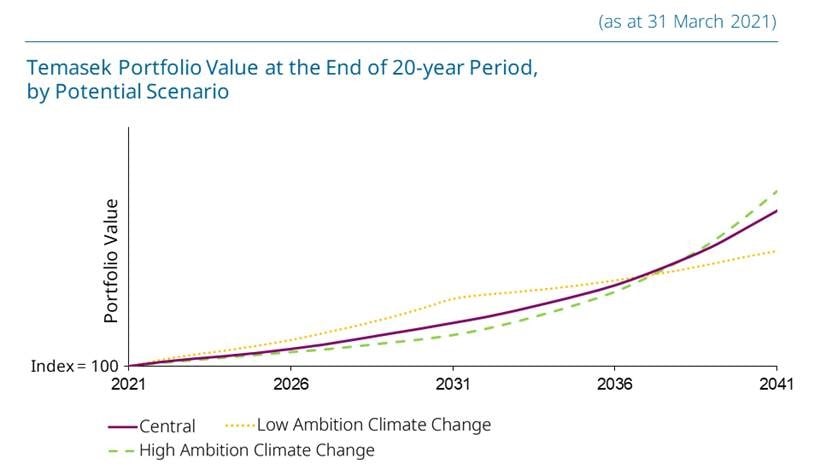
We have simulated the expected long term returns pathways of our portfolio based on different scenarios across our portfolio over the next 20 years. Broadly, our Central Scenario models our baseline expectations of growth. We also model for other scenarios where growth may be impacted by external events, such as escalating trade tensions, geopolitical events, and climate change.
We have specifically looked at two scenarios around climate change (See Fig.1): the first is what we call ‘low ambition’ – few efforts made to address climate change. The second is ‘high ambition’: where the world is prepared to make hard decisions to achieve the goal of containing temperature increases within the Paris Agreement.
In the case of the low ambition scenario, despite marginally better returns during the shorter term, the trade-off will be an unliveable planet within our lifetime, and commensurate lower returns further out to 20 years.
In a High Ambition Climate Change Scenario, despite moderated returns in the medium term due to transition costs, the payoff will be a more liveable planet for all, and higher expected returns over the long term.