Close
Top

Temasek Review 2026 Media Briefing: CEO Address Video Transcript

The following is the transcript of a video presentation by Temasek Holdings’ Chief Executive Officer, Dilhan Pillay, at the Temasek Review 2026 media briefing.

Hello and thank you for coming to the media briefing for Temasek Review 2026.

We’re not simply in a VUCA world, we are in a polycrisis world.

This is not new to us. As a long-term investor seeking to deliver sustainable returns, we have had to navigate volatility and uncertainty over the years. But the environment we are in today is the most complex that we have seen in five decades.

This brings us back to the 1970s — the decade in which Temasek was founded, when the world had several wars, fractures in society, runaway inflation, and markets that were volatile.

What is unprecedented is the convergence of geopolitical tensions, technology transformation, energy security concerns exacerbated by recent events in the Middle East. A demanding environment where fiscal space is constrained by rising costs, inflation, and interest rates which are a drag on growth and returns.

Meanwhile, generative AI is reshaping business models and the nature of work itself, bringing both opportunities and risks. Climate transition is under pressure amidst rising power demand.

Taken together, this is one of the most challenging environments we have had to navigate as an investor seeking good sustainable returns over the long term.

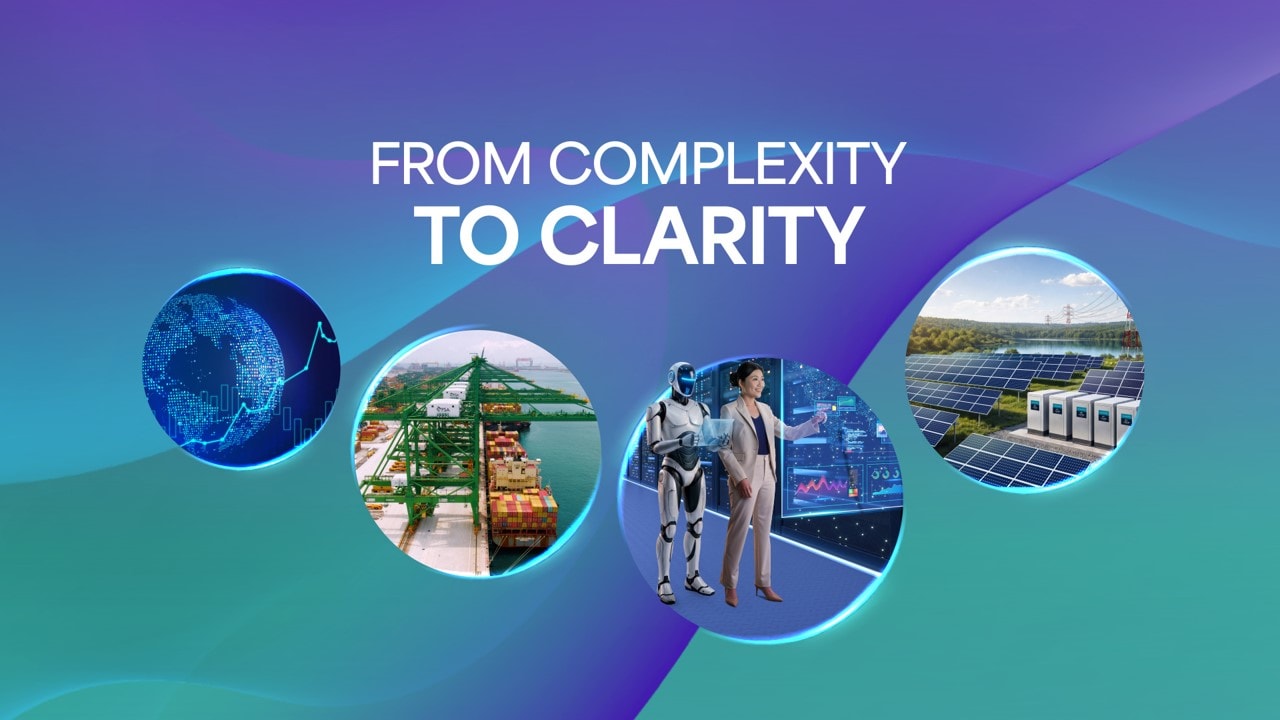
From Complexity to Clarity

We are focused on complexity to clarity. For a long-term investor like us, it is very important to be clear-minded about how we need to operate to achieve the returns that we want.

We have to live with the world as it is, not as we wish it would be, as Mr Lee Kuan Yew once said. And that is why you will hear my colleagues talk about how we are navigating this complexity to deliver clarity.

What does this entail?

We have been consciously making important shifts to our portfolio and investment strategies over the past few years. And it is starting to bear fruit, as you will see from the results of the past two financial years.

Do Well: Performance and Investment Stance

Since we started making these shifts, we have added about S$100 billion in portfolio value. That is a good outcome for us and hopefully represents a positive trajectory forward.

What have these shifts looked like?

Sharpening discipline across investments and divestments, driving value creation across our portfolio companies, strengthening our public markets capabilities.

But for performance to remain resilient going forward, the most important factor is to build a quality portfolio, one that can bounce back from shocks. And we should expect these shocks to continue. A good investment environment matters too, but that is something we cannot control.

Year-to-year performance may not be the most natural measurement for an institution like ours, which is geared towards good sustainable returns over the long term. The real measurement of success is the longer-term returns of 10 and especially, 20 years. It is aligned with our mandate.

This year, we have fully transitioned our financial reporting to mark-to-market.

We started this four years ago.

Only about 25% of our portfolio needed to be aligned; the rest was already marked-to-market. In the longer 10-year TSR for example, you will see that there is no significant difference between mark-to-market or prior basis TSR.


What did we achieve this year?

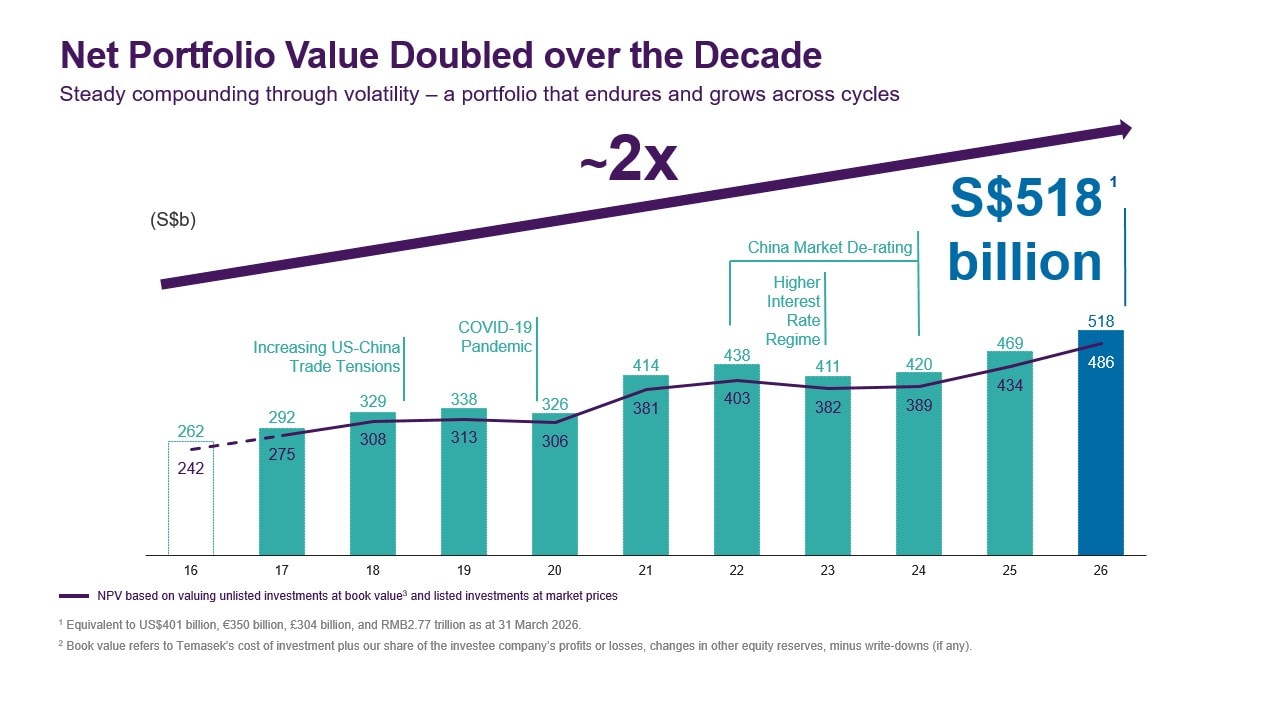
A net portfolio value of S$518 billion, representing a doubling of our portfolio over the past decade.

Our long-term performance remained resilient. 20-year TSR was 6.8% and 10-year TSR was 7.1%, delivered through market cycles and shocks.

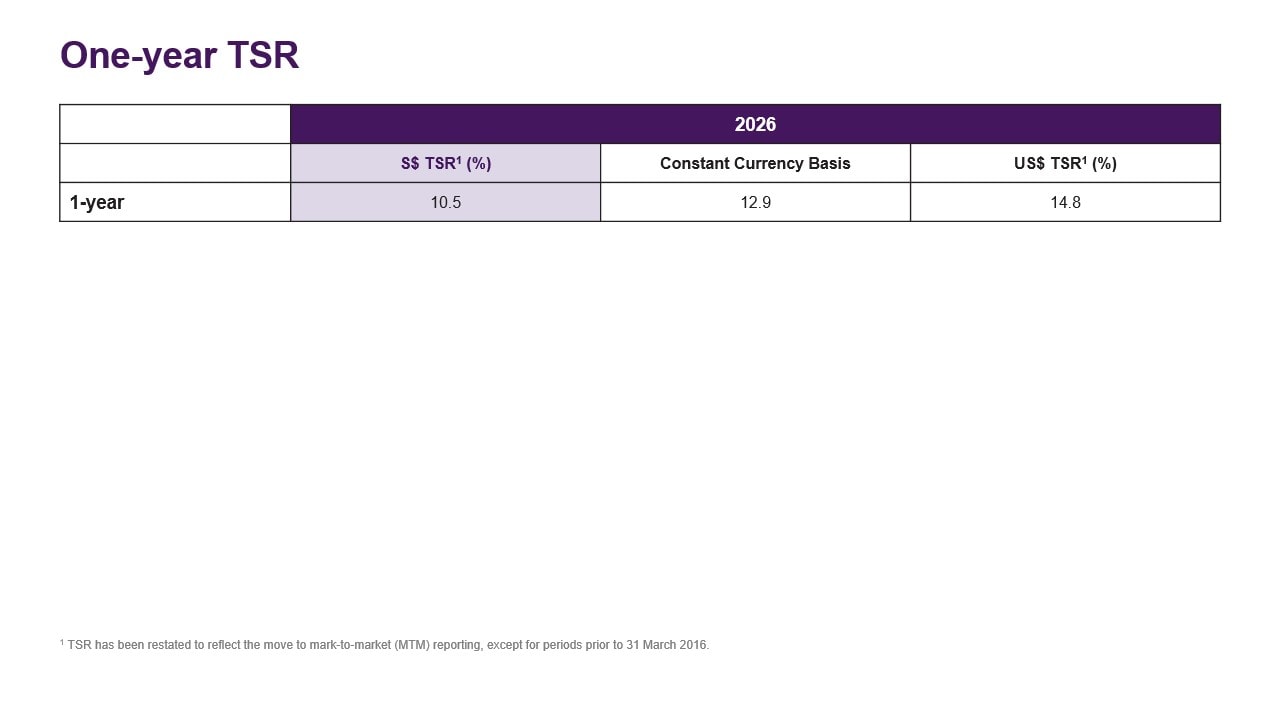
Our one-year TSR was 10.5%. This was driven largely by the strong performance of listed Singapore-based Temasek Portfolio Companies, or TPCs, and realised gains from key divestments. Bear in mind that every time we announce our results, it is at a point in time. The one-year TSR depends on the start and end date, which for us is 1 April to 31 March.

On the positive side, we were able to continue the momentum built over the past few years. We saw a rebound in China. India has done very well for us, although the last year has been challenging because of exchange rate volatility.

Our one-year TSR of 10.5% was moderated by two factors.

First, events in the Middle East impacted public markets performance. Up to the end of February, returns in our public markets’ portfolio were very acceptable based on the size of the portfolio. Our NPV would have been about 2% higher if not for the impact of these events on public markets.

Notwithstanding that, we saw a bounce back in April and May in the public markets. The vast majority of losses was recovered, which gives us confidence that our public markets strategies remain relevant for longer-term portfolio performance.

Second, the strength of the Singapore dollar against major foreign currencies also had an impact. Across all currencies relating to where we invested our capital, we saw a drawdown of about 2 percentage points in returns, attributable to currency movements alone.

When you build a long-term portfolio, you cannot hedge all your currency exposure. You take the volatility over a multi-year basis. That is why reporting on a constant currency basis provides a clearer view of our underlying performance.

On that basis, our one-year TSR was 12.9%, about 2 percentage points higher. For comparison with our global peers, our US dollar returns were 14.8%.

As more of our portfolio is invested outside Singapore and in non-Singapore dollar assets, all these three currency bases become relevant for understanding our performance. Our portfolio is structurally different from market indices, which makes direct comparisons less meaningful.

Portfolio Built for Resilience, Different from Indices

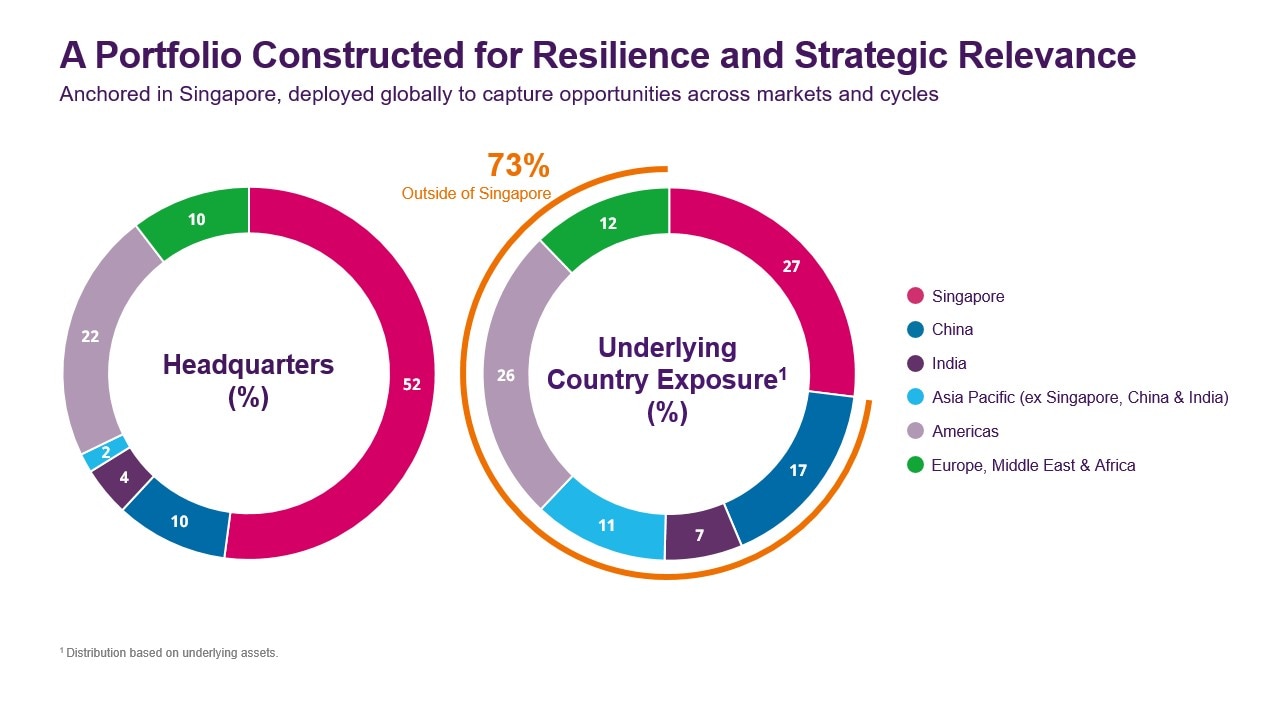
52% of our portfolio is in Singapore-headquartered companies, but 73% of our underlying exposure is outside of Singapore. Over the last decade, we have invested significantly outside Singapore and in non-Singapore dollar assets. This is partly because of the Yellow Pages rule that still applies to us: we should not crowd out the private sector in Singapore.

The US continues to be our largest market because of the depth of the markets and the pool of opportunities available.

On China, we remain committed to investing in China, and continue to invest in the promising areas. Our China exposure grew by about S$10 billion in absolute terms over the year, alongside a rebound in market valuations since 2024, and it grew by about S$24 billion over the past decade.

Even as we take a long-term view on returns, we have had to strengthen our capabilities in the near term — such as public market investing.

Liquidity and Public Markets

Which brings me to another important aspect of our portfolio — liquidity.

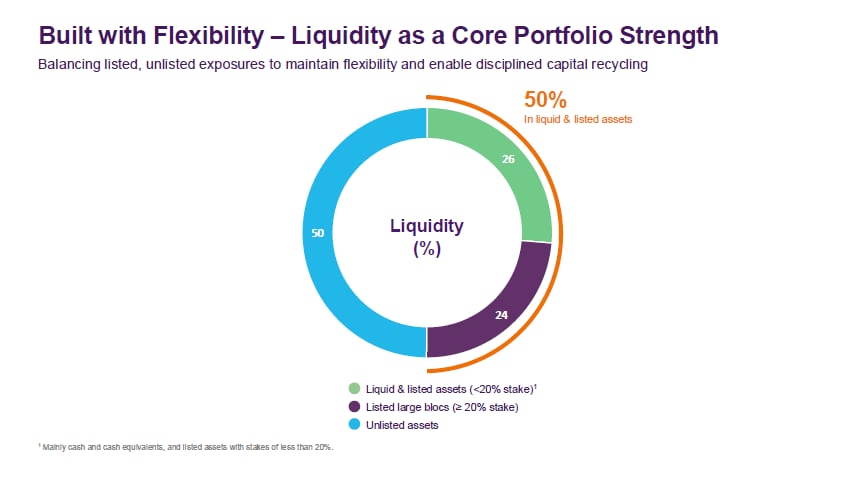
Our portfolio today is roughly half listed and half unlisted. We intend to maintain that balance — liquidity gives us the flexibility to rebalance and deploy capital in a world of more frequent shocks.

Of the 50% listed portfolio, 24% comprises stakes in listed TPCs which we do not trade. We intend to compound these stakes for value over the long term. That is why our global public equities strategies play an increasingly important role.

Since 2023, we have built dedicated teams and strategies focused on public equities and stock selection, as well as liquid strategies.

We were also more disciplined about re-underwriting the investment theses for our private investments in emerging champions, after they find their way into the public markets.

It is still early days, but the results across these strategies so far give us confidence that we are doing the right thing.

Portfolio Composition

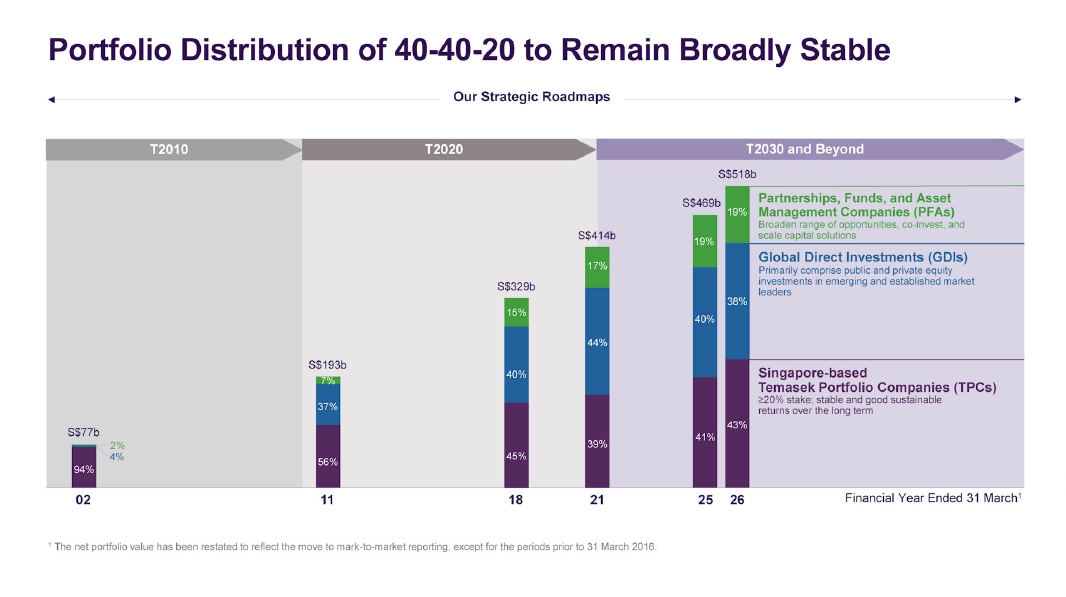
Our portfolio has evolved from being concentrated in Singapore-based TPCs more than two decades ago, to three distinct segments today.

Directionally, we believe that about 40% should be in TPCs, another 40% in Global Direct Investments, and 20% in Partnerships, Funds, and Asset Management Companies. This 40-40-20 distribution has been broadly stable since 2018, giving us balance, scale, and long-term resilience. In any given year, you may see some variance, which is normal because it depends on how markets perform. This year, Singapore is at 43%, Global Direct Investments is at 38%.

That does not mean we are slowing down our global investments. It is a question of relative market performance.

Clarity from Refreshed Structure

Against this backdrop, last year we undertook the first major restructuring since 2011.

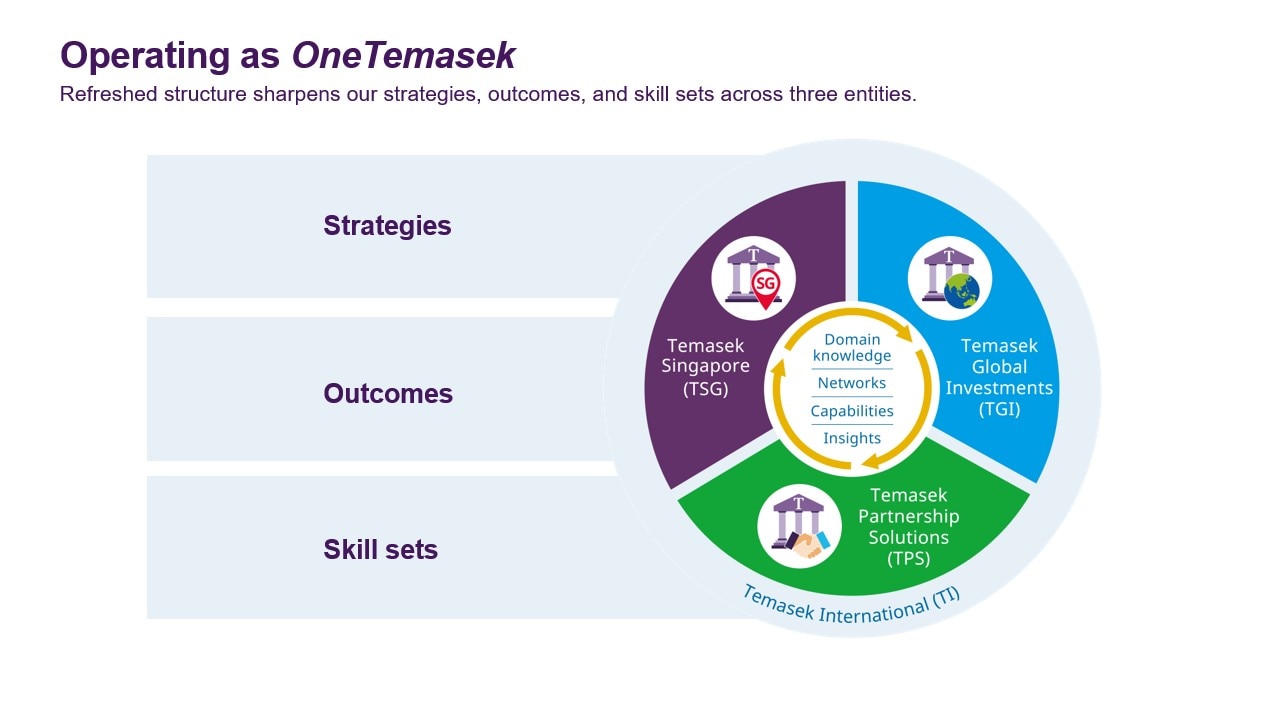
Why? Each segment requires distinct Strategies, Outcomes and Skill sets.

Our refreshed structure sharpens our focus and strengthens accountability. This brings greater clarity to strategy, and ultimately better returns.

Our shared values, culture, and purpose will be critical. We continue to work together as OneTemasek, with Temasek International as an institutional enabler.

But structure alone does not enable returns. In a world of deepening complexity, we aim to bring more to the table than just our capital.

Our franchise value comes from the breadth of our portfolio, domain capabilities we have built across our sectors and markets, and the operating knowledge that comes from working alongside the companies we invest in. But also, the relationships we built across decades.

We are not among the largest capital providers globally. But we get more than our fair share of opportunities, because our partners know what we can offer beyond just our capital.

The restructuring sharpens this further. It gives each business entity the empowerment to deploy that franchise value, and ultimately, to continue delivering good performance.

T2030 Strategy and Investment Stance

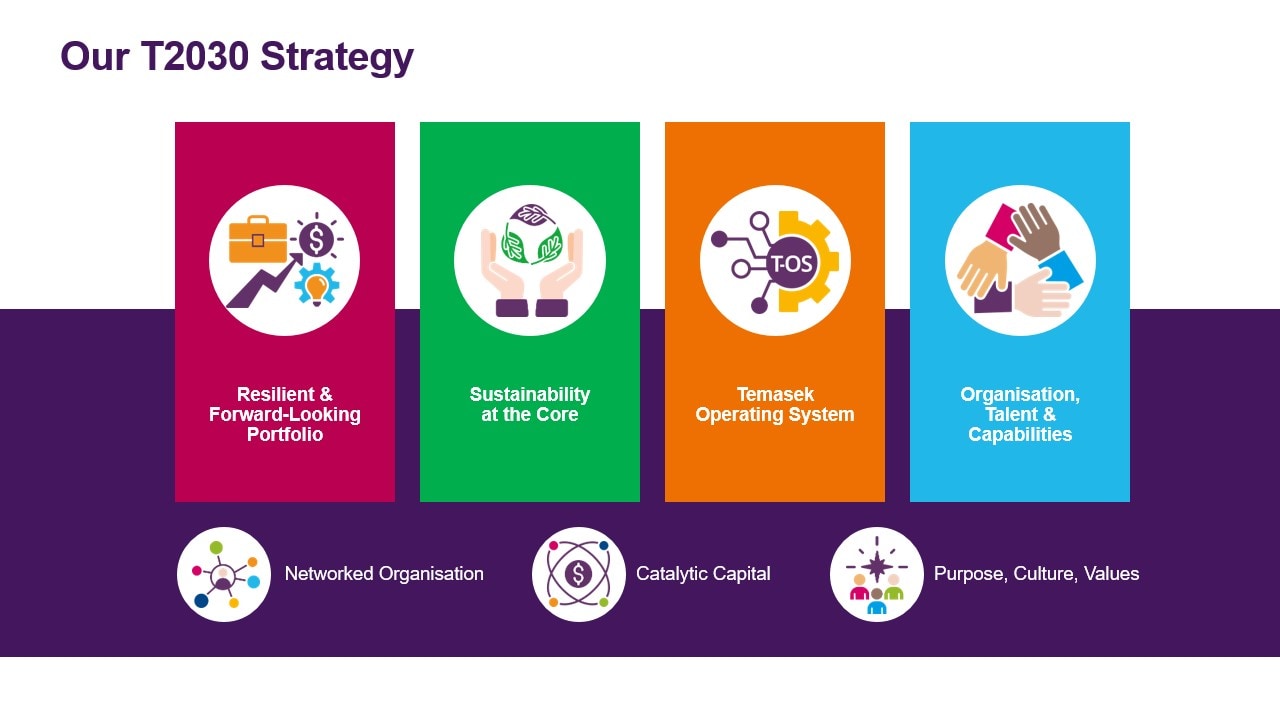
Under our T2030 strategy, our focus is on building a resilient and forward-looking portfolio, one that can withstand shocks and perform through cycles.

There are opportunities where demand is underpinned by long-term structural trends, and where patient capital like Temasek’s can add value.

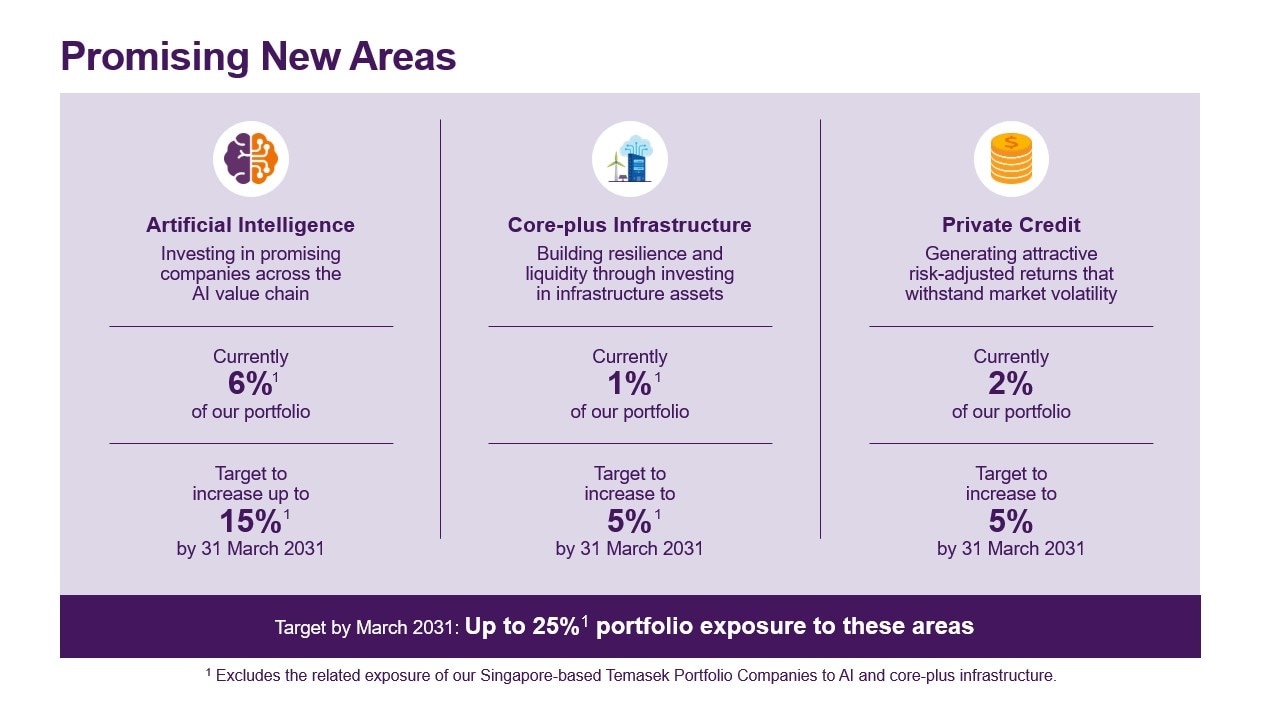
Looking ahead, there will be additional investment focus on three promising areas.

We have set targets to grow our portfolio exposure to these three areas by 31 March 2031. Up to 15% for AI-focused investments, up to 5% for Core-plus infrastructure — and both of these exclude our TPCs’ exposure. And up to 5% for private credit.

In private credit, we are very focused on where we invest, with a clear limit of the 5%. Core-plus infrastructure is quasi-equity: longer-dated, predictable cash flows. And for AI, it is all equity.

My colleagues will take you through the details on returns expectations and why these areas matter. But I am sure you want to hear more about AI, so let me start there.

AI is integral to how we sense emerging opportunities, adapt our portfolio, and thrive as an institution.

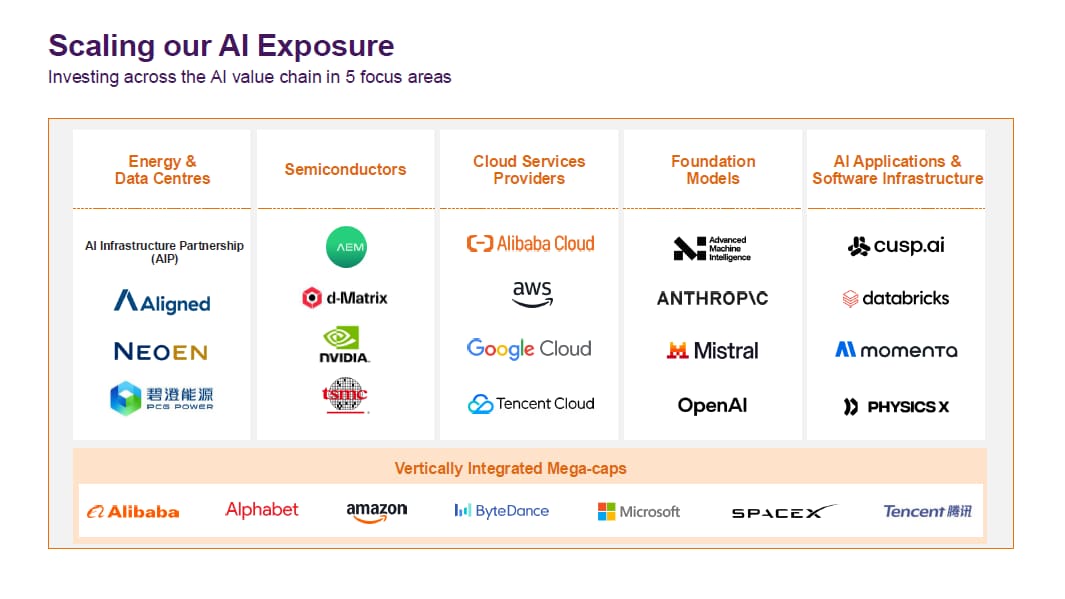
Investing across the AI Value Chain

Let me touch on how we are investing across the AI value chain.

Within these five areas, some companies are leaders in one area, and some are vertically integrated across multiple areas, creating a flywheel effect. Across the board, these investments reflect our view of AI as a structural, long-term driver of value creation.

While it is important for us to invest in AI-innovative companies, which may well become scaled enterprises, the rubber hits the road in AI adoption. The remaining 85% of our portfolio must be focused on AI adoption for competitiveness. That is where the rest of our portfolio will see value capture.

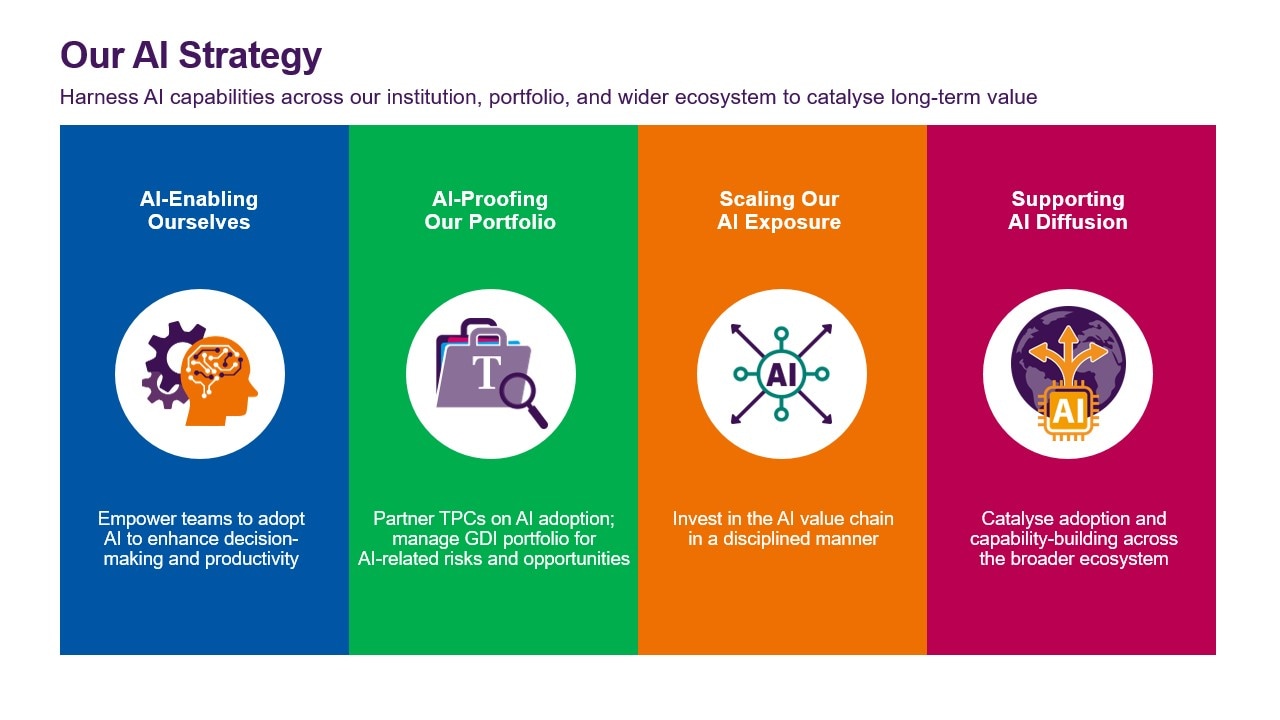
Our broader AI strategy consists of four pillars.

The first is AI-Enabling Ourselves, which focuses on raising AI fluency across our Temasek workforce, redesigning jobs and workflows, and developing our agentic AI strategy. We have a firm-wide Digital Fluency programme, and deploy AI agents for specialised, high-value workflows.

AI-Proofing Our Portfolio requires us to future-proof TPCs and manage our global portfolio exposure to AI risks and opportunities.

Our TPCs have thrived through cycles. AI presents new opportunities, and we are actively engaging their boards and management teams on AI as a strategic priority. We do this in partnership with unions and government agencies through tripartism, to redesign jobs, reskill, upskill, and uplift our TPC workforce.

AI-Scaling Our Portfolio means scaling our investments across the AI value chain, while remaining selective and disciplined about risks.

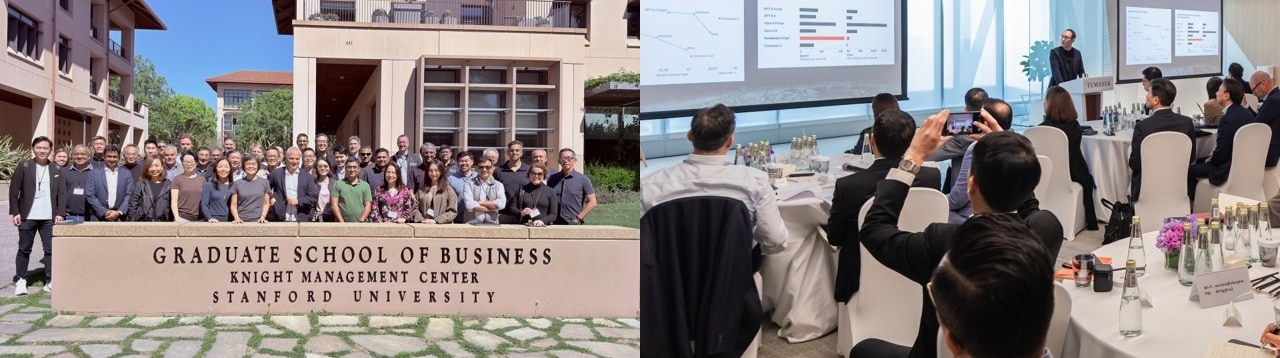
And finally, AI-Diffusion involves driving broader adoption through our ecosystem. We have organised AI immersion programmes for our TPC leaders in Silicon Valley, Shanghai, and Hangzhou. These have given them insights and inspiration for their own AI transformation.

People-centred AI

Every company on a transformational journey will need to redesign its business models, its organisation, and jobs.

With AI, the organisational structure of the future will increasingly be built around systems, agents, and people. But critically, people must remain at the heart of this transformation.

AI replaces tasks — it does not necessarily replace jobs. This means we must focus on skilling, reskilling, and upskilling our workforce to leverage AI for higher levels of productivity. AI will make people more productive and allow them to have fulfilling careers.

I also want to make one more point. It is not right to say that there is no role for entry-level talent or young graduates in this new world with AI. The world is ripe for them. This is an exciting time — one they should embrace with positivity. We just have to enable it.

Temasek has about 1,000 people globally. But within our broader ecosystem, our TPCs employ over 160,000 people in Singapore and about 400,000 globally.

This means we have a responsibility to ensure that we remain people-centred and people-led — not just as a company, but across the ecosystem. We believe in AI’s promise, but we also take the risks seriously. We want to empower our people to harness AI, not be replaced by it.

Doing Right

For us, AI is as much about doing right by our people as it is about investing and doing well. One of the key tenets of our Temasek Purpose is to “Invest in Human Potential”. Nurturing talent and building capabilities are core drivers of long-term value.

Doing right also means taking a long-term view on systemic issues. AI enablement is one. Climate change is another.

Sustainability and Climate Goals

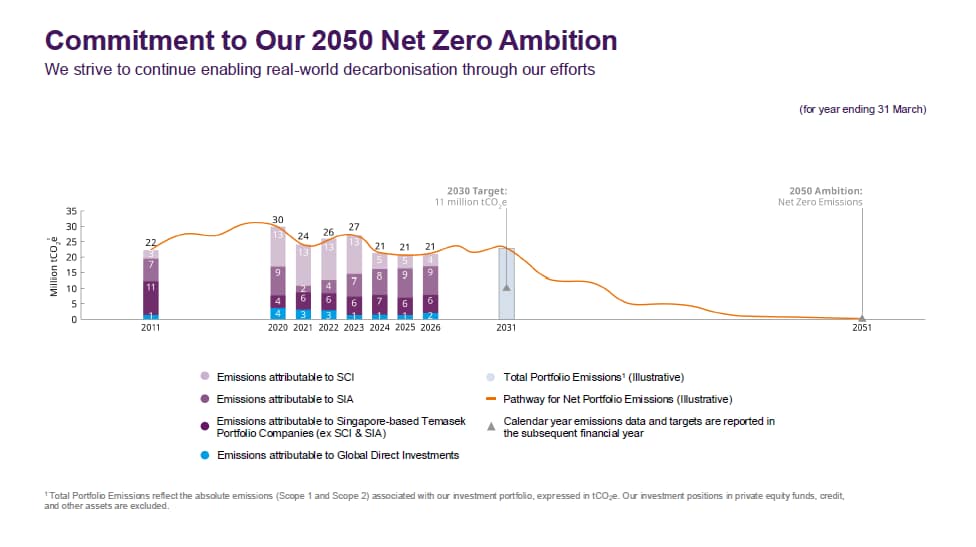
On sustainability, we remain firmly committed to our 2050 net zero ambition.

The path is not linear and requires everyone to act together to effect systems-level changes. We have to be calibrated in how we undertake the next phase of our climate journey. As we invest, we must be aware of the trajectory for success.

Ultimately, doing right means we must be good stewards of the capital we are entrusted with.

Doing Good

It is also important that every enterprise focuses on contributing to social resilience and social cohesion, because that gives rise to social capital.

Our social license to operate depends on our ability to create value for all stakeholders. We must give back to communities, especially those we operate in, so that they can adapt and benefit from new business models.

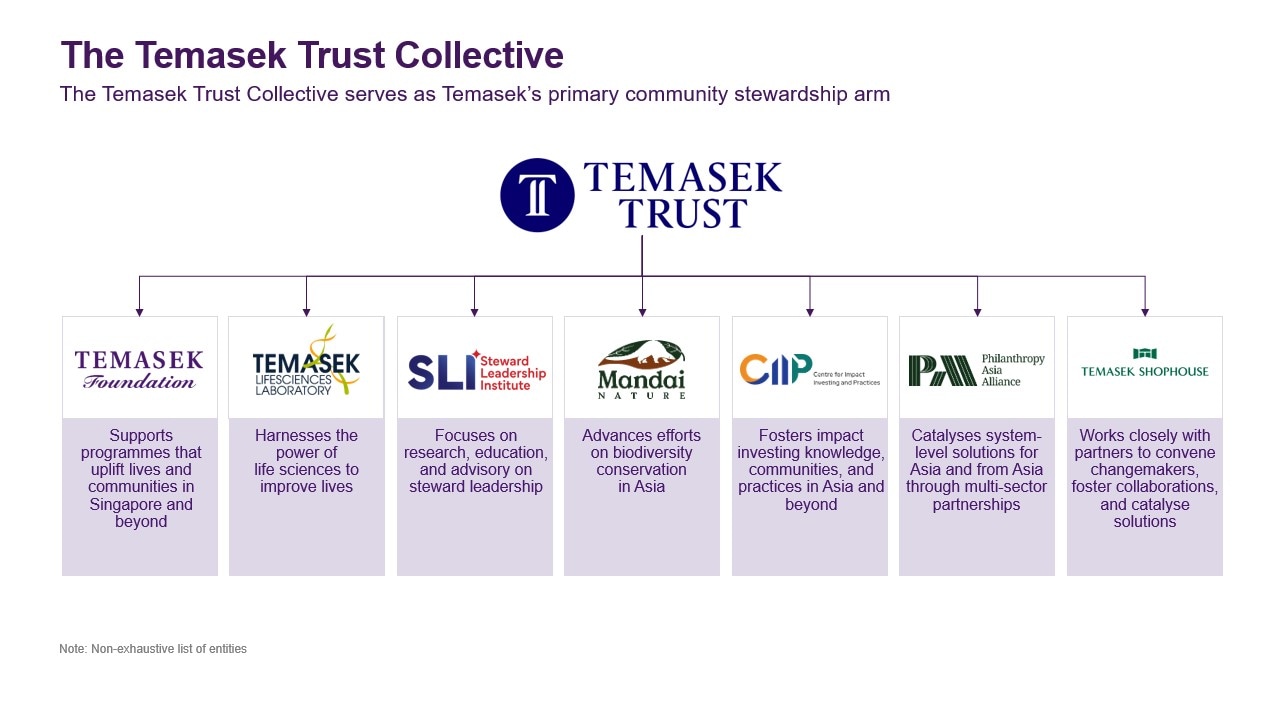
That is why we have Temasek Trust, our primary community stewardship arm.

We do well so that we can also do good.

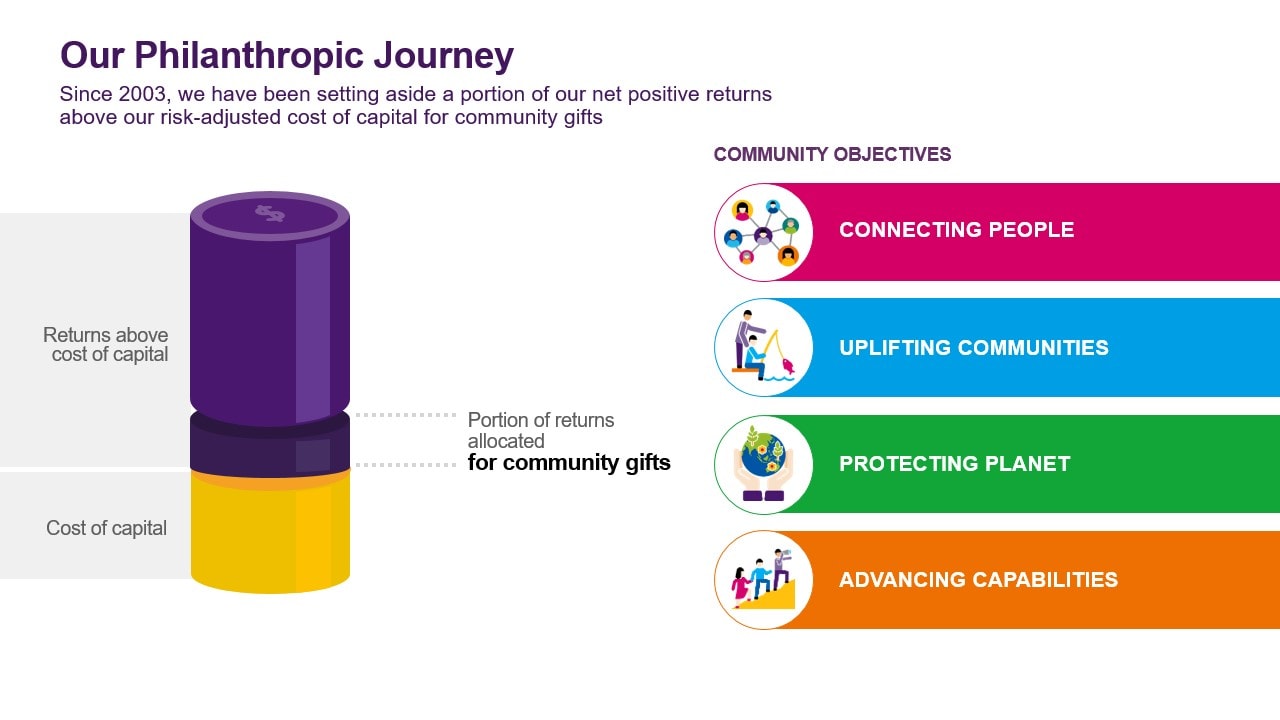
In 2003, we committed to set aside a portion of net positive returns above the risk-adjusted cost of capital for community gifts. Two decades on, that commitment has not changed.

Our approach is structured, intentional, and governance-oriented.

Our programmes help to Connect People, Uplift Communities, Protect Our Planet, and Advance Capabilities. These have delivered positive social impact to about 5 million lives in Singapore and beyond.

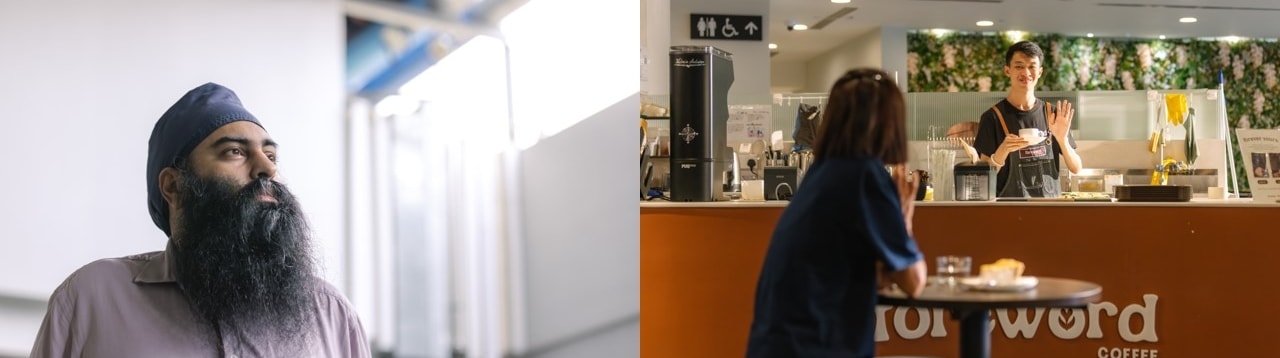
Let me share two stories that bring this to life.

Raj is a beneficiary of a Temasek Foundation programme offering hope to people with treatment-resistant depression.

And Wei Chiang is with Foreword Coffee, a social enterprise supported by Temasek.

Beyond Singapore, we also run programmes in our neighbouring countries. Because when our region thrives, Singapore will thrive.

Looking Ahead

When Temasek was founded in 1974, the world was in a difficult place. And at every point of crisis since then, we have moved forward — with clarity, and with purpose.

Today, the complexities are different, but the imperative is still the same. We have to sense what lies on the road ahead, and around the corner. We have to adapt, because the world will not wait for us.

Our strategy is clear, and our capabilities as OneTemasek are stronger than ever.

I am confident we will navigate this environment, not because complexity will go away, but because we are building for it.

We will continue to do things today with tomorrow clearly on our minds, So Every Generation Prospers.

Thank you.

Subscribe to our newsletter

Stay up to date with our latest news, insights and stories

Select a type of content
    Please select Stories you are interested in.
    Please give us your consent.
    Please confirm that you are not a robot.