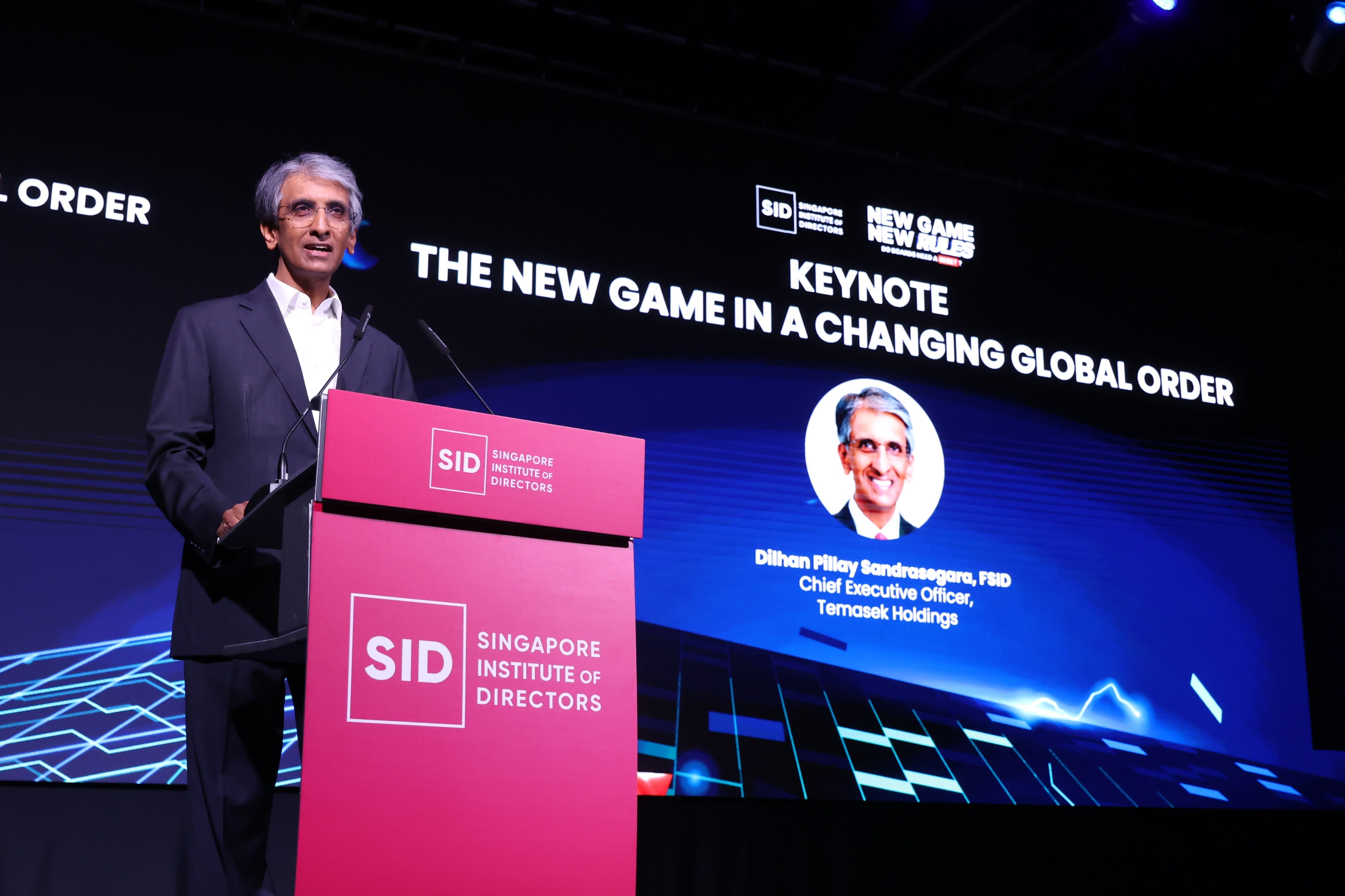
Ms Indranee Rajah, Minister in the Prime Minister's Office, Second Minister for Finance and National Development,
Mr Yeoh Oon Jin, Chair, Singapore Institute of Directors,
Distinguished guests, ladies and gentlemen.
It is really a privilege for me to come here and speak to you. I think the last time I did that was back in September 2021 as we were just coming out of COVID. A lot has happened since then.
The global operating environment is being reshaped by strategic competition, economic security, and a renewed focus on resilience. Trade, technology, supply chains, capital, and industrial policy are increasingly influenced by national priorities, geopolitical, and geoeconomic considerations.
The assumptions that supported decades of globalisation – open markets, efficient supply chains, stable and predictable rules – no longer hold.
A confluence of geopolitics, geoeconomics, technology, energy, and business is redefining how the world operates.
Trade tensions, tariffs, geopolitical conflicts, energy security, climate transition, and generative AI are converging in increasingly complex and less predictable ways.
This creates uncertainty and wide-ranging implications for businesses looking to operate efficiently, but also opportunities for companies that are able to adapt thoughtfully. The world of business craves a high level of predictability, which is palpably absent today.
If VUCA described the previous era, as the minister said, today’s world increasingly feels BANI. I will repeat what it means – brittle, anxious, non-linear, and incomprehensible.
BANI captures a boardroom reality that many of us here today are facing.
Boards need to guide management in making decisions when signals are unclear, assumptions need to be assessed and reassessed continuously, and the future is becoming harder to predict.
Directors’ duties, however, are unchanged. But what it takes to fulfil them is evolving.
As the minister says, we have to pay attention to the Companies Act. What does it mean when you read the sections of the Act and when you read the words that have been there for the last 60 years?
For the past few decades, boards were rewarded for helping companies become better, faster, cheaper, and more efficient.
In the early 2000s, major corporate scandals such as Enron and WorldCom problems in the United States exposed failures in governance, oversight, and accountability.
This led to a major shift towards stronger governance, including the Sarbanes-Oxley Act of 2002 in the United States and changes to corporate governance codes elsewhere including in Singapore. These reforms strengthened board oversight, financial discipline, internal controls and accountability.
This foundation of governance continues to matter.
But over time, the focus on governance may have supplanted the focus on business growth for the long term and shareholder value, often because of concerns board members have about reputational risks and legal liabilities.
Shareholder activism, which is more prevalent today, has been considered as a factor in shorter-term actions by boards and management in recent years.
In a polycrisis world, external forces such as geopolitics, technology, and energy disruption can have a major impact on a company’s business model.
And this of course preoccupies most boards today whether in Singapore or elsewhere.
Boards therefore need a balance between the focus on governance and the focus on business growth for the long term and this needs to be reflected in the composition of the board.
One should not come at the expense of the other. Both must coexist if companies are to remain resilient and forward-looking – sensing and adapting to an ever-changing world and external environment to be able to drive value for shareholders and other stakeholders.
Put simply, boards must ask themselves: do we have the skill sets and capabilities to help our companies navigate a polycrisis world?
That is why the conference theme “New Game, New Rules: Do Boards Need a Reset?” is apt.
In this speech, I will focus on four themes:
- Boards as strategic anchors amidst uncertainty.
- Boards as catalysts for company-led value creation.
- Building boards for the future.
- Why trust and responsible stewardship still matter.
The first theme: Boards as Strategic Anchors Amidst Uncertainty
For decades, boards were tasked with optimising companies for efficiency – lower costs, leaner operations, and tightly integrated global supply chains.
Increasingly, this led to more short-termism which markets are focused on than long-term resilience of business models.
Efficiency still matters, but today’s boards must prioritise resilience in the parts of the business most critical to continuity and long-term value creation.
Just-in-time is giving way to just-in-case.
This means they need to distinguish temporary volatility from structural change.
Boards must challenge strategic assumptions and test whether they still hold and ensure the company does not remain tethered to yesterday’s operating model.
Boards must also ensure risk is embedded in strategy, not managed separately from it.
Rather than treat critical risks, such as geopolitical issues, technology disruption, supply chain dependencies, cyber readiness, as one-off agenda items, these need to be constantly tested against plausible disruptions and integrated into strategic planning and debates in board meetings.
This is why Enterprise Risk Management is becoming central to board oversight. Risks today are interconnected. Boards need to understand how these risks affect the business as a whole.
In this context, the Board Risk Committee (BRC) may take on greater importance as a mechanism for overseeing enterprise-wide risks and resilience in a more integrated way.
The skill sets of the BRC must complement the most significant risks faced by the company and its business environment.
The BRC needs to also cover cyber risks especially in connection with the deployment of AI and the disruption caused by it, as well as risks associated with climate change which has longer-term effects on both business models and assets.
Having access to experts that the members of the committee can go to for advice on a continuous basis is an imperative.
This brings me to a broader point: Board effectiveness is critical.
Shareholders expect to see a high-level of cohesion in the board, but there must also be robust debate.
The board’s role is to support and challenge management and to focus on the company’s value drivers, both long term and short term, in the interest of resilience for value.
A key driver of board effectiveness is the right combination of Chairman and CEO, and the dynamics between the two of them.
The Chairman is a mentor to the CEO and is also a bridge between the board and management. The Chairman guides the board’s agenda and discussions, engages the CEO regularly on what the board expects, and the strategic directions of the company, as well as stakeholder engagement, plays a role in evaluating both CEO performance and board effectiveness.
When this works well, it allows major shareholders to take a step back and allow the board and management to function without interference or influence.
At Temasek, we have observed the importance of this factor in the significant value creation of many of our companies, both public and private.
Two companies that have exhibited this over long periods of time are PSA, a private company held by Temasek, and DBS, which is the largest market cap company in Singapore. Perhaps this is something Su Shan and Chong Meng can reflect on in their panel.
I would say the 15-year partnership between Peter Seah and Piyush Gupta was probably one of the most important factors which saw DBS becoming Singapore’s largest market cap company. And over the decade that Chong Meng spent as CEO of PSA, together with the chairmanship of Mr Fock Siew Wah and Mr Peter Voser, they were instrumental in PSA becoming the largest independent port operator in the world.
Su Shan continues the partnership with Peter and the share price has increased 75% in the past 15 to 18 months with them as Chairman and CEO.
The second theme: Boards as Catalysts for Company-Led Value Creation
The litmus test for board stewardship is whether it translates into sustainable value creation for the company and its stakeholders.
For listed companies, the real scorecard is shareholder value – delivered through dividends and overall stock appreciation over time.
Acting in the best interests of the company, public or private, is also becoming more complex.
It is about the company as a whole, not shareholders alone.
Boards must consider whether the business model remains credible and sustainable, while making difficult trade-offs between the long term and the short term, and between long-term resilience and short-term profitability.
They need the right skill sets and access to adequate advice to understand these issues and make the right decisions for sustainable value.
Boards must help to ensure companies act decisively, allocate capital well, and deliver outcomes that investors and stakeholders can understand and trust.
I think we saw this really during COVID, between March 2020 and towards the end of 2021. One example I would raise which I was very much involved in was Singapore Airlines. After COVID hit us, in March 2020 the revenue of Singapore Airlines fell off the cliff. At that time, the board had committed to the long-term fleet renewal which was connected to route renewal and also to a transformation plan which included upscaling of its fleet.
So their focus was to make sure that the fleet renewal programme and the need to retain talent continued in a COVID world.
In the beginning, they were burning over S$400 million a month. They kept the tyres warmed up so that they were ready to fly when they could. The whole idea was to make sure that the airline was ready to take to the skies. They needed S$15 billion and Temasek and other shareholders pitched in.
We put up capital to ensure that the airline remained strong – and stronger it became. It was able to fly when COVID abated.
The reason for that was the long-term orientation of the board and management. They think about decades ahead, not just about the crisis at present. And they have shareholders to back them up.
This is what we require from boards today, working with management as they go through crises, in order to focus on resilience in the long term.
There is no reason to believe that the board of SIA will not continue to maintain this focus.
Business transformation is most important today in the business world and it is a journey that knows no end. There are constant changes in technological advancement and the disruptions in the world whether it is energy-related or whether it is based on skill sets.
Workforce development that we have to undertake to make sure that our colleagues remain relevant to maintain social resilience and social cohesion in Singapore is critical.
Corporate transformation efforts must be tied to clear strategy, disciplined capital allocation, execution milestones, and sustainable shareholder value, while addressing long-term risks.
This is especially relevant to Singapore’s market context.
The Singapore Equities Market Review has helped set the flywheel in motion for Singapore’s equities market and stock exchange.
The Value Unlock programme reinforces the need for company-led transformation.
However, market reform alone cannot unlock sustainable value. Long-term market vibrancy depends on companies with clear strategies, robust governance, and meaningful investor engagement.
We have seen this in Japan where the reforms of JPX, implemented by CEO Hiromi Yamaji are a case in point. There has been renewed investor confidence in the Japanese stock markets which have benefitted from domestic and foreign flows of capital. There is no reason why Singapore cannot do the same.
Boards sit at the centre of this transformation.
Boards should ensure investors understand how companies create value before external scrutiny makes the case for change more urgent.
Companies need to explain where they are headed, the journey they are on, and the milestones in their roadmap and key metrics that serve as guideposts.
Investor Days are becoming more important because they provide a structured way to engage the investment community. Regular engagement with institutional and retail shareholders and analysts is also critical, so that they understand the company’s strategy, progress, and long-term value creation plans.
This is why strong Investor Relations functions matter whether they are held internally or done with the help of external advisors.
Temasek has been engaging our Singapore-based Temasek Portfolio Companies (TPCs) on this, and we have seen the benefits of a robust Investor Relations framework that includes active investor engagement.
The third theme: Building Boards for the Future
As we can see, the role of the board is becoming more demanding, more technical, and more visible.
Boards must keep refreshing their agenda, capabilities, and ways of working as the operating context changes. Director selection should not be based only on past career success. That is still important.
But boards should assess which skills, experiences, and perspectives are missing from the current board mix given the company’s future strategy.
Boards should communicate clearly how their composition supports strategy.
The scrutiny on board composition is intensifying from shareholders, regulators, and the broader market.
There is growing focus on whether the board’s mix of skills, experience, independence, and renewal aligns with the company’s stated strategy.
Boards must communicate clearly and proactively how they approach board composition – these include identifying and articulating expertise gaps, how directors are selected, and ensuring the board has the right collective capabilities for the company’s future.
Such transparency is core to the credibility of the company’s strategy, and how the equity narrative is built.
So what would a high-calibre board entail?
First, independence and renewal.
From Temasek’s perspective as a long-term shareholder, we do not seek to dominate the boards of our portfolio companies or direct their business decisions and operations. That is the responsibility of the respective boards and management teams.
When our employees are appointed as representative directors to the boards of our portfolio companies, they do not take instructions from Temasek on how to vote. They owe their primary fiduciary duties to the portfolio company and act only in its best interests.
Consistent with this approach, we also avoid having a Temasek employee serve as Chairman of the board.
Our role is to support high-calibre, effective boards that exercise independent judgment, bring the right mix of competencies, and are empowered to be stewards of companies for long-term compounding value.
Board renewal requires balancing experience and knowledge.
We should not think about this simply as an age or experience issue.
What matters is whether the board has the requisite experience, knowledge and capabilities for the company’s future.
In areas such as technology and AI, younger directors who are digital or AI natives or cyber experts may bring increasingly relevant perspectives to discussions.
If we look at the US, for example, some companies are already appointing directors in their 30s who bring relevant technology or business model expertise.
Here in Singapore, we tend to appoint well-established and well-known profiles. That is not unusual. These directors continue to bring value, but the important question to ask is whether the board has the right combination of skill sets to enable robust discussion and challenge management.
Director tenure should be assessed through two distinct lenses: tenure of independence and tenure for capabilities.
Longer tenure may raise questions about objectivity and independence.
But from a capability perspective, a fixed threshold may be too blunt: nine years may be too long in fast-moving areas where technology, cyber and AI are prevalent, or too short where a director continues to bring deep sector knowledge, institutional memory and judgment. A balance is therefore required.
Second, high-calibre boards need future-relevant competencies.
Directors increasingly need to be geo-literate.
They need to be able to monitor geopolitical developments, interpret geoeconomic signals, and prepare for sustained periods of strategic friction in areas such as supply chain resilience.
They also need an understanding of areas of focus such as AI, cybersecurity, digitalisation, sustainability, and transformation.
The distinction between duty of care and standard of care also matters. The duty of care applies to all directors, but the standard of care may be higher where a director brings specialist expertise.
Even then, every director must be sufficiently informed to ask the right questions, challenge assumptions and form an informed view. The statutory duty of care in Singapore requires directors to apply reasonable diligence in the exercise of their duties.
Diligence requires knowledge: understanding the company’s business model, opportunities, challenges, risks and operations.
This requires engagement beyond board and committee meetings, including regular engagement with management and, where appropriate, exposure to the company’s operations, markets and customers.
Management also has a role in ensuring the board has the knowledge needed to discharge its duties.
Boards may need to augment their skill sets through sub-committees, or through advisors to the board and its committees.
The right mix of competencies will differ by industry and business model.
A bank will have different needs from an industrial company.
Boards therefore need relevant business and operational experience around the table to ensure robust discussion and also ensure there is challenge to management.
The question is how can we ensure boards have sufficient capabilities in these areas?
It does not mean specialists must be appointed as board members.
But boards need access to specialised skills, whether through committee or sub-committee memberships, co-opted experts, or advisory arrangements.
Boards should therefore ask whether they can continue operating the way they have in the past, or whether their structures and mechanisms need to evolve.
As a long-term shareholder, Temasek has sought to support boards and leaders of our portfolio companies in building capabilities and knowledge in emerging areas.
This is part of a broader commitment to continuous learning, supported by platforms such as our roundtables which in recent years have addressed core issues such as sustainability and technology. We also encourage effective engagement with the investor community. These roundtables are not just about Temasek engaging the companies, they also enable peer exchange and expert insights across our ecosystem. That is why forums such as SID play such an important part in enhancing knowledge for each one of us who sit on boards.
In March 2026, for our AI Leadership Programme, we brought 70 people to Stanford so that we understand the pace of change and understand how we can work together as one. 45 Temasek employees and 25 (TPC) CEOs. It was a very engaging week. We need to do the same in Singapore and bring that kind of expertise, environment, and learning here.
It is critical that we build cyber resilience in our ecosystem. We are doing that ourselves with our CISOs and senior leaders across our portfolio companies to strengthen capabilities in that area.
We have taken the position that the responsibility for cybersecurity lies with the CEO. Not with the CISO, and not with anyone else, because it is an enterprise management issue risk.
The fourth theme: Trust Requires Responsible Stewardship and Transparent Engagement
I’ve spoken about how boards, management, and shareholders each play a distinct but complementary role in long-term value creation.
In Asia, this is especially important.
Many companies have significant, family, state-linked, or controlling shareholders.
Foreign investors can be cautious where controlling shareholders dominate.
Singapore’s governance reputation, which foreign investors hold in high regard, is an important asset in attracting capital flows whether in the private or public market.
Maintaining this reputation requires responsible ownership, credible boards, and meaningful stakeholder engagement.
All shareholders have a role in building trust.
Long-term shareholders can provide stability, patient capital, and strategic conviction, allowing management to focus on long-term value creation while addressing short-term pressures and opportunities.
Investor confidence is also shaped by the quality of boards.
Constructive engagement across all shareholders strengthens governance and supports long-term value creation.
For us, this is very important. For Temasek portfolio companies that are publicly listed, we don’t control the movement of their share prices. We don’t trade in the shares of our companies. It is very much dependent on the minority shareholders and their views of the companies, the boards, and the management teams. We are very much reliant on their perspectives of the future prospects of the companies.
So all the more, it is very clear to us that the boards and management teams of our companies must engage their external community and not just Temasek.
In closing, it is clear that the operating context has changed more fundamentally than many anticipated.
As a generational investor, Temasek seeks alignment on long-term value creation for all stakeholders.
This hinges on having the right boards in place.
In a BANI world, we need a different kind of BANI board.
- B for Bold in preparing companies for the future, not anchored to yesterday’s assumptions;
- A for Anchors of stability and long-term perspectives amidst uncertainty;
- N for Navigating ongoing disruptions with expertise, judgment, and confidence;
- And I for Independence in their oversight and exercising objective judgment in the long-term interest of the company and its stakeholders.
Ultimately, boards that succeed in this environment will be those that help companies remain resilient while delivering good sustainable returns over the long-term, and addressing the legitimate expectations of all stakeholders.
Thank you and I wish you all an engaging and productive conference.