How does traditional farming hurt the environment?
Sebastien: Agriculture is responsible for about 20% to 30% of global carbon emissions. There is a sizable contribution to climate change coming from how we produce what we eat.
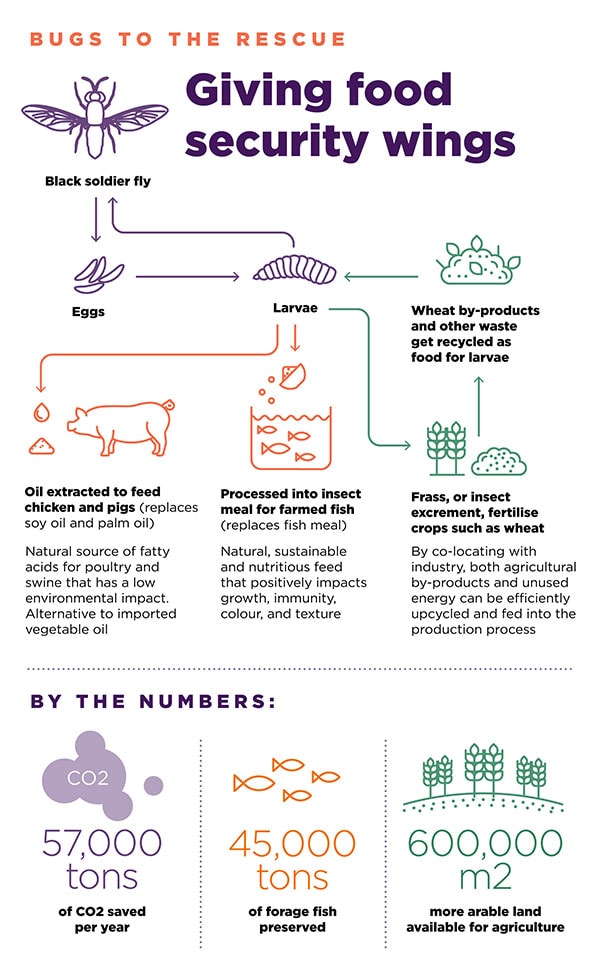
Aude: To reach the targets set by the United Nations to limit global temperature rises to 1.5-2.0 degrees Celsius, we need to reduce carbon emissions by 45% from 2010 levels by 2030. This can only be done by changing the way we produce and consume food. We conducted a life-cycle analysis that showed that the carbon footprint for insect feed production was at least 50% smaller compared to that of existing protein sources, on top of offering an alternative nutrient source of higher quality.
Are we running out of food?
Sebastien: For now, there is enough for everyone. However, we rely on a global supply chain that could be impacted by events such as Covid and geopolitical crises. With an additional 2 billion people to feed by 2050 and the bulk of population growth in Asia and Africa, our food supply will be placed under greater stress if we don’t act now. We can make a choice today to help avoid a food crisis in the future by making the supply chain more sustainable.
Aude: Insects also reduce the need to grow more crops, rear more livestock or catch more fish for conventional feed. This helps alleviate carbon emissions, safeguarding our natural environment while securing long term food supply.
How can technology help us feed more people in a sustainable way?
Sebastien: With technological advances, farmers today can produce more food more affordably and with improved nutritional value than at any point in our history. Emerging technologies could allow us to feed even more people with less environmental impact.
Aude: We share Temasek’s belief that disruptive technology can bring positive change. At Innovafeed, we use robotics, data analytics, and artificial intelligence for real-time monitoring and to optimise the environment in which the insects grow so their growth and quality are maximised while their energy, water and land consumption are minimised. To reduce our carbon footprint further, we recycle agro-industrial by-products and waste streams to feed our insects, and energy waste streams, such as heat, for our own processes. So with cutting-edge technology, we have been able to get a very good product at the lowest carbon footprint possible. At a production facility the size of our factory in Nesle, France, this would represent CO2 emission reductions of 60,000 tonnes a year, equivalent to the emissions generated by a city of 6,000 people.
At Temasek, sustainability is at the core of all that we do. We actively work with our portfolio companies to address the climate challenge, reverse the loss of nature and build a more inclusive society.
Temasek is an investor in Innovafeed.