QUESTION: Going back to the domestic companies, since the pandemic started to date, how much has Temasek spent to support the companies that have been in need of capital? Do you think that that sort of financial support, due to COVID, will end soon or continue? If it will continue, do you have an upper limit for the money you will spend to support them? And eventually, will you be bringing down the exposure, the shareholding, that has been raised due to this run of support for companies like Singapore Airlines (SIA), Sembcorp Marine?
NAGI HAMIYEH: Yes, there have been several capital raisers at some of our portfolio companies where we have participated as an investor. As an active investor, we look at each opportunity on a standalone basis, and we look at the outlook for the company, the business plan, and decide accordingly in terms of how we participate. So we don’t have a fixed plan on how much we're going to deploy to support our companies, because unfortunately things don't come out this way. It's on a situation‑by‑situation perspective.
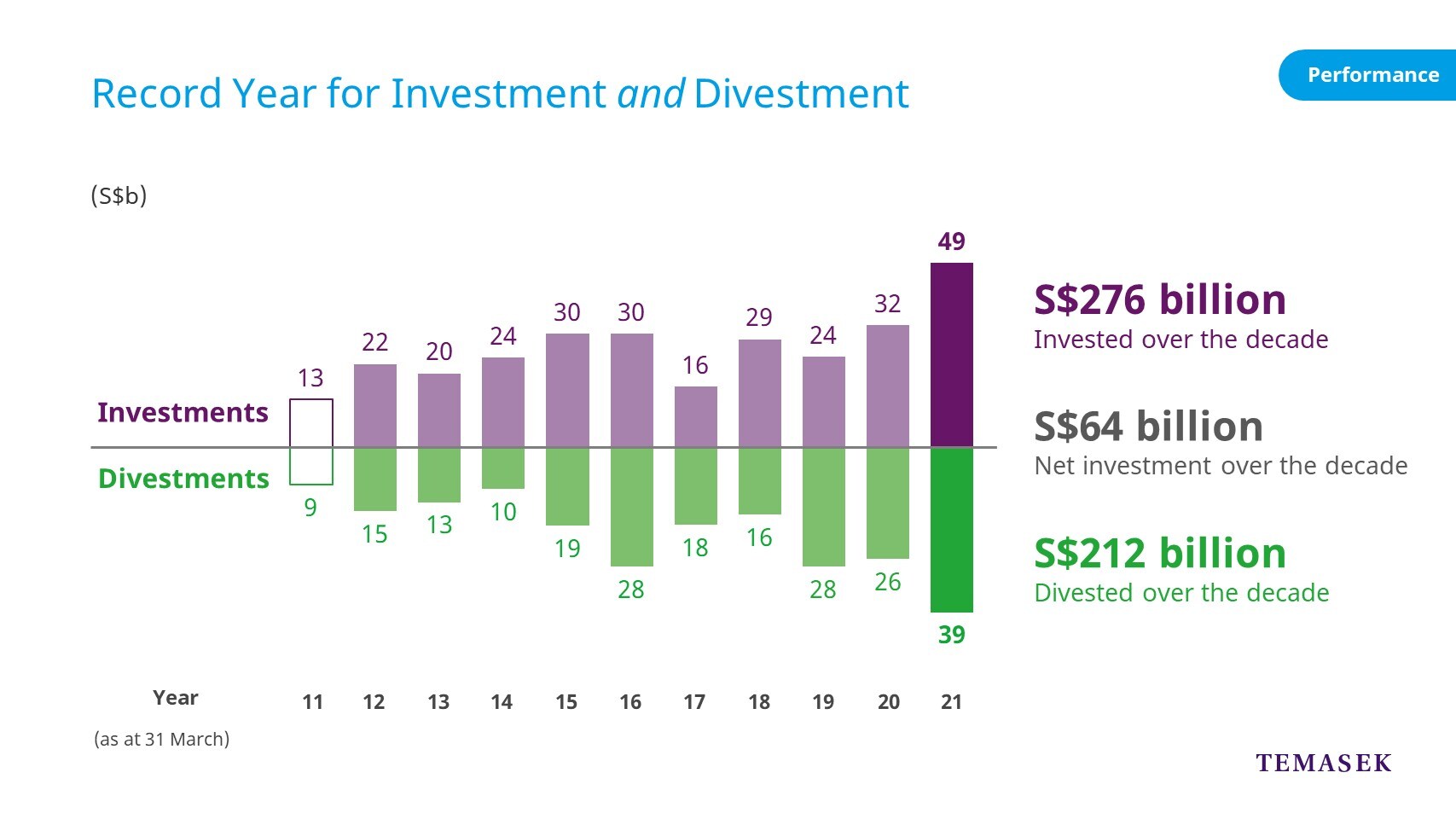
As I mentioned, for SIA, over the last year and a half, we deployed S$13 billion, among other investors, of course. On the demerger of Sembcorp Industries and Sembcorp Marine, we got the shares as part of the dividend in specie from Sembcorp Industries to all shareholders, and then we ended up investing S$200 million in it. Out of the rights issue that was announced, we decided that we would take our pro rata shares, and in case there is any excess shares that the minorities don't want — and bear in mind we're the last in the stacking order — we would take up to 67% while DBS is taking the residual 33%.
The reason why we have done that is not to increase our shareholding, but we wanted to ensure that the company has certainty and access to these funds to be able to move into their new objective of looking at the new areas, which happened to be very aligned with us.
As for the future, what other companies of ours do, again, it's up to their boards and management. We will ascertain every situation and then decide how we act.
NEO GIM HUAY: If I may add, just on the outlook of the situation, we are cautiously optimistic about the progressive recovery of business as the vaccines continue to get rolled out. The recovery may be a bit uneven across different countries and different sectors, but we are cautiously optimistic that we could resume business, and regain confidence with the various measures that are being rolled out by the Government.
FOCK WAI HOONG: When it comes to Singapore specifically, once again ‑‑ I think we're well positioned to emerge from, I guess, the post‑pandemic world. The manufacturing sector should benefit from global cyclical recovery. Our financial services and technology sectors remain resilient and have shown strength through the pandemic. And certainly the domestic economy has taken the brunt of a lot of the lockdown measures and the circuit breakers, but is also well positioned to improve and benefit at this stage as we move forward through, as Gim Huay has mentioned, improving vaccination and all the work that has been done around a safe reopening of the economy.