Close
Top

Temasek Review 2026: Media Briefing FAQs

Selected Questions & Answers from the Temasek Review and Sustainability Report Media Briefings 2026

8 July 2026, Singapore

The following is an edited transcript of questions and answers from various media briefings on the Temasek Review and Sustainability Report 2026.

Grammatical edits have been made to improve readability. For the same reason, questions have been grouped thematically.

Slides and charts from the Temasek Review 2026 have been included where they were part of the presentation, or where they provide additional context and detail to supplement the answers.

Click here to read the transcript and accompanying slides from the Temasek Review 2026 media briefing, and here to view all key financial metrics and diagrams in Temasek Review 2026. 

Question on Performance – Net Portfolio Value

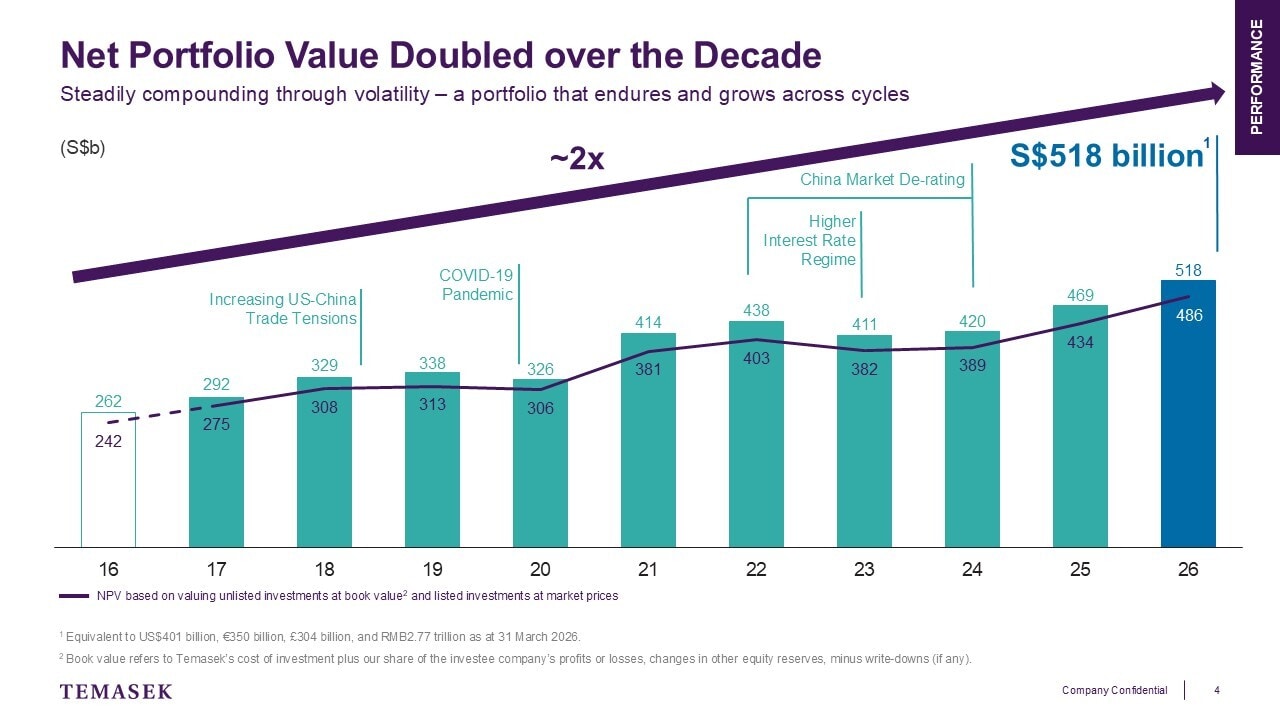
QUESTION: This is the first time that Temasek's net portfolio value has crossed US$400 billion and S$500 billion. Would you consider this a milestone and what does it mean? One would think that, with such a large base of capital now, compounding can really accelerate over the long term. How else would you mark the trajectory you are on, given this performance?

ROHIT SIPAHIMALANI: S$500 billion isn't just a number. More importantly, it is about the doubling of our portfolio over the last 10 years. This was achieved in an environment that has been very volatile, particularly for a portfolio that's historically been very Asia-focused and only became more global in the last 10 years. 

We are happy that we have doubled our portfolio value over the last decade, but the resilience of our portfolio is more important. Every time there have been shocks, the portfolio has been impacted, but it has bounced back quite quickly. 

That is what's important for us – to have good, sustainable returns, which can only come from having a high-quality, resilient portfolio. With a resilient, high-quality portfolio, we should be able to continue compounding from the current base that we have.

Question on Performance – On Peer Comparisons

QUESTION: There was a story by the Financial Times last year that quoted sovereign wealth fund (SWF) rankings for Temasek and GIC, and mentioned that they were at the bottom of the rankings. Does Temasek have any comments on how these ranking systems are put together, and how people should approach the rankings?

PNG CHIN YEE: The way we think about it is that we want to construct a resilient portfolio that can ride through different market cycles and perform well from a returns perspective. We are focused on delivering what we set out to deliver, rather than comparing ourselves to other SWFs. That said, I would say this year's performance would probably be comparable to other peers’ outcomes.

ROHIT SIPAHIMALANI: If you think about it from a longer-term perspective, our 10-year and 20-year returns in USD, which is how you would compare with other peers, have been 7.5% and 8% respectively. We think, for a portfolio of our scale, this is quite credible. We do not have direct peers, but despite that, I would say it is a credible performance.

CHIA SONG HWEE: The mandates of each of us are different, and that has to be taken into account. The mix of the portfolio is also different. Some are purely public, with no private investments. We have a mixture of both. It is not easy to have a top-level comparison.

More importantly, our performance is relative to our own mandate: are we delivering the level of returns that our shareholder expects us to deliver? We have often articulated that our job is to invest and generate long-term sustainable returns, and returns that are resilient. The word "resilient" is extremely important.

How do we judge whether our portfolio is resilient? You have to look through history to see how many shocks we were able to withstand. While we cannot avoid drawdowns, the question is what happened after a drawdown, whether we were able to come back up again, and whether we can continue to grow from there. That is even more important when you look at whether the portfolio is delivering returns.

Our reporting periods and currencies are also different. There are many factors, so it is really hard to compare.

Question on Performance – Portfolio Segments

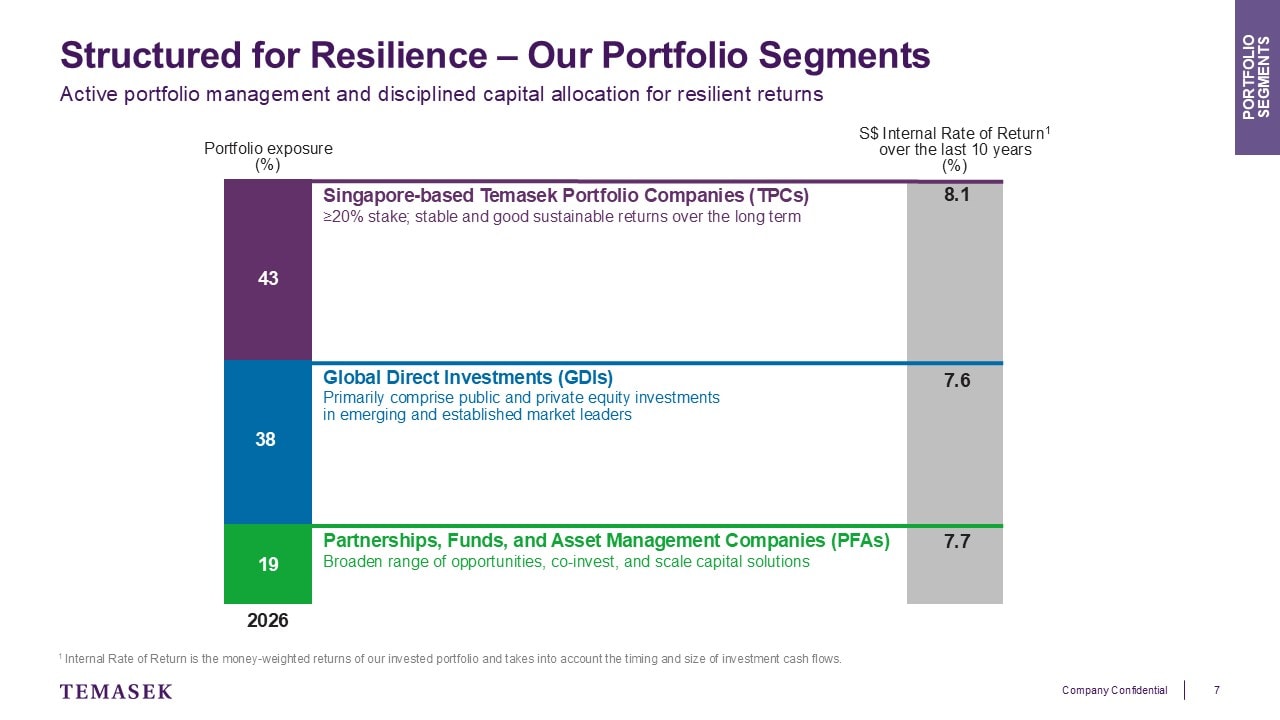
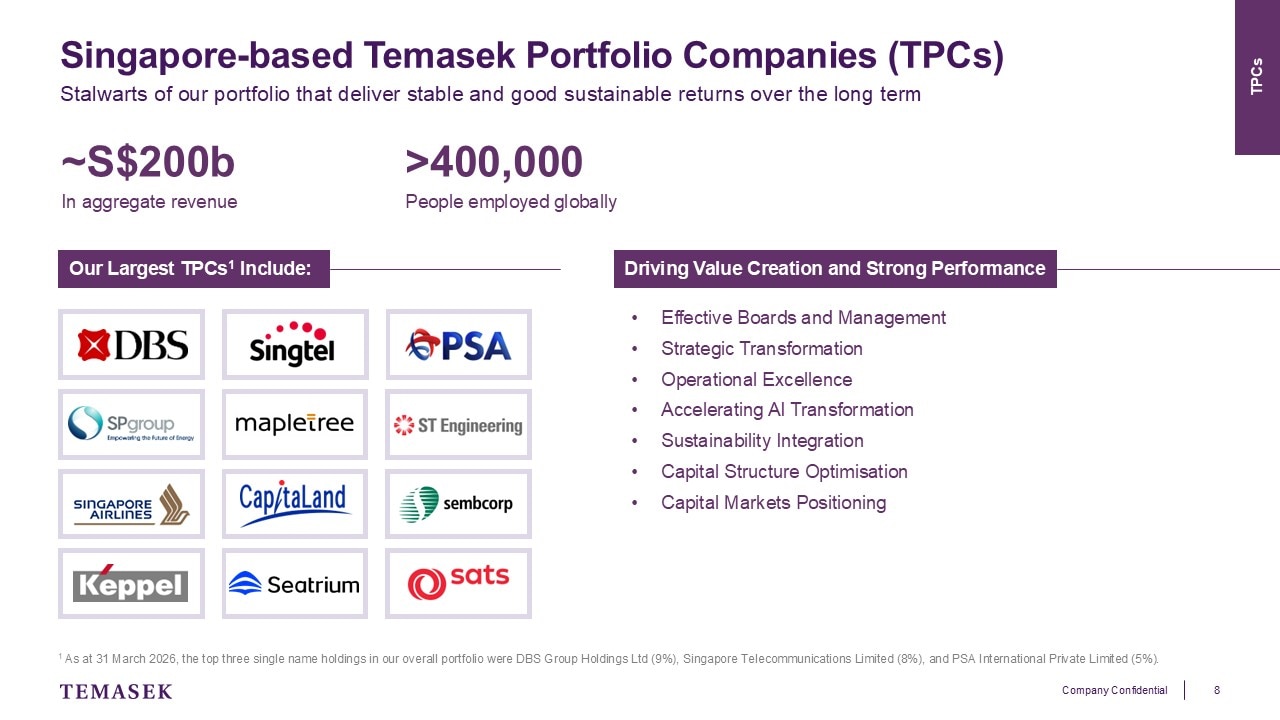
QUESTION: The Singapore-based Temasek Portfolio Companies’ (TPCs) Internal Rate of Return (IRR) is higher than the other two segments. How much of this is attributable to the restructuring of the Singapore entities you've done over the past few years? Is the heavy lifting of the Singapore TPCs restructuring work largely completed? 

PNG CHIN YEE: The Singapore TPCs have done quite well in the last few years. This comes on the back of more active engagement across a number of initiatives, including strategic transactions and restructuring. The boards and management teams of the TPCs have also done quite well and delivered in the last few years in terms of the operating performance. For example, DBS, ST Engineering are listed companies and you can see from their stock price performance the underlying strength of the businesses and how they have performed in the market. 

We will continue to actively engage with our TPCs. It is a continual process. In particular, one of our key initiatives will be around AI adoption and AI transformation, and how our TPCs use that to be competitive globally. So, these are the engagements that we will continue to have with our TPCs. 

QUESTION: Why are the IRRs of the three segments so similar and why are they not more distinct? I would have thought that the IRR for GDI would be higher. Do you expect these IRRs to diverge over time?

ROHIT SIPAHIMALANI: The similarity in the 10-year numbers is coincidental. Over different periods within the 10 years, there would have been variations, as each portfolio segment plays a distinct role in our overall portfolio construction. For example, the GDI segment is more growth-oriented, and in a rising interest rate environment, we would generally expect some of the TPCs to perform better. Conversely, in a lower interest rate environment, certain high-growth companies within GDI may perform more strongly.

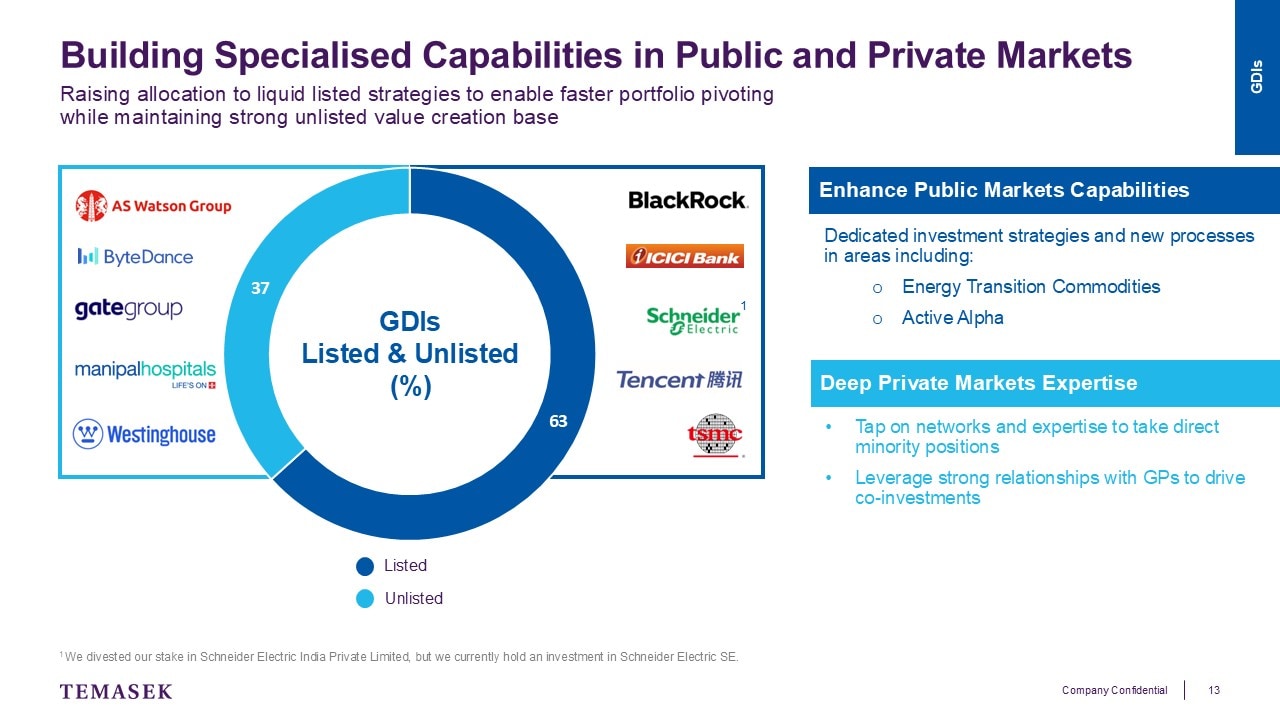
On the point about private versus public exposure, it is worth noting that more than 60% of our GDI portfolio is invested in public, rather than private assets. This contributes to the overall liquidity of the portfolio from a portfolio construction perspective.

Each segment has different characteristics, and together, they help us build a more resilient portfolio. Over time, we would expect shifts in terms of the performance. However, the objective is for the portfolio, as a whole, to continue delivering resilient long-term returns and, importantly, to absorb shocks effectively. 

CHIA SONG HWEE: I would add that the GDI portfolio has, and should have, a higher risk-return profile. The fact that the IRRs are similar is coincidental, as the underlying assets and exposure across the two groups are quite different. 

This can be seen in the volatility that the GDI portfolio has experienced over the past 10 years. More recently, for example, the portfolio was affected by headwinds in China’s capital markets, which lasted from 2021 to 2024, as well as the impact of the war in the Middle East. These developments have had a different impact on the GDI portfolio, as compared to the impact on the TPCs. 

Question on Temasek’s Refreshed Structure

QUESTION: Temasek has gone through a restructuring amid what Dilhan has described as the most complex environment in five decades. Could you share more about the specific strategies for each of the three portfolio segments?

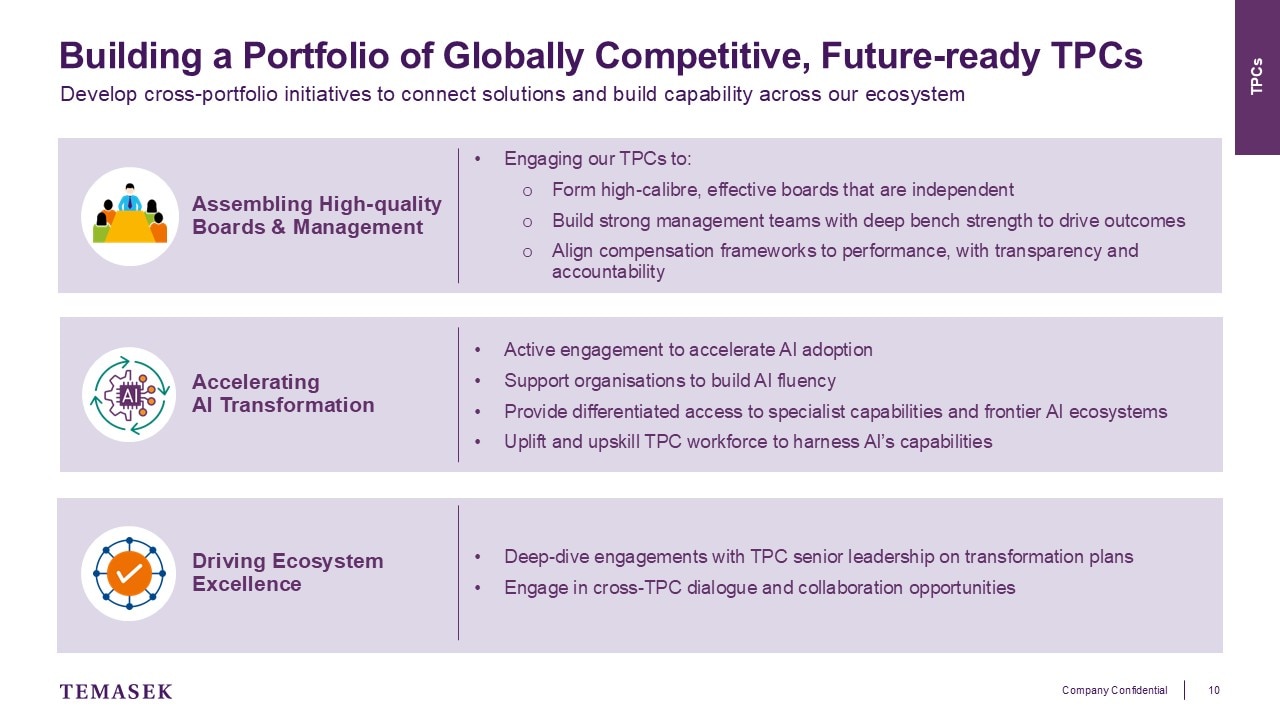
PNG CHIN YEE: For Temasek Singapore (TSG), our aim is to build a portfolio of globally competitive and future-ready companies with strong roots in Singapore. We do that through two key levers.

First and foremost, it is important that we have strong boards and management in our Temasek Portfolio Companies (TPCs). We actively engage our TPCs to scout for talent to ensure that their boards and management teams have the requisite breadth and depth. We also work with management teams on issues such as strategic business transformation, whether it is on operational excellence or AI transformation. This would involve things like making sure they are cyber-ready and that they incorporate sustainability into their thinking and practices.

Second is on AI; we want to ensure that the workforce is ready, upskilled and reskilled for the new roles and opportunities ahead. We work quite comprehensively with our TPCs’ boards and management teams to help them become more future-ready and create long-term value for us all.

These are some of the areas in which we work very actively with our TPCs. This is not new following our restructuring. We have been doing this for several years, and our engagement has intensified over time. TSG allows us to give a lot more focus to some of these broader issues.

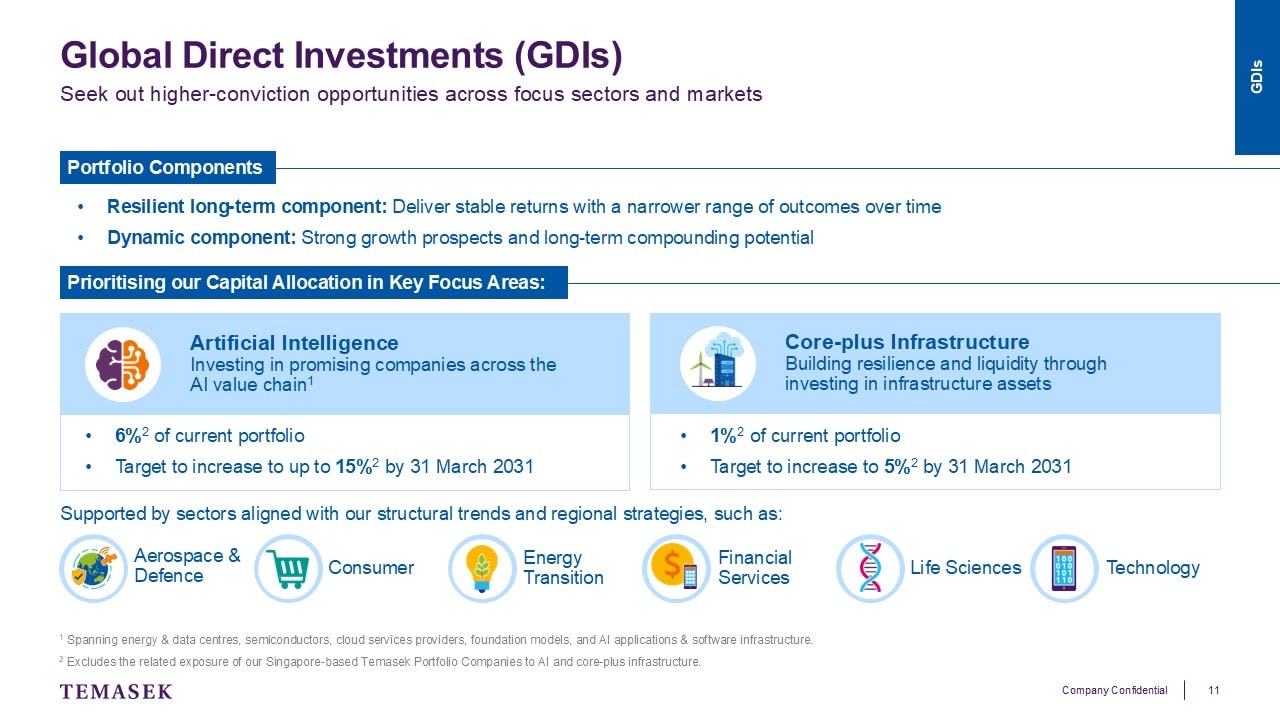
NAGI HAMIYEH: For Temasek Global Investments (TGI), there is not much change in strategy, except that it is now much more focused, and we want to go deeper. The strategy remains to invest globally in emerging and established market champions, guided by our structural trends. We also have the option to invest in the public space. This complements our investments in the private market, which have been part of our DNA for many years, where we seek to create value post-investment. We have the opportunity to take minority stakes, as well as to co-control positions in very select opportunities.

We are focusing on larger tickets, so that we do fewer deals, build deeper domain knowledge, and focus much more in a granular way on a handful of sectors, rather than taking a more horizontal approach. In terms of sectors, besides AI and core-plus infrastructure, defence has become an important sector, given what’s happening with defence spending and deterrence. This is not an area we have historically invested in. The consumer space is also one of the core sectors we invest in, particularly in India and Europe. Energy transition, which is part of core-plus infrastructure, financial services, non-banks and more asset-light business models all remain very relevant to our strategy. 

In every sector we invest in, we focus on fewer areas and go much deeper, either with partners or as strong minorities with a seat at the table and strong governance rights.

ALPIN MEHTA: The purpose of Temasek Partnership Solutions (TPS) is to strengthen Temasek's alternative assets portfolio by leveraging our strategic relationships, accessing curated deal flow with our General Partners (GPs), and building our assets under management (AUM) business. 

The other element of TPS is to enable an ecosystem where we, alongside our GPs, can work with TGI to share market intel and large deal flow with our TGI colleagues. We also work with TSG to bring our GPs to our portfolio companies, and vice versa, to create areas of collaboration.

If you think about TPS as a business, there are three large elements: our private equity business, private credit business, and then our asset management companies (AMCs). I can touch upon the first two in terms of our strategy.

In our private equity business, our strategy is to offer comprehensive capital solutions to our GPs. This includes investing in their funds as a Limited Partner (LP), making larger co-investments with them on both a syndicated and co-underwritten basis, and offering them secondary solutions. Given that we also have our credit and hybrid business, we can offer them financing solutions. A large part of our purpose is to build strategic relationships with our GPs, seed new businesses with them, buy into their GP stakes, and be part of their growth. 

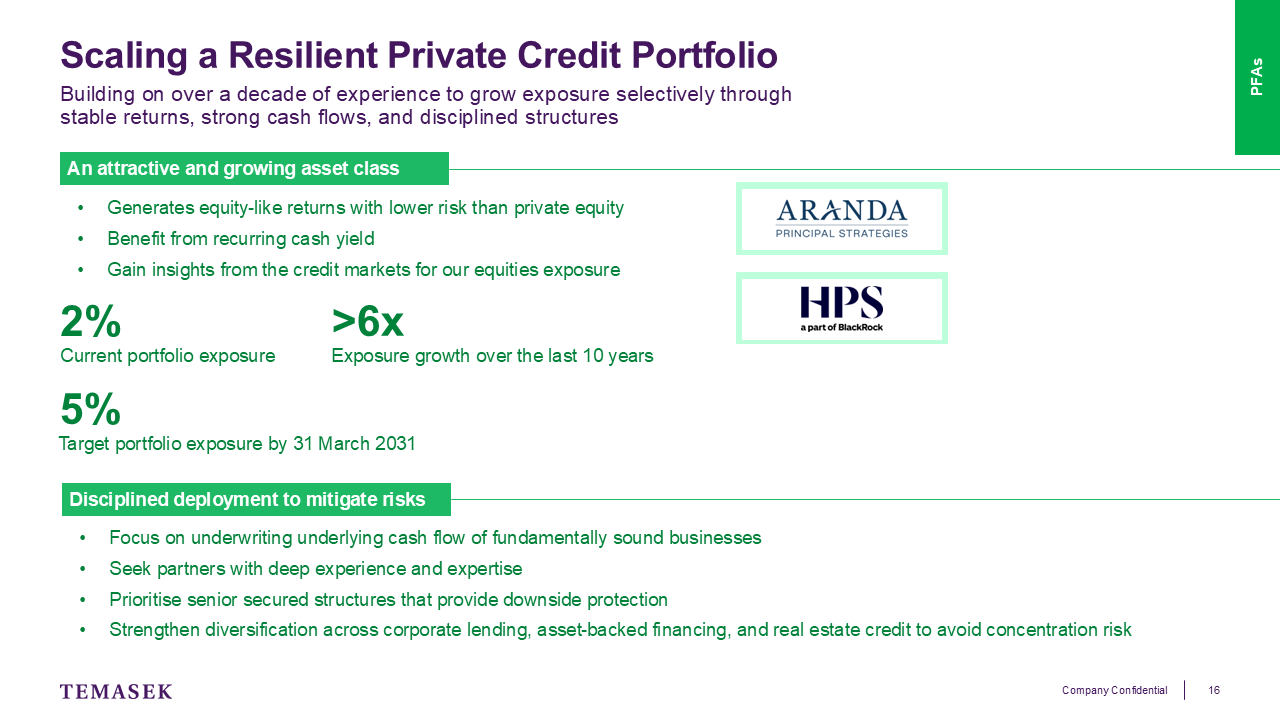
On private credit, this is a very important part of our portfolio because it provides greater diversification and resilience to our earnings. Our focus is to build a portfolio that is diversified across sectors and markets, including corporate lending, asset-backed financing, and real estate financing. What we like about private credit is that it offers us very attractive risk-adjusted returns, with significant downside protection and equity subordination. A large part of our income in that strategy also comes from cash income, which allows us to de-risk and hence provide more resilience to our portfolio. 

That is our approach on the private credit side. Today, private credit is about 2% of our portfolio and we aim to grow that to 5% of our portfolio by 2031.

GABRIEL LIM: I'll speak on behalf of Seviora Group, which is on the asset management side. Seviora is the main Asset Management Platform of Temasek. As an asset management platform, we manage other parties' assets. When people or institutions put their money with us, it's somebody's savings, a university's endowment, or part of a country's national reserve. Fundamentally, we are in the business of trust. We are trusted with delivering performance and returns, and to manage clients as a fiduciary.

As we think about what's next for Seviora, we want to deepen that in three ways.

The first is really strengthening the strategies where we believe we have a comparative advantage, and which have performed well from a returns perspective. We are also differentiated partly because of our partnership with Temasek and the broader ecosystem. One good example is Astrea, a product we have had in the market for some time, where we have taken Temasek's primary equity portfolio and restructured it into an investment-grade bond for retail shareholders. I am simplifying, but it has been running for more than 10 years now, and we continue to want to build on that.

The second is expanding the Seviora platform itself. Earlier this year, we welcomed Pavilion Capital into the Group. This has strengthened our Asia fund-of-funds business and our network of General Partner relationships, primarily in Asia. Arising from that, we believe we have a broader portfolio of relationships and products that we can offer to our investors and clients.

The third is growing partnerships in new markets. We set up a Middle East office last year. We have signed high-quality partnerships and Memoranda of Understanding (MOUs), most recently with Samsung Securities in Korea. We just concluded a joint CFO — a collateralised fund obligation — with Churchill Asset Management, which is a US private capital subsidiary of Nuveen. It is the first time we have done so. This is another example of how we are building out the platform, going international, and ultimately strengthening our ability to serve as a good fiduciary for our clients and investors.


Question on Portfolio – Temasek Portfolio Companies (TPCs)

QUESTION: My question is on the domestic portfolio companies. They have done well – congratulations! Is Temasek happy with the dividends they have paid out, or would you prefer to see higher dividends?

PNG CHIN YEE: On dividends, we are a receiver in that respect. The boards and management teams decide what is the right level of dividends to give to shareholders. They determine their dividend policy. 

As the boards and management teams of our TPCs think about their dividend policies, it is important for them to consider the growth opportunities in their businesses that they may want to fund, whether they should retain capital for that purpose, or whether they should return excess capital to shareholders. They have been in a fortunate position where they do have excess capital to distribute to shareholders.

From Temasek’s perspective, we are very happy to support companies that want to retain capital for growth, if they can put the capital to good use and generate a return that will reward shareholders. We are very open to that as well.

Question on Portfolio – Global Direct Investments (GDIs)

QUESTION: For GDIs, there was a mention of a two-thirds to one-third ratio between listed and unlisted investments. Is there an ideal allocation that Temasek has in mind, or is the aim to maintain that to two-thirds and one-third split?

NAGI HAMIYEH: Liquidity is very important, and being able to deploy in an agile manner in a complex world is also very important. But everything is driven by where we see better opportunities. 

So, we are not fixated on the ratio. We go through phases where we see more value in the private space, and we invest more there. At other times, we see a better reflection of our goals and objectives in the public space, and we invest there. 

As long as we remain nimble and able to deploy in both public and private markets, that is the guideline for us.

Question on Portfolio – Partnerships, Funds, and Asset Management Companies (PFAs)

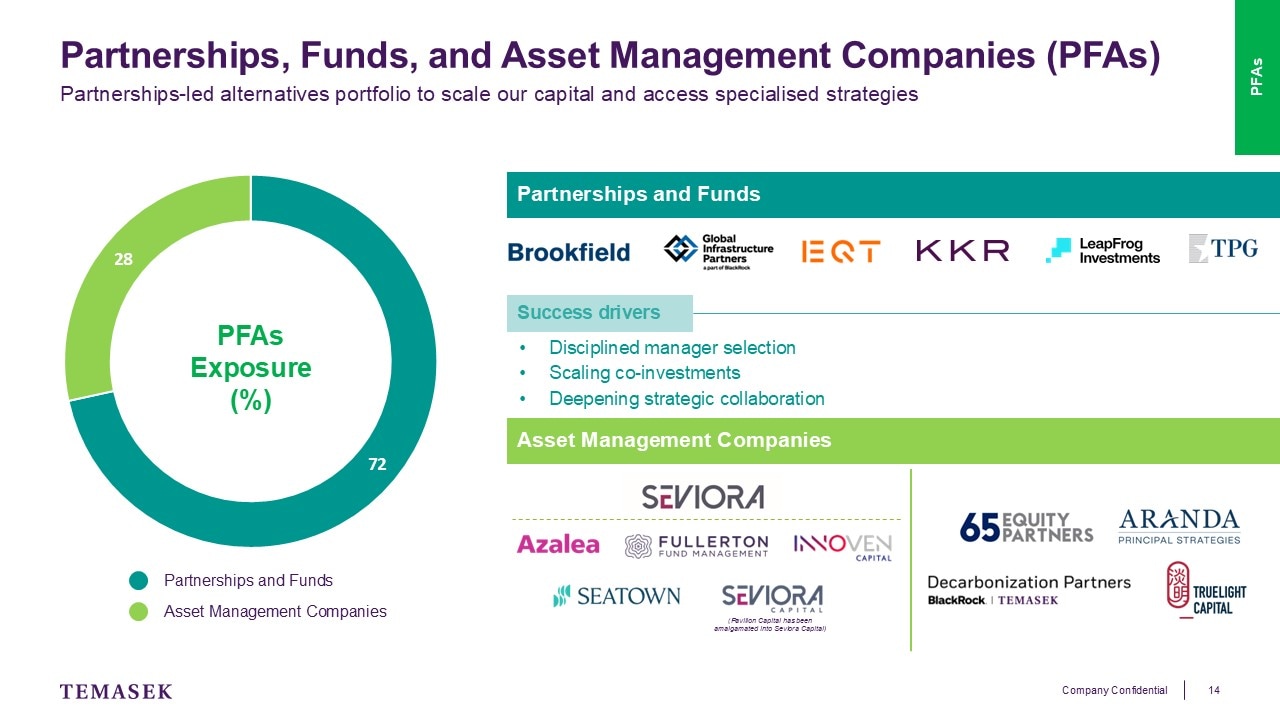
QUESTION: Right now, Temasek's PFAs exposure is 28% in Partnerships and Funds, and 72% in Asset Management Companies. With the changes made around Seviora last year, and as Seviora and the asset management companies grow, can we expect the Partnerships and Funds portion to reduce over the years?

GABRIEL LIM: We definitely want to grow the Seviora platform, so we would like the absolute amount to grow over time. Ultimately, the relative proportions within PFAs will also depend on the growth of Temasek's capital deployed into the global General Partners (GPs) and corporate partners, as well as the size of the overall Temasek portfolio in time to come. But certainly, the intent is to grow the platform under Seviora.

ALPIN MEHTA: On private equity, we are more than just a fund investor and are more like a capital solutions provider. Apart from investing as Limited Partners, we have been doing much more with some of our strategic partners, to build up strategic partnerships where we can do larger deals and co-create on the right opportunities with these strategic partners. At times, we bring in our TGI team to underwrite deals alongside our GPs, and we also participate in opportunities where we can ride through the growth of our GPs. 

The secondary opportunity in private equity also has been very great, with the market growing from US$60 billion in 2020 to US$220 billion today, and the market is expected to be US$260 billion by the end of the year. That's growing quite well and we participate in that. We can also offer credit and hybrid solutions to our GPs, and create a lot of synergies between Temasek, Seviora, and some of our other AMCs. So, we are looking to expand that and deploy more capital on the private equity side as well. 

Question on Portfolio – Liquidity

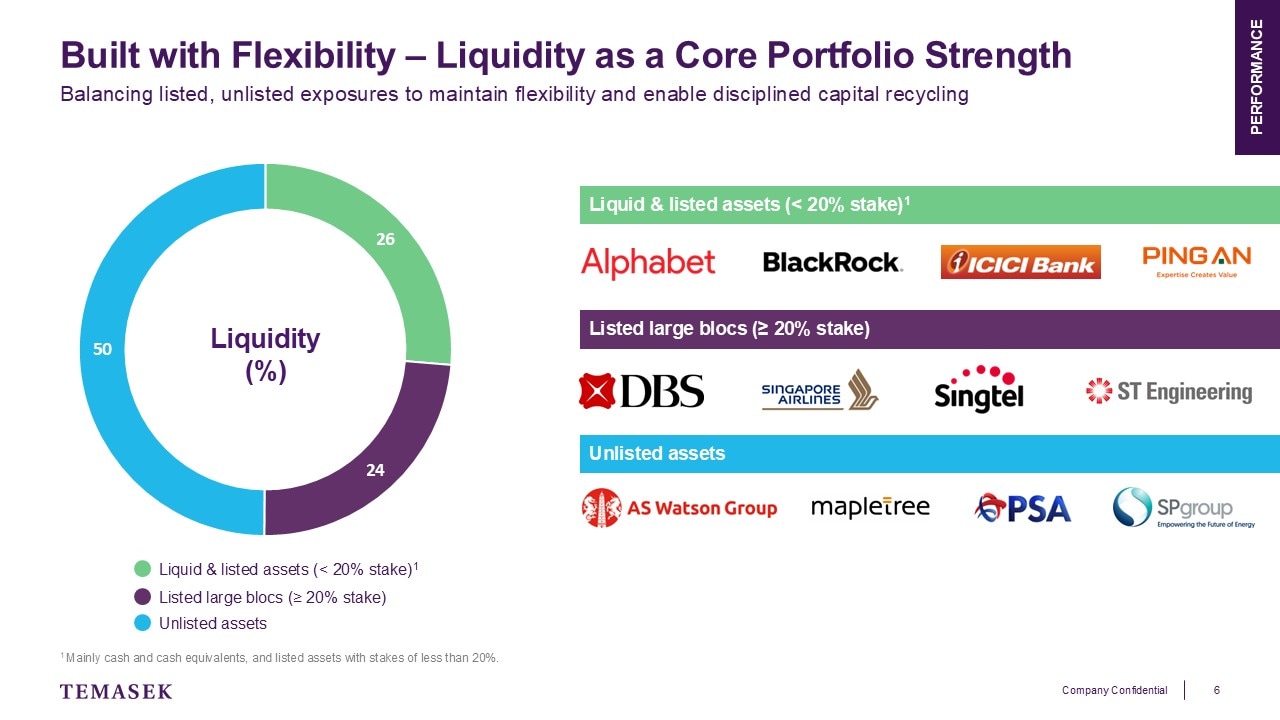
QUESTION: On the liquidity, with about 25% of the portfolio in liquid and listed assets, is that new for Temasek, or has this been ongoing? 

PNG CHIN YEE: This is not new, and it is something we have always considered within our portfolio construction. We have always maintained a very liquid portfolio – about half of our portfolio has been liquid, although at times it may be a bit more or less. What we are emphasising is that, in today’s environment, it is even more important for us to have liquidity in our portfolio. But this has always been part of our portfolio construction.

NAGI HAMIYEH: When you look at how we split the listed assets, 24% out of the 50% are TPCs, which we are not going to sell. So we are really talking about the remaining 26% as being truly liquid.

In this complex environment, when we need to re-pivot the portfolio towards the trends we see and where we want to double down, this 26% portion becomes very, very critical for us.

Question on Portfolio – Changes in Sector Exposure

QUESTION: As part of your sharpened focus, which sectors will Temasek be moderating exposure to? If you're going to increase your AI exposure to up to 15%, which sectors will you be scaling back on?

CHIA SONG HWEE: AI is part of the digitisation trend we have been investing in, so it is a continuation of that. Another way to look at it is that our portfolio exposure to Telecommunications, Media and Technology (TMT) is 23% of our total portfolio, and AI is a subset of that 23%. As time goes by, the AI component will likely become a larger part of that 23%.

PNG CHIN YEE: It is not unlike the journey that [our investments in] financial services have taken. Financial services remain one of our largest sectors, but within it, the composition of the portfolio has shifted over time. In the early days, around 2011 or 2012, most of that exposure was in banks. Today, banks make up about half of it, with the other half in insurance, payment services, and so on.

Similarly, if you look at our TMT exposure — which stands at 23% — an increasing part of that would probably be driven by AI going forward.

CHIA SONG HWEE: Around the same time period that Chin Yee mentioned, in the early 2010s, telecommunications made up 95% of TMT. Today, that is no longer the case. You would expect the technology component to increase over time.

The portfolio is less static than it appears. Although the sector classification may be the same, the underlying has shifted and will continue to shift over time.

Question on Seviora – Strategy

QUESTION: My understanding is that if Seviora wants to build up assets under management (AUM), size matters. With US$75 billion today, it might be quite tough to scale up. How are you going to be competitive, both in Asia and globally? How do you intend to grow AUM?

GABRIEL LIM: AUM is definitely an important consideration, but arguably even more important is performance. When you deliver good performance, you create or accelerate the flywheel for attracting capital, because investors who place money with you are going to receive good returns.

We are definitely focused on scale, but we are also very focused on performance, and both go hand in hand.

QUESTION: I understand that there is a strategic review of the asset management companies under Seviora. When is it expected to be completed and shared?

GABRIEL LIM: The strategic review is ongoing. We will release the details as and when updates are available.

Question on Investment Stance

QUESTION: On the Middle East, there was a 2% NPV drawdown in March. I assume this was unexpected, but how would Temasek position its portfolio going forward, given the increase in geopolitical events? Do you think this kind of drawdown could happen again?

ROHIT SIPAHIMALANI: We are in an extremely VUCA world, so we will continue to see shocks arising from geopolitics, AI, climate change, inflation. If you react to every shock, you will get a whipsaw effect. The only way to address this is by having a resilient portfolio.

We are achieving that in a number of different ways. First, to address geopolitics, we need some geographic diversification, but more importantly, we focus on businesses that have access to large domestic markets and are relatively self-contained in terms of technology and supply chains within one geoeconomic sphere of influence. For example, in India we are investing in healthcare services, while in China, we are investing in domestic consumer brands. These are areas that are likely to be less impacted by geopolitics. 

Secondly, on AI, we want to benefit from AI opportunities. We have talked about how we are significantly more than doubling our exposure to AI over the next five years. The other part of that is AI disruption, as we know businesses will be disrupted. One way to address this is to look at it business by business, and have a greater focus on asset-oriented businesses, such as core-plus infrastructure, commodities, and equities – sectors that are likely less disrupted by AI.

The biggest way we try and address these shocks is through liquidity. Looking at the Middle East shocks, the main manifestation was through energy prices. Whether this was going to last a few months or a year, in the long run, we do not think oil prices would remain elevated forever. So, you need to be liquid enough to ensure that, if you are going through that down cycle, you can not only protect your portfolio companies but also take advantage of opportunities that arise.

Portfolio liquidity is one of the key ways we navigate these shocks, which is why we try to keep 25% of our portfolio in globally liquid securities. One reason is to take advantage of opportunities, but it is also to be more resilient during these shocks. Ultimately, portfolio construction is the only way to equip ourselves for the various uncertainties we see today.

PNG CHIN YEE: The direct impact on our portfolio was actually very limited. It was mainly a second-order impact and part of the general market sell-down.

As Rohit said, the most important thing is to build a resilient portfolio that can rebound after such events. In fact, we have seen our portfolio rebound in line with the markets post-event.

Whenever you look at performance over a specific time period, whether one-year or 10-years, there is always a particular date that can make things appear a little counterintuitive. So, we look at performance over very long-term periods, and we make sure that the portfolio is constructed to be resilient and able to rebound from these one-off events.

Question on Global Outlook

QUESTION: Can you talk a bit more about the global outlook? You are seeing opportunities across different areas, but given the complexities, how will that translate into investments going forward? Do you expect to deploy capital at the same pace as before, or are you taking some money off the table?

ROHIT SIPAHIMALANI: One of the things we have been very encouraged by is the strong growth and earnings we have seen, not just in the US, but across all markets.

The growth is driven by capital expenditure (capex). Yes, AI capex is a big part of it, but there is also capex around defence, energy security, electrification, and many other areas. When there is such strong capex momentum, it drives a lot of growth. Looking at this year, market returns have been earnings-driven. In fact, multiples today are lower than they were at the beginning of the year.

We recognise that this capex momentum cannot go on forever. At some point, there will be some tapering off. But at least in the near future, we do not see anything that would pull it back in a meaningful way. AI is a major theme, and we are investing significantly alongside that. But we also recognise that there are many risks in the environment, and we are trying to balance that by ensuring we have resilience in the portfolio.

Overall, I would say the growth outlook remains positive. Potential headwinds include inflation — we think it will continue to slow from here, but we could be wrong. We will probably see periods of volatility, but the general trend across the ecosystem remains constructive.

NAGI HAMIYEH: As Rohit said, it is a complex environment. The key is to remain disciplined, adaptable, and nimble when needed. We do not take this constructive backdrop for granted, and we will continue to adjust the portfolio as we go along.

We have a big chunk of the portfolio in the public markets, and we have added more complementary skills to the team, so we will be investing more dynamically in that part of the portfolio. On the private side, we are being selective. We are trying to invest as much as we can in line with the trends we see.

The two most important trends for us now are AI and sustainability, which includes core-plus infrastructure. One offers high growth and high returns, while the other provides a more stable and resilient profile with a narrower set of outcomes that we can underwrite more easily.


Question on Outlook – US

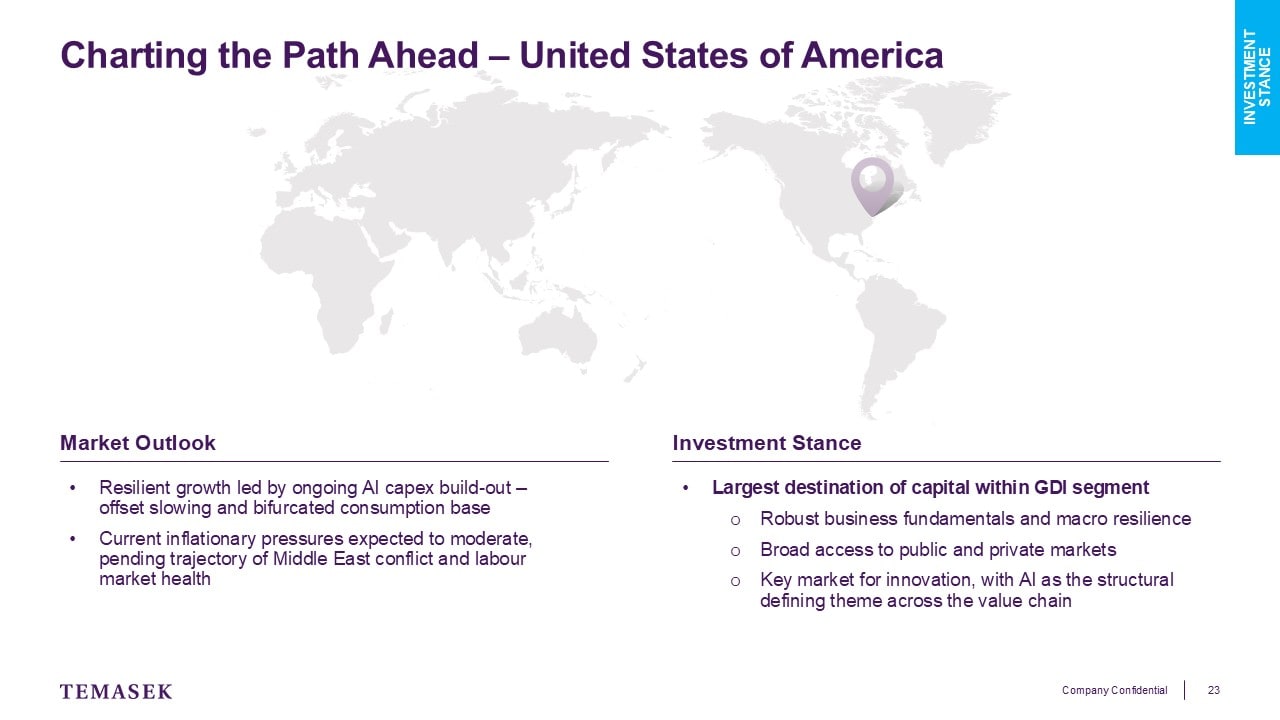
QUESTION: Globally, we are seeing a trend of fund managers and companies diversifying out of the US, whether by raising capital in other currencies or diversifying their investments elsewhere. Is this something you are looking at? In the coming years, can we expect the US to constitute a smaller part of the overall portfolio, with other regions taking up a larger share? If so, which regions are you more interested in focusing on? 

NAGI HAMIYEH: The US is still the largest and deepest market, with the most innovation. So, it is natural for us to invest more in the US than in any other market. However, over the last two years, we have been increasing our exposure outside the US. 

For example, in Europe, we deployed slightly more than €12 billion over the past couple of years because we saw many good opportunities despite the macroenvironment there. Our investments in Europe are in areas such as industrial companies, strong consumer brands, the energy transition and other core-plus infrastructure sectors.

We also continue to invest in Asia, and India is a large market for us. We have deployed quite a bit despite the headwinds we have seen, especially after the war in the Middle East. India remains one of our top-performing markets, and we remain very constructive on it.

ROHIT SIPAHIMALANI: It is important to consider the context of different firms when thinking about why some investors may be seeking to reduce their exposure. We opened our US offices only in 2014, and our exposure to the Americas, compared with most other institutions, is still very low. Given the opportunities we are looking at right now, such as AI, core-plus infrastructure and private credit, these are global opportunities, but they are somewhat more concentrated in the US.

Over the last few years, and today, we have been allocating about 50% of our capital every year to the US. We do not see that changing in the near term. So you would probably see our US exposure inch up a little from where it is right now. We are quite comfortable with that because, on an absolute basis compared with many other institutions, the US is still a modest portion of our total portfolio. 

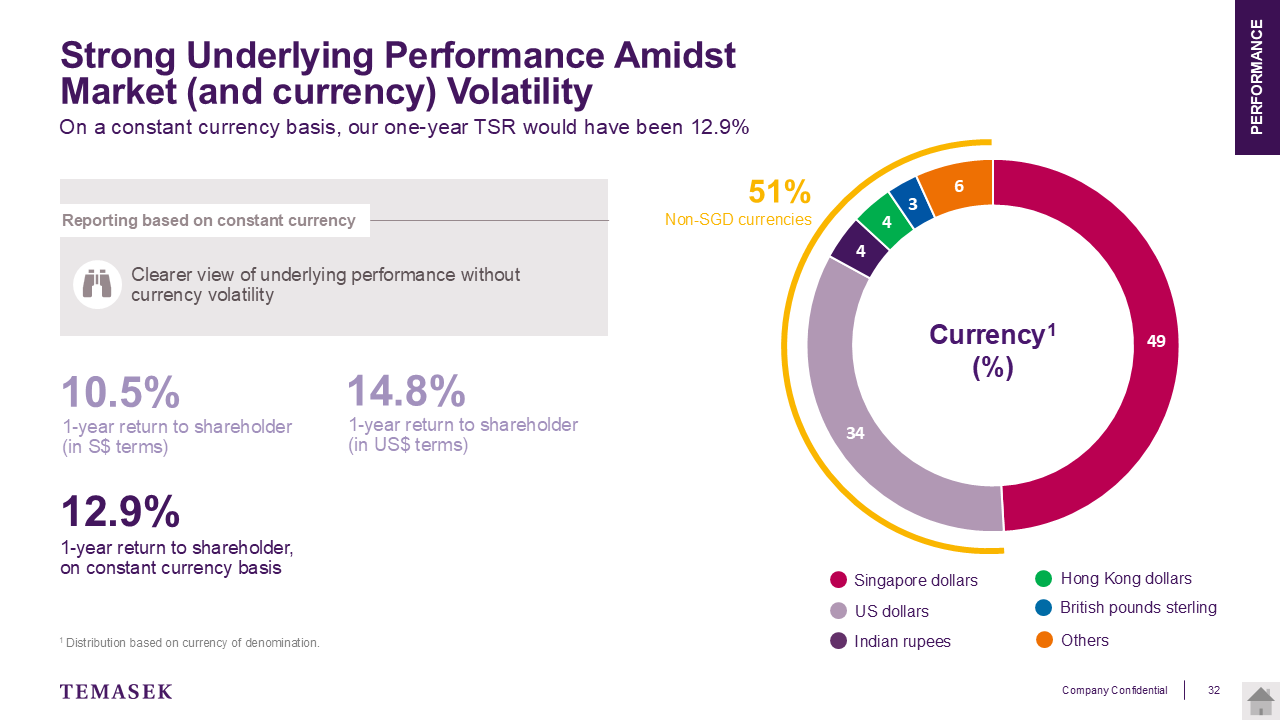
QUESTION: Regarding the de-dollarisation trend, there's been quite a lot of currency fluctuation over the past year. Has this changed your currency hedging strategies, especially as the world moves towards a de-dollarisation phase?

PNG CHIN YEE: You are right to say that we have seen much more foreign exchange (FX) volatility over the last year, and that has been a headwind to our returns.

We do consider FX when we look at capital deployment and when we make investments. We keep it in mind as we think about what our expected returns would look like. 

As a long-term investor, it is difficult to hedge the currency of our investments because, when we invest, we are pretty much taking a view on the currency as well. It is also quite expensive for us to do that consistently.

Last year, we mentioned that we had protected ourselves against a very sharp move in the US dollar. However, it does not make sense for us to do that continually. So the way we think about it is that we actually factor currency movements into our investment decisions.

Question on Outlook – China

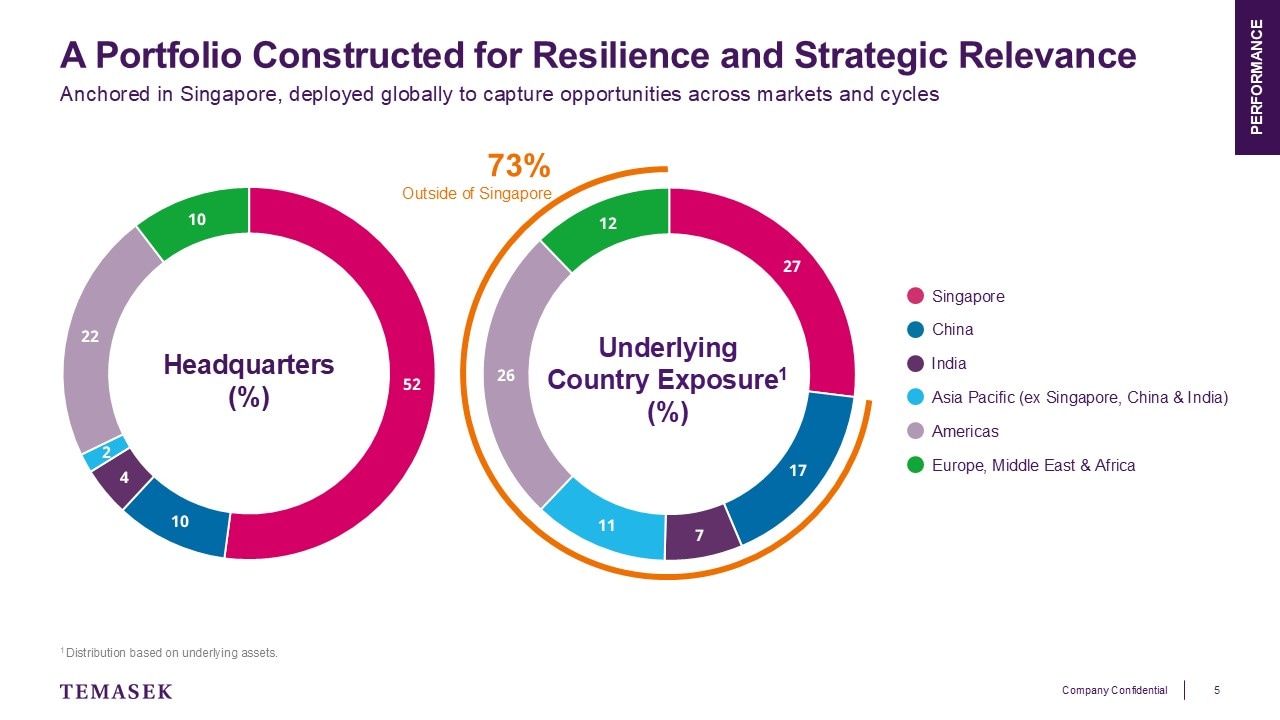
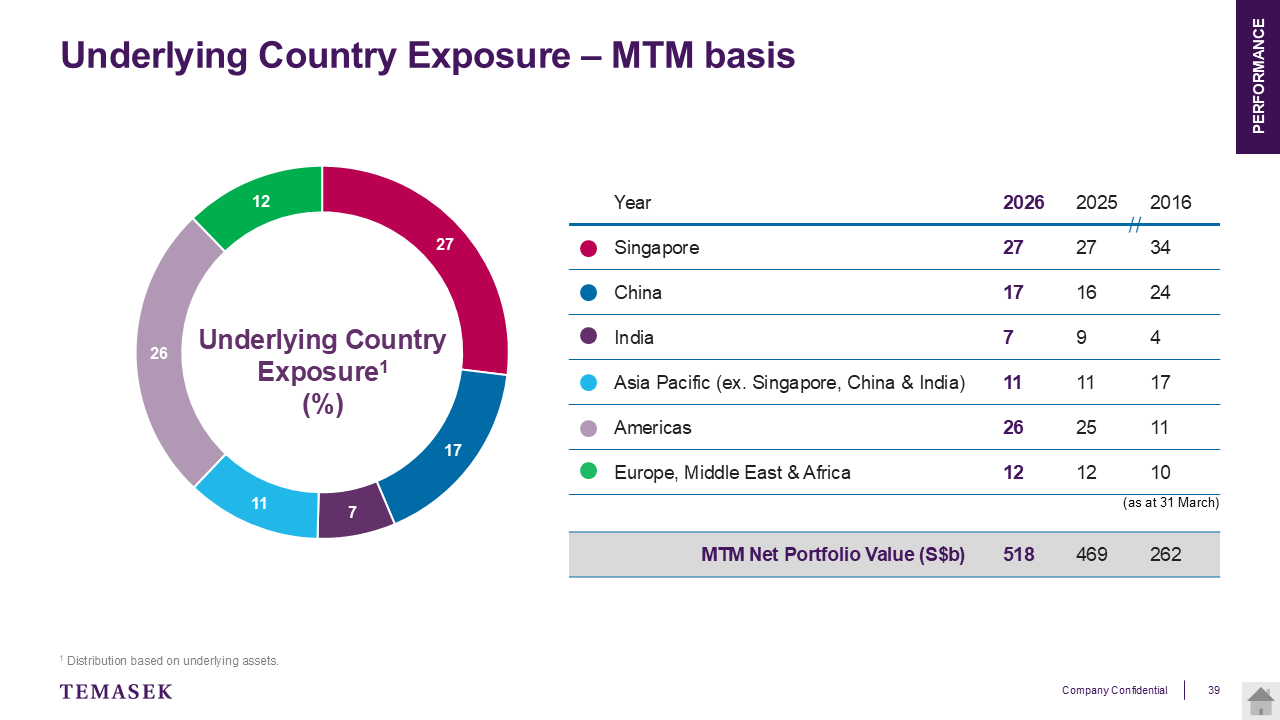
QUESTION: I have a question regarding the China market. We see that the underlying exposure, in terms of percentage, has been falling year on year. You also mentioned that, in value terms, your portfolio has grown by S$10 billion over the past year. Moving forward, what is the outlook for the China market? Do you expect the China portfolio, as a percentage of the overall portfolio, to continue to fall?

CHIA SONG HWEE: We believe China’s economy is moving into the next regime, from one of very high growth to a maturing economy, and you can expect a more mature growth rate. This is not new for China, as it has gone through different phases of economic development. What we need to do is to evolve our portfolio accordingly.

China remains a very competitive market, not just in exports but also in terms of technological advancement, innovation, the renewable energy transition, and the progress it has made in these areas.

On AI, there are many companies supporting the industry across different parts of the value chain. For example, China is very strong in optical transceivers and optical connectors, which are essential for data centres. That is a very strong part of their capabilities. 

There is also a shift in consumer spending. We all know that the aggregate growth in consumption is low, but within that, we are seeing different types of consumption patterns. For example, people are buying fewer physical items and spending more on experiences. Consumers are also gravitating towards local brands rather than foreign brands, although there are exceptions. This is the trend to which we are seeking exposure.

We also see potential in consumer-related companies that are growing overseas, such as Insta360 and Luckin Coffee. They are growing their presence outside China and these are promising opportunities for us to invest in.

PNG CHIN YEE: Taking a step back, looking from 2016 to 2026, it may appear as though our China exposure has come down. In fact, over this 10-year horizon, our China exposure has increased by about S$24 billion. The reason for the fall in percentage terms is also that, in 2014, we opened offices in London and New York, and those exposures have grown over time, as the US and Europe have been key markets for us over the last decade.

Looking at China in conjunction with the overall portfolio shifts, we moved from being a very Asian-focused investor to a much more global investor, based on the opportunities we saw in the US and Europe.

NAGI HAMIYEH: China is a leader in robotics. This is an area that will play a very important role in the physical world of AI. If you look at the advancements China has made in biotech, this is an area we have been interested in for some time, and we continue to be very constructive.

Question on Seviora – China

QUESTION: There was a Reuters report last year about Fullerton Fund Management downsizing its private fund operations in China. In terms of this approach towards China, could you share more detail on how Temasek is approaching talent recruitment and investment?

GABRIEL LIM: Fullerton Fund Management, which is one of the asset management platforms under Seviora, continues to remain in China. More broadly across the Seviora Group, whether it's Fullerton Fund Management or other platforms, we continue to look at ways to invest in China.

InnoVen Capital, another platform company, has a presence in China, in venture debt. We continue to invest in that space and grow that platform. We continue to look for ways to invest in China. As China’s economic structure and its drivers for growth evolve, we evolve alongside the economy as well.

PNG CHIN YEE: From Temasek’s perspective, our China portfolio has evolved. In the early days, it was very much focused on financial services. We then moved into consumer and internet, and subsequently into biotech. 

Our team has been very stable in the market for many years. They have deep relationships and strong networks, and have done well for us in China.

Question on Outlook – India

QUESTION: This year's portfolio exposure to India has fallen. Could you explain the reason behind this and share your thoughts on the India market?

ROHIT SIPAHIMALANI: India is a very important market for us and has been our best performing market over the last decade. The decrease in our underlying India portfolio exposure last year was mostly due to one very large divestment of Schneider Electric India. This was one of the best investments that we made in terms of size. That sale reduced our exposure to India.

We continue to make new investments. Last year, we made a sizable investment in Haldiram, a snacks food company. There are also other areas in healthcare, financial services and renewables where we have been investing in the country. So, we are investing quite actively in India and it remains an important market for us.

The decline this year was due to a significant divestment, which was also a very profitable divestment for us.

LENA GOH: Over the decade, our portfolio exposure to India has grown from 4% in 2016 to 7% in 2026, while the absolute portfolio value grew threefold.

Question on Outlook – Indonesia

QUESTION: My question is about Indonesia, about the volatility we have seen in the market and the Morgan Stanley Capital International (MSCI) downgrade. Does Temasek have any worries about what is happening in the country? Could we see a repeat of 1998? What exposure do you have in terms of Temasek Portfolio Companies (TPCs) and other portfolio companies?

ROHIT SIPAHIMALANI: We are nowhere close to 1998; that was a very different world. Looking at Indonesia today, such as its macro credentials and leverage amongst other things, there is no comparison to 1998. Yes, Indonesia is going through a rough patch right now, particularly with the whole MSCI issue, but it is also obvious that the Indonesia Stock Exchange is working to address these issues.

Obviously, we are also impacted by the Middle East crisis, the energy crisis and other developments, which have impacted many Southeast Asian countries. So, there have been a few different factors at play. But for us, we look at countries and markets from a longer-term perspective. Our TPCs have been invested in these markets for decades, and their businesses continue to do quite well there. They also continue to look for more opportunities.

So, I do not think this has fundamentally changed how we look at the market over the longer term, despite the challenges we have faced recently.

Question on Outlook – Japan

QUESTION: Could you tell us more about your investment portfolio in Japan, as well as your areas of interest in the country?

ROHIT SIPAHIMALANI: Japan is a market we have been looking at closely over the last few years, and we have been quite encouraged by the developments there. We have been increasing our exposure, which today stands at around S$7 billion. It is an area where we are looking to increase our investments further.

We do not have a direct on-the-ground presence, so our exposure has primarily been through the public markets, as well as through working with our private equity partners on private deals and co-investments. We have been encouraged by the corporate governance reforms underway in Japan, as well as the growth of companies in the AI ecosystem and the broader economy.

Overall, it is a part of the portfolio that we are keen to expand. Seviora has traditionally been quite focused in Japan, and we have allocated capital through Pavilion Capital to invest in Japanese mid-market private equity funds.

ALPIN MEHTA: Activity in Japan's private equity market has been very strong, driven in large part by the ongoing corporate governance reforms. We have seen improved governance standards, a greater focus on shareholder returns, and more efficient balance sheet management. As a result, private equity firms have been very active in the market.

We see particularly attractive opportunities in the middle-market private equity segment, where competition is lower and valuations are better. We have been investing actively in this space, including through co-investments alongside our private equity partners.

Pavilion Capital has a strong track record and long-standing presence in this segment, and as Rohit mentioned, we invest with them in Japan.

GABRIEL LIM: To affirm the points Rohit and Alpin made, Pavilion Capital joined Seviora a couple of months ago, and we are happy to have them on board. They have a long history of investing in Japan, having worked with Japanese General Partners for over a decade.

Within Seviora, we have also been very privileged to have some very important Japanese Limited Partners, such as Bank of Japan and Norinchukin Bank, who have invested in our funds and been with us for some time. We are very grateful for those relationships.

Overall, we are excited about the opportunities in Japan, and we would like to do more there as we continue to study the market.

Question on Investments – Middle East

QUESTION: On the Middle East, with 12% exposure to Europe, Middle East and Africa (EMEA), what are some of the specific impacts from the Middle East crisis that we have seen, apart from the public markets? Were there any write downs on specific investments?

For Seviora, which opened its Abu Dhabi office last year, what were some of the moves made in the region, and were there any strategic shifts this year?

NAGI HAMIYEH: Out of the 12%, we have very little direct exposure to the Middle East today. We have invested in a couple of funds, but beyond that, the majority of our exposure is in Europe. 

Where Europe has been affected by the Middle East is in energy supply chain disruption. This goes back to the issue of energy security, and the case for the green transition becomes even stronger. Nations will need to balance long-term priorities against short-term needs.

Because of the supply disruption, including issues around the Strait of Hormuz, people are going to focus and double down on energy sovereignty. This would include, among other things, renewables and other utility-scale solutions. 

CHIA SONG HWEE: On the Middle East, we started looking at the market more deeply in the last two to three years. And like Nagi said, our investments started with funds because they have been on the ground much longer. More importantly, we believe the underlying economic drivers are strong, and we also believe that they are sustainable. Policy and economic reforms have been progressing quite well, although they have, of course, been disrupted by the war.

At the same time, this war has created investment opportunities as infrastructure needs to be rebuilt. More importantly, new infrastructure needs to be built to address supply chain resilience, including exports.

We recently announced a partnership with L’IMAD, a new sovereign wealth fund in Abu Dhabi, and with Global Infrastructure Partners, our long-term partner on infrastructure projects, to look at infrastructure investment opportunities in the Gulf Cooperation Council (GCC) region and the wider Central Asia.

PNG CHIN YEE: The Middle East is also an interesting opportunity for our TPCs who are venturing outside of Singapore. We have TPCs in the infrastructure space and there are opportunities for them in the market as well.

GABRIEL LIM: On Seviora, yes, we opened the Abu Dhabi office last year, and our experience since the opening has been good. We have been able to develop good partnerships with the local companies, sovereign wealth funds, as well as banks and financial institutions.

As mentioned by Song Hwee, Nagi, and Chin Yee, we continue to believe in the long-term potential of the Middle East. Naturally, there are other preoccupations at this point in time, but we continue to engage with them. We continue to have conversations on what more we can do together. Our team is safe, and we look forward to doing more in the region.

Question on Investments – AI

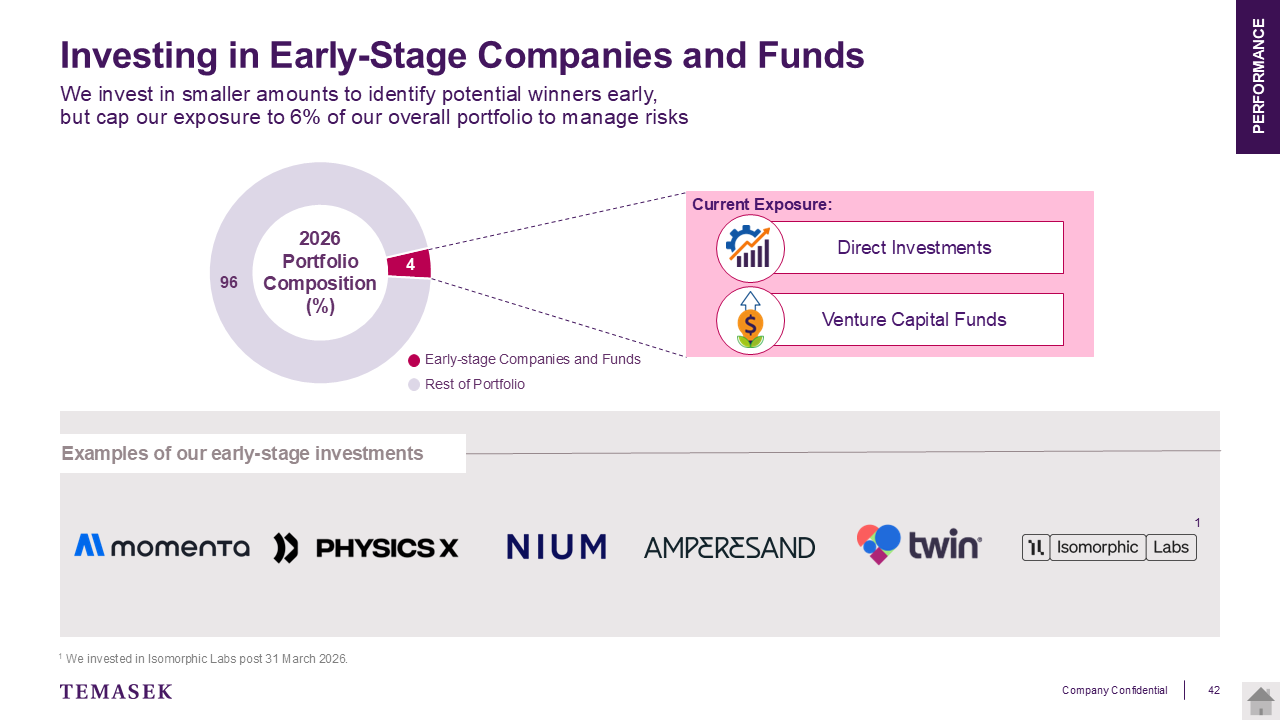
QUESTION: There are growing concerns about an AI bubble and AI-related risks, even though Temasek’s investments are diversified across the ecosystem. Countries are also putting a cap on how AI can be used. What are the key risks that Temasek is looking out for, and is this something that you are particularly concerned about? You have also capped your early-stage portfolio exposure to 6%. Is AI a part of this or do you consider it as a sector by itself?

CHIA SONG HWEE: AI is a theme that will last for decades, just like the internet, advanced communications and so on. The technology will continue to develop and evolve. At the same time, there will be market cycles and volatility, including periods of overvaluation. We cannot stay away from investing simply because of those risks. What we need to do is ensure that we understand and manage them.

We invest across many sectors that are exposed to AI. Many of those companies, such as the mega-cap companies, have multiple business lines, with AI being just one part of their business. Even in the semiconductor space, while companies may be exposed to AI, they also sell into other segments of the sector. These companies may be impacted during a market correction, but fundamentally, they have other businesses that can help underwrite some of the risk.

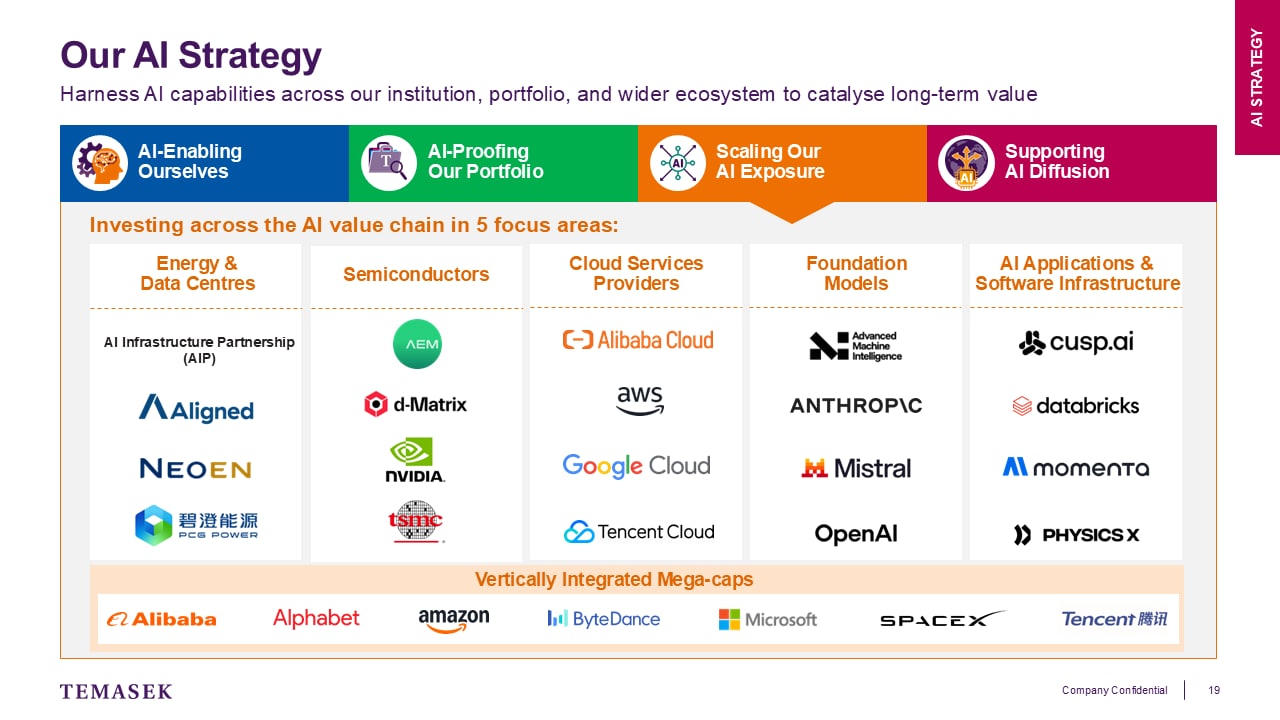
Another way to look at it is our overall exposure, beyond portfolio construction, and whether we can manage that risk. As shared in our presentation, we hope to grow our AI portfolio exposure to up to 15% by 2031. This is a natural extension of our digitisation trend, which we have been investing in since 2016. In Temasek’s portfolio mix, Telecommunications, Media & Technology (TMT) accounts for 23% of portfolio value. Going forward, the 15% AI portfolio exposure will be part of that 23%. We believe this is manageable, and allows us to ride through periods of market volatility or correction. While it is difficult to time and manage short-term volatility, we must ensure that we have the ability to deal with changes in market direction from time to time.

On whether AI is considered part of early-stage portfolio, yes, if an AI investment is considered early-stage, it will be part of that 6%.

NAGI HAMIYEH: We've seen that some of these companies can scale up very quickly. Companies that were deemed to be early stage just a few months ago, not even a few years ago, have become multi-hundred-billion-dollar companies. 

PNG CHIN YEE: I think most of what may form the early-stage investments will mainly be in the application layer. If you look at the rest, such as chips and cloud providers, most of them are reasonably mature. Today, less than 5% of our overall portfolio is within that early-stage phase.

ROHIT SIPAHIMALANI: Also, because this is such a fast-changing area and still relatively new, it's hard to determine the winners. A lot of our early-stage exposure is through our venture capital funds, and that forms part of our early-stage exposure. As some companies start to break out, we then look to invest directly. But more of the binary risk exposure is through our venture capital funds, which provide a much more diversified portfolio. We then overlay on that as and when some of these companies break out.

CHIA SONG HWEE: Another favourable factor is that many of our AI investments are already publicly listed, large cap companies. This means our ability to manage the portfolio is much stronger. For example, we know that SpaceX just went public, so it is going to be a large, liquid stock going forward. You’ve also heard about Anthropic and OpenAI planning their initial public offerings. So we expect that in a year or two, this portfolio will be highly liquid rather than highly private. That is our view. 

Question on AI – Assessing Opportunities in US and China

QUESTION: You have invested in Anthropic and OpenAI, and we've just heard that your China strategy also has at least a partial AI focus. Many investors are choosing one market – either the US or China. There is obviously a geopolitical component in some of these investments, but also investors also want to pick the winner in this race. What is your strategy? On the China AI story, are you focused more on implementation or AI use cases, compared with the US, where the focus is more on foundation models?

CHIA SONG HWEE: It is important for us to think about AI as part of the natural evolution of our investment in the digitisation trend, which we started way back in 2016. Many of our AI investments were made even before generative AI came into play. Our focus is on having coverage across the value chain that represents this multi-decade trend.

With regard to AI in the US and China, we believe both markets have different capabilities and competitive advantages. For large language models and frontier models, the US is in the lead. In this aspect, the focus and go-to-market approach so far have been very much on B2C. On the B2B side, the focus has been more on the digital side.

China is quite different. It is scaling on the physical side of things because of its strong manufacturing base and related competencies.

So, we see both markets as having relative competitive advantages, with quite different areas of focus based on their own ecosystems and capabilities. That is how we are thinking about investing in capabilities and companies in both countries.

Question on AI – Adoption among Temasek Portfolio Companies (TPCs)

QUESTION: How is Temasek, through its Temasek Portfolio Companies, encouraging the adoption of AI? Is it setting targets for the TPCs to meet? How does this affect manpower across these firms?

PNG CHIN YEE: It’s very clear to us that AI is going to be a multi-decade trend. All our TPCs will need to adopt AI in their businesses and think about what it means for their business models – how they can gain efficiencies, better serve customers, and identify new revenue streams.

We are encouraging our TPCs to think through their AI strategies very actively. In fact, we took the leadership teams of our TPCs to Stanford University in Silicon Valley for a week-long programme to help them understand the risks and opportunities. We also took them to China — Shanghai and Hangzhou — to see what the Chinese tech landscape looks like, and how AI is being applied by companies, particularly in the physical space.

I think it’s important for us to know what the possibilities are, but at the same time, we need to be very clear that our AI transformation has to bring our people along with us. It’s not just about how the organisation can benefit, but also about making sure that people benefit from it. We are working with our TPCs to ensure that there is an AI policy across the organisation, and to uplift and upskill the workforce so that they can be prepared for the new opportunities and job roles that will emerge.

I would say this is a journey that we all have to undertake to be globally competitive. I don’t think we can afford not to go on this journey.

CHIA SONG HWEE: Most of our TPCs operate in the physical world, while most of the AI activities we are exposed to today are mainly in B2C. Even with B2B, the focus is more on the digital side. Those are quite clearly the first wave of adoption.

The next wave will be in the physical world, where large language models alone are not sufficient. We will need real-world models and more specific systems-related models to facilitate the transformation.

This is still at a very early stage because it is much more difficult to do. The advantage of TPCs is that they have domain expertise and data. It’s not difficult to imagine that AI model companies would like to have access to that data. Companies that are able to leverage that data and find new ways to enable the business will be even more interesting to invest in than just the frontier model companies themselves.

NAGI HAMIYEH:  On the physical AI side, we have made two specific investments: PhysicsX and CuspAI. PhysicsX helps optimise processes for R&D and engineering companies, while CuspAI looks at materials science and the discovery of new critical materials.

There are already discussions with some of our TPCs on how they can collaborate. We think the power of the franchise — what we bring together across the three pillars — is in connecting the dots between the TPCs and what we are seeing on the global investment side.

That is a critical part because, as Song Hwee mentioned, these companies would like to come in because there is data and there are real manufacturing processes there. For us, our portfolio companies would benefit from unique access to these companies because we are invested in them.

Question on Investments – Initial Public Offerings (IPOs)

QUESTION: Everyone is talking about the potential IPOs of Anthropic and OpenAI. Would you consider those to be exit opportunities?

CHIA SONG HWEE: We will assess the opportunities at the appropriate time, depending on the valuation and the outlook. We believe AI is a multi-decade game and therefore, we need to stay invested. How we think about it is to consider what should be structured for long-term holding, versus where we need to be more agile in responding to market conditions. If the portfolio, or the position in an individual company, is large enough, that gives us that flexibility.

QUESTION: How big are your stakes in Anthropic and OpenAI?

CHIA SONG HWEE: We do not disclose specific stakes.

ROHIT SIPAHIMALANI: For the AI portfolio as a whole, we have said that we want a substantial part of it to be in liquid assets. Today, well over a majority of our AI exposure is already liquid, in the current exposure we have.

Question on Investments – Private Credit

QUESTION: On the private credit market, we have seen some funds, such as GIC, reducing their exposure to private credit. At the same time, Temasek is still quite bullish about this market and increasing its exposure in the sector. Can you explain the rationale behind this, and how you manage the risks involved?

ALPIN MEHTA: The recent redemption pressure in some private credit funds is largely driven by product design rather than the underlying investment itself.

Our portfolio is largely through Aranda Principal Strategies, which does not invest retail capital or third-party institutional capital. Aranda invests in capital allocated from Temasek's own balance sheet, which has a much longer duration and a different liquidity profile. Hence, we are not impacted by the challenges that exist in the market.

In fact, periods like this offer us a very interesting opportunity to lean into the market and deploy capital in select assets. Aranda Principal Strategies has also been very active recently in secondaries, buying portfolios where we can assess and select the risks that we are comfortable with. Given our balance sheet and nature of our capital, periods like this can give us differentiated access to the market.

CHIA SONG HWEE: Private credit is a very wide space, so we need to be careful not to generalise. While we are active in private credit, we are quite disciplined with our focus areas and approach to capital deployment. Within the space, we try to be as diversified as possible, so that we are not overly exposed to any type of sector or geography-related macro event, and can manage our overall risk.

I often say private credit is easier than equities, because there are clearer indicators of whether the market is becoming frothy. When it is, spreads tighten very quickly — and if spreads are too tight, you know that risk isn’t adequately priced. You also have to watch the terms. If you see very high loan-to-value ratios, or loans without high-quality collateral, that is probably when you need to be careful. In equities, many of these signals are not as readily observable.

GABRIEL LIM: For Seviora, I am on the sell side. We do have private credit strategies within our group. SeaTown has a private credit strategy, and InnoVen Capital, which does venture debt. I agree with Song Hwee that we should not overgeneralise.

When we look at some of the product features, including in areas that have been in the news recently, you find that they are covenant-lite. This means that there is not much recourse for the lender. Some also have poorer collateral. Our products generally have strong covenants and good collateral.

Many of these products that have been in the news are either publicly traded or are evergreen or open-ended funds. Ours are closed-ended. When investors come in, they understand that the fund will be around for a few years.

So, you have to look at it quite selectively and quite differently. Many institutional investors are also putting money into private credit, so it depends on the starting points. From our side, as long as we remain selective, disciplined, and structure the products properly, we believe private credit remains a good asset class worth investing in.

CHIA SONG HWEE: Our Aranda Principal Strategies portfolio is mainly cash-yield loans. In other words, we get coupon payments. We almost do not have anything that is paid in kind. So over time, getting interest coupon payments actually helps you de-risk the loan, the exposure, or the portfolio.

ALPIN MEHTA: We have been investing in private credit for over a decade now. We have seen a few cycles come through in the last decade. I think the portfolio has actually performed very well during this period of time, and it still continues to perform well.

CHIA SONG HWEE: The credit cycle is something that we often talk about. We have to assess – where are we in a cycle? And if you think that there is going to be a bubble, then the best thing is to have dry powder to deploy when things are challenging. We have done that twice by positioning ourselves to buy great portfolios and great assets at attractive valuations or prices.

Question on Investments – Real Estate Sector

QUESTION: Real estate as a proportion of the overall portfolio has reduced quite a bit from a few years ago and it continues to decline. Temasek has also been linked to a few ongoing or prospective real estate sales. What is the thinking there, and should we expect real estate exposure to reduce further? How are you managing your China real estate exposure now?

ALPIN MEHTA: On our direct real estate investments, our focus has increasingly been on real estate credit, where we see very interesting opportunities. It offers good downside protection through equity subordination, as well as fairly attractive risk-adjusted returns. We have therefore been focusing on real estate credit, and have been investing in the US and Europe as part of that strategy.

Our real estate exposure, as a proportion of the overall portfolio, has come down. One factor has been the market, as valuations across the sector have come down quite a fair bit in a higher interest rate environment. Specifically, on China real estate, most of our exposure is indirect through our portfolio companies.

QUESTION: Should we expect to eventually see a sale of your legacy real estate assets, particularly those not related to private credit? Given that you regularly engage with Temasek Portfolio Companies (TPCs), on Temasek’s indirect exposure to China, are you engaging your TPCs to discuss strategies on how to handle their exposure in China?

ALPIN MEHTA: We invest across the capital structure, and periodically review where the best opportunities are for us to invest. Right now, there are two areas that we are focused on. First, on the direct side, we are invested in real estate credit. On the equity side, we are continually looking for opportunities to invest in asset classes that would structurally benefit from tailwinds. Data centres are one of the asset classes where we have been actively deploying capital.

Our indirect exposure in China is through our TPCs, CapitaLand and Mapletree. It is for the management teams and boards of those companies to direct their strategies. We do not get involved in the management, nor do we direct any of our portfolio companies on their business. It is for them to decide what is in the best interest of their shareholders.

But let me share a little bit about each company’s exposure in China. For CapitaLand, they have adopted a more asset-light approach to China over the last few years. They have been using RMB-denominated funds or C-REITs, and focusing more on China-for-China capital. You would have seen over the last couple of weeks, that they received approval for their second C-REIT, which is sized at RMB4.8 billion. As the share of fee income increases, this should provide greater resilience and stability to their earnings across cycles in China.

For Mapletree, their exposure to China is low. A large part of Mapletree’s exposure has been in the logistics segment, which continues to do reasonably well across many submarkets there, on the back of consumption and other demand drivers.

Question on Investments – Mapletree and CapitaLand

QUESTION: On Temasek Portfolio Companies, there has been a lot of restructuring, and we are seeing the results, such as with Keppel and others. One topic that has been widely talked about is a potential merger of Mapletree and CapitaLand. How is it progressing? It seems that size matters and that a combination would be more efficient but talks seem to have stalled. Does Temasek think it would be good for Mapletree and CapitaLand to combine?

ALPIN MEHTA: This question is more for the management teams and boards of Mapletree and CapitaLand to answer. As you know, we do not direct the boards or the management teams of any of our portfolio companies. We leave it to them to make decisions which are in the best interest of their business and shareholders. It is not for us to comment. 

Question on Investments – Defence Sector

QUESTION: You mentioned opportunities in the defence sector in Europe. Is there a policy on defence sector investment, particularly given the ongoing wars? Are there areas where you would not invest?

NAGI HAMIYEH: Defence is very topical right now, particularly in relation to national sovereignty and deterrence. That is the lens through which we look at. We also focus mainly on dual-use technologies. First and foremost, we will comply with the laws of Singapore. We have to take a practical approach, but because this is a sensitive topic, we apply a very rigorous ESG lens when assessing these opportunities. We look at the activities and how companies are managed before deciding where to invest. Specifically, anything related to biological or chemical warfare is not something we would consider. 

Question on Investments – Hedge Funds

QUESTION: As part of the restructuring, there was talk of increasing investment in funds like Citadel, Millennium Management, other external fund managers and hedge funds. Structurally, will that come under Seviora? Would Seviora manage those hedge fund investments, and do you think those investments will go up?

ROHIT SIPAHIMALANI: Hedge funds, macro and multi-strategy funds are part of our portfolio, and these investments are made from Temasek’s own balance sheet. When we think about diversifiers and non-correlated assets, they form one part of the portfolio, together with other areas such as royalties and closed block insurance. That is our proprietary capital, and we have a diversified set of managers with whom we invest. This is part of the Temasek strategy and is separate from Seviora. Seviora has its own strategies, which Gabriel can speak to.

GABRIEL LIM: We do have a fund of hedge funds, which Standard Chartered manages and helps to distribute to its private wealth clients – it is called STAR for short. However, that is separate from Temasek. That strategy is where we bring in external, third-party capital, mostly through private wealth channels. It is different from Temasek’s use of its own proprietary capital. 

Question on Investments – Sports Teams

QUESTION: With the FIFA World Cup currently taking place, would Temasek consider looking beyond your current strategies and explore sports investment assets as a possible institutional asset class in the future? What is your view on this currently, and how might it evolve in the future?

ROHIT SIPAHIMALANI: We have been investing in this space for a long time. Fanatics is an investment we have held for over a decade. That said, it has not been part of a clear strategy into sports. Some of the General Partners (GPs) that we are invested in are also looking at it. It’s not a core strategy at this point, but we are looking into the opportunities.

NAGI HAMIYEH: It is still nascent. We have not looked at it seriously in the past, although we have made a couple of deals. Sports could be viewed as an uncorrelated asset class, and given that we are over 90% long equities, we like strategies like insurance, royalties, and others. We look at sports through that same lens. We have not done enough to call it a mainstream strategy for us.

ALPIN MEHTA: To add a point on our private equity General Partners (GPs), they have been active in sports for some time, and we see that across our portfolio. The point to recognise is that sports, as an industry, has a very large value chain of its own.

We see our GPs being active across that value chain. There are many services and businesses around the sports industry that have grown over time as the industry expanded. There is a value chain there that can be captured, and we do invest alongside our GPs in some of those strategies.

Question on Seviora – Role in Singapore’s Equity Markets

QUESTION: How does Seviora support the local Singapore stock market? For example, Fullerton Fund Management is one of the Monetary Authority of Singapore’s (MAS) partner funds. Do you see a role in encouraging companies within your remit to list here, rather than in markets abroad? What are your thoughts on the role that Seviora can play in bolstering the local ecosystem?

GABRIEL LIM: Our primary mandate is to be a good fiduciary and to manage the money that investors have placed with us responsibly and well. That means delivering good returns over the long term. We are very grateful and honoured to have been given the mandate by MAS to Fullerton Fund Management.

More broadly, through our private equity strategy under SeaTown, we can nurture strong and resilient companies that perform well across cycles. These companies can contribute financially to our fund while also supporting the broader economy. That is one way we contribute back to the capital markets and to the broader Singapore economy.

To that extent, when companies are doing well and are strong, they could be listed. One of our portfolio companies, Foundation Healthcare, is undergoing an IPO right now.

ALPIN MEHTA: One of our AMCs, 65 Equity Partners, also has a partnership with the Ministry of Trade and Industry through Anchor Fund. This helps support some of these companies that are going through, or may want to go through, an IPO process in Singapore in the future. In that way, it also supports the broader initiative.

Question on Sustainability – Climate Targets

This question and response are from the Sustainability Report 2026 Media Briefing.

QUESTION: Will Temasek set new interim climate targets, since the disclosure that Temasek is unlikely to meet its 2030 target? How does this affect Temasek’s sustainability investing approach?

FRANZISKA ZIMMERMANN: In Dilhan’s Ecosperity speech he shared that we are unlikely to meet our interim target, but he was also equally clear that we retain our ambition towards net zero by 2050 – so the way we're thinking about it is that our target still serves us as a very important directional marker. What we are doing now is really focusing our efforts on implementation and making sure that we are harnessing all the levers that we can, both from an investing and portfolio engagement perspective, to progress towards the emissions reductions. The important part there is that we are not just looking at managing for the number; what we really care about is the real economy impact. And also, I think the industry is more and more understanding that the absolute emissions number at portfolio level may not be the most effective measure of progress.

Question on Sustainability – Emissions from AI and Data Centre Investments

This question and response are from the Sustainability Report 2026 Media Briefing.

QUESTION: How does Temasek ensure that AI and data centre investments do not conflict with its net zero ambition and emissions reduction targets?

KYUNG-AH PARK: As part of our ESG due diligence for any new investments, including data centre investments and partnerships, we do the diligence to see if they can apply renewable energy, and clean energy more broadly, as well as things like water efficiency and community safeguards. So, we do the diligence and then engage (the companies) post-investment. Having said that, it depends on where you are in the region. And in some cases, they're colocation data centres, so it's very dependent upon the tenants.

But what we are seeing more broadly is that done the right way, the hyperscaler demand is actually pulling forward renewable energy, as well as nuclear technology and even in some cases, long duration storage. One of our portfolio companies, Form Energy, is a good example of that, where it has partnered with Google not only as an offtaker, but also as an investor into the technologies as well. Fortera’s partnership with Microsoft is another example.

NAGI HAMIYEH: As Kyung-Ah mentioned, we've seen a convergence of solutions provided by different players, and this is mainly behind-the-metre type solutions like fuel cells and industrial scale renewable storage. We've seen that the hyperscalers are going out and trying to get into long-term arrangements with renewable providers and sometimes owning part of the generation as well. So, that is an important trend.

The hyperscalers’ AI models are going to become better and better, and are going to be part of the solution when it comes to energy efficiency. We've seen companies use AI to regulate grid loads. Cusp.ai, one of our investee companies, focuses on novel material science by discovering new materials which are going to be key to this energy transition. 

We take a long-term view, and analyse every investment with an ESG lens. Sometimes we can try to sway the outcome, but the reality is you can't have every data centre be a green data centre, because it is dependent on the region and availability of renewable power. But that is top of mind for us.

Question on Sustainability – Energy Transition Investments

This question and response are from the Sustainability Report 2026 Media Briefing.

QUESTION: How does Temasek view the role of renewables, nuclear and other energy transition investments amid rising energy demand and geopolitical uncertainty?

NAGI HAMIYEH: We try to align our investments to the key trends that we see. One of the key trends that we've been talking about for the last few years is Sustainable Living. When you look at the sectors that fall within this trend, clearly, energy transition is key. Within energy transition, we can invest across the whole value chain – in technologies that provide grid solutions, in growth platforms as well as in very mature projects.

When we talk about renewables, it has to include storage to deal with the intermittency. They are highly scalable, there is no technology risk, and from a cost perspective, they are very competitive. We made a big investment in Europe a couple of years ago, in Neoen, which is the largest renewable company in France and several other countries, including Finland and Australia. We invested in Luminace Energy last year in the US, which is a distributed energy generation platform; they use decarbonisation as a service.

We will continue investing quite heavily (in energy transition) for a couple of reasons. One, from a commercial returns perspective, we're very happy with the risk-adjusted returns we get. Two, these are highly scalable, and they are very aligned with our long-term target. But this is not the only area we're going to look at. Now, looking at nuclear, we have two very different investments. We have one in Westinghouse, which is a very established nuclear services provider in the fission space, while Commonwealth Fusion is in fusion, and we know that fusion is not going to happen tomorrow. But it's a relatively advanced company when it comes to fusion systems. 

Nuclear, in our opinion, will play a big role because you have to look at the energy mix, you have to look at the energy demand over the next multiple years. Nuclear is probably the cheapest and most abundant baseload power after hydropower, and there is a limitation in terms of how much hydro one can use. Hence, we believe that nuclear will play a role. And there are several technologies from SMRs or other reactors that we think can be installed faster than before, where it used to take 8 to 10 years to get any reactor up. Would we look at other investments? If we find interesting investments that meet our objectives and targets, possibly.

Question on Sustainability – Internal Carbon Price

This question and response are from the Sustainability Report 2026 Media Briefing.

QUESTION: Given Singapore has indicated its carbon tax is likely to track towards the lower end of the announced range by 2030, does this affect Temasek’s Internal Carbon Price (ICP), and how does Temasek determine future ICP reviews?

PNG CHIN YEE: Directionally, we're looking at up to US$100/tCO2e by 2030. We've just done a review of our internal carbon price earlier this year. We're staying with US$65/tCO2e at this point. We'll monitor the external environment and see how it unfolds, and look at it every two years to determine if we should be moving our internal carbon price.

Subscribe to our newsletter

Stay up to date with our latest news, insights and stories

Select a type of content
    Please select Stories you are interested in.
    Please give us your consent.
    Please confirm that you are not a robot.