In recent years, the firm has also been exploring promising opportunities in AI, core-plus infrastructure and alternative assets. This approach builds on its long-term strategy, guided by four key structural trends: digitization, sustainable living, the future of consumption and longer lifespans.
AI’s Expanding Value Chain
AI, one of the strongest forces of industry transformation, is driving technical breakthroughs, bridging sectors, accelerating automation, enabling new business models and redefining foundational infrastructure.
“We are in the early innings of a multi-decade opportunity with the potential to transform industries,” says Martin Fichtner, Temasek’s head of West Coast and head of Tech and Consumer for North America and EMEA. “We had the Industrial Revolution, we had the digital and connectivity revolution, and we’re now living through the AI revolution.”
While Temasek recognizes the potential of stretched valuations, it has adopted a disciplined approach, focusing on companies with resilient business models and strong customer traction to meet the moment. This means backing scaled AI-native leaders, emerging AI innovators, AI factories that power digital ecosystems and traditional businesses that will benefit from AI adoption and transformation.
Beyond working with its Singapore-based portfolio companies to identify opportunities for value uplift, it invests in AI funds and works with partners to position itself for long-term growth. Its involvement in the AI Infrastructure Partnership (AIP)—a consortium established by BlackRock, Global Infrastructure Partners and MGX—offers access to critical AI infrastructure.
“Being part of a unique consortium broadens our ability to participate in building the digital backbone behind AI’s next wave,” Ravi Lambah, head of Strategic Initiatives and head of India says of Temasek joining AIP earlier this year. “It’s an opportunity to invest in foundational capabilities that will be critical for the future.”
Stability Amid Fragmentation
If AI represents technological acceleration, infrastructure provides the counterweight: essential assets with stable cash flows and strong barriers to entry for potential rivals.
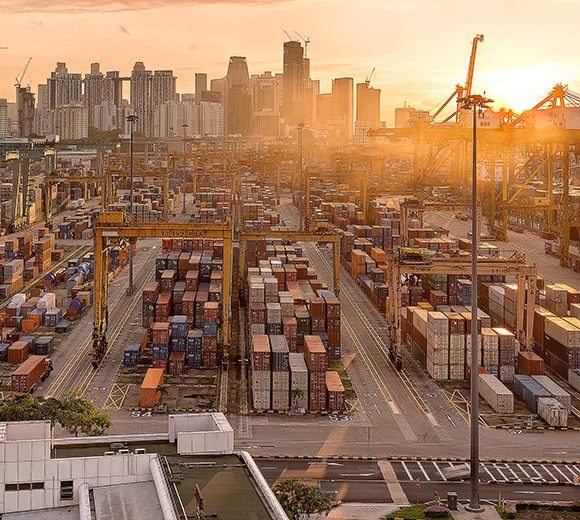
Infrastructure has been integral to Temasek’s portfolio since its inception, with Singapore-based operating companies such as PSA International, Sembcorp and Keppel operating critical infrastructure.
What has changed is the scale of global needs—from next-generation data centers and energy resilience to aging transport and utilities networks that need upgrading. “Over the past 20 years, infrastructure has become a critical component of many institutional portfolios,” says Nagi Hamiyeh, Temasek’s head of EMEA. “Key attributes include stable recurring or contracted cash flows and resilience through cycles.”
Core-plus infrastructure—assets that maintain the fundamental stability of traditional infrastructure with the potential for enhanced returns—fits squarely within that thesis. For example, Temasek’s recent investment in Luminace, North America’s largest distributed energy generation platform, reflects its recognition of the growing demand for reliable energy, digital connectivity and modern infrastructure.
Consistent with its strategy to scale capital deployment across public and private markets through funds and partnerships, the firm partnered with Brookfield to acquire Neoen, a fully integrated renewables development platform based in France with an 8,500-megawatt portfolio of wind, solar and storage assets in operation or under construction, powering millions of homes each year. This is one example of how Temasek aims to support the energy transition.
“We have invested alongside partners to accelerate and scale capital into critical areas required for the energy transition,” says Hamiyeh, “while ensuring that we’re learning from best-in-class operators globally.”
Alternatives for a More Volatile Decade
With equity markets increasingly synchronized and macro uncertainty rising, alternative assets and hedge funds are expected to play a larger role in generating uncorrelated returns and portfolio resilience.
“We see alternative assets as an important driver of returns for us in the years ahead,” Sipahimalani says. Working with top investors, asset managers and leaders across private equity, private credit and infrastructure—such as Temasek’s deep partnerships with EQT, KKR and TPG, which provide access to global networks and expertise—allows the firm to co-invest selectively in high-conviction opportunities, unlocking resilience and growth across an evolving global economy.
Multi-strategy and macro hedge funds, closed-block insurance and royalty streams offer low-correlation return streams, a vital buffer in today’s volatile markets. “We believe that exposure to these funds can give us fairly stable double-digit returns regardless of the equity market environment,” Sipahimalani adds.
Planning for the Future
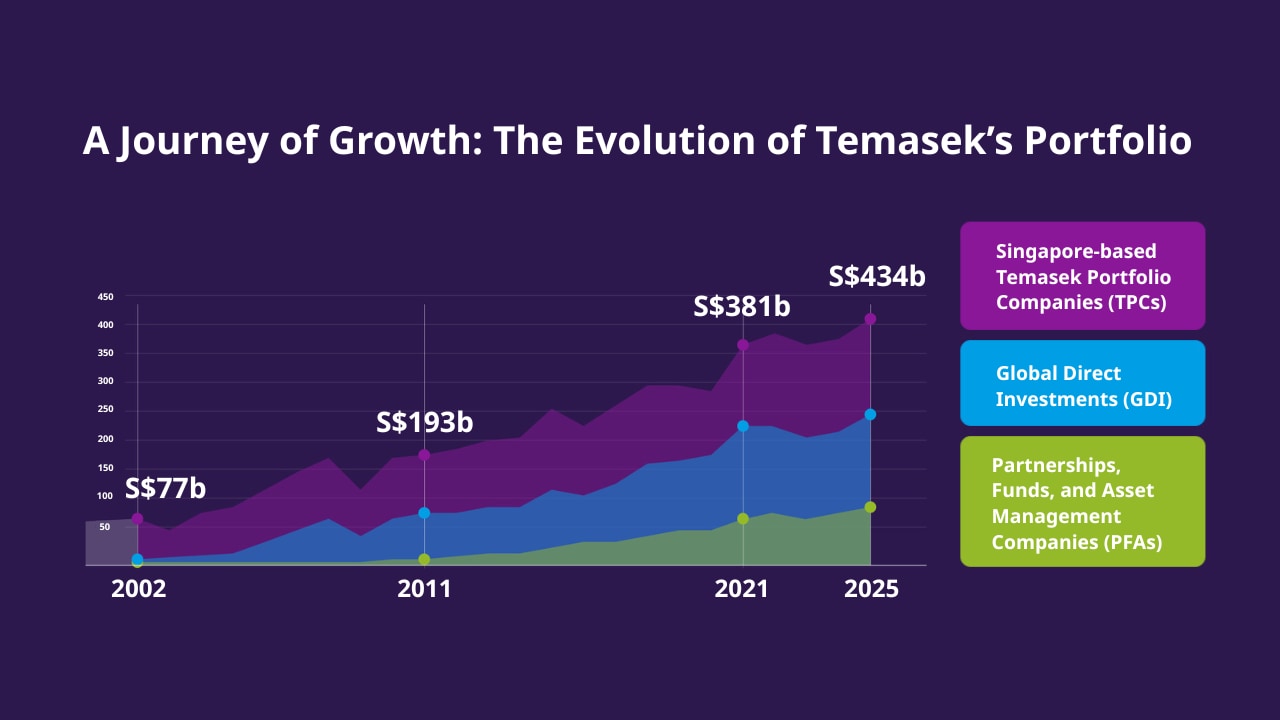
To deliver sustainable returns over the long term, Temasek is guided by its decade-long road maps. Under T2010—Temasek’s strategy leading up to the year 2010—it ventured beyond Singapore to invest more actively in emerging markets, particularly in Asia. Meanwhile, T2020 launched the company’s journey as a global investor—venturing into developed economies in the Americas and Europe—and sharpened its focus in sectors such as technology, life sciences, non-bank financial services and consumer sectors. In 2019, Temasek developed its T2030 framework, centered on building a forward-looking portfolio that can withstand exogenous shocks across market cycles.
“In an investment landscape of heightened uncertainty due to geopolitics, AI and climate change, building for resilience becomes an imperative,” says Sipahimalani.