Close

Putting People First: How AI is Making Banking More Human

Putting People First: How AI is Making Banking More Human

Minute Read 0 views

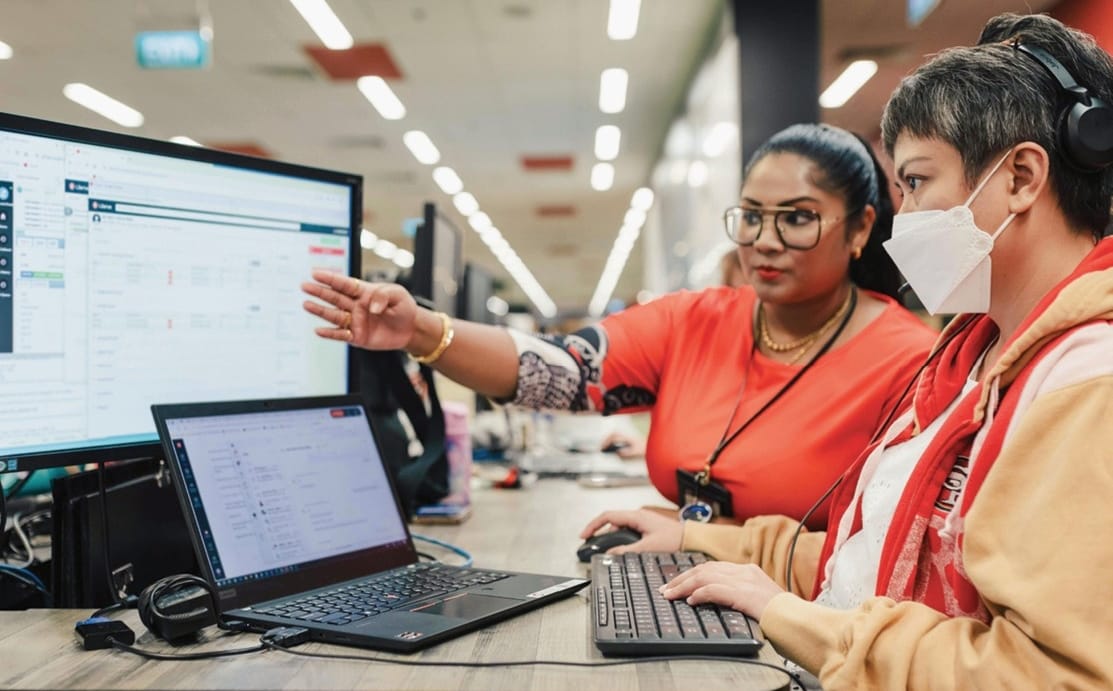
DBS' Customer Service Officers using the GenAI-powered Customer Service Officer Assistant.

For years, DBS Customer Service Officer Kennedy Ng juggled three competing tasks.

On any given call, he listened closely to the customer’s concern while searching through the systems for information on past interactions, and typing notes in real time. The constant multitasking made it harder to stay fully present in each conversation – the most human part of the role. With his attention split between screens, shortcuts, and note-taking, it was difficult to engage as deeply as ​​he wanted to. 

This dynamic changed in 2024 when DBS introduced the CSO Assistant, a generative AI-powered tool that transcribes calls, recommends solutions with over 95 per cent accuracy, and generates instant summaries.

The shift in human attention was immediate.

“It freed us up for all the actual things that a customer service officer is supposed to do,” Kennedy says. “I could jump into the call without having to get a customer to repeat the entire story, and simply focus on asking the right questions.”

The CSO Assistant also reduces call handling time by up to 20 per cent.

As work evolves, so do people

For Ying Yuan Ng, DBS Group Head of Talent Acquisition and Talent Management, and Singapore HR Head, the bank’s approach to workforce transformation rests on a simple but important philosophy: “We protect people, not jobs."

As AI reshapes the nature of work, DBS believes its responsibility is not to preserve every task exactly as it exists today, but to help employees transform alongside the work. This means redesigning jobs, investing in large-scale upskilling and reskilling, and creating pathways into new opportunities as roles change.

In many cases, AI is enhancing how work gets done. In roles like Kennedy’s, “copilots” like the CSO Assistant handle documentation and data retrieval, easing administrative workloads and allowing employees to focus more fully on problem-solving and customer engagement.

In other areas, the change is more structural. As technology takes on a larger share of the operational load, DBS redeploys employees into new positions, supported by structured reskilling programmes. For some customer service officers, that has meant opportunities to step into newly created roles such as AI agent monitoring managers and GenAI evaluators – jobs that did not exist five years ago.

The scale of this commitment is significant. It starts with providing staff with broad access to tools such as DBS-GPT, and extends to workforce development at scale: some 40,000 employees are being equipped with foundational AI skills, while a further 11,000 have been identified for targeted, role-specific capability building. 

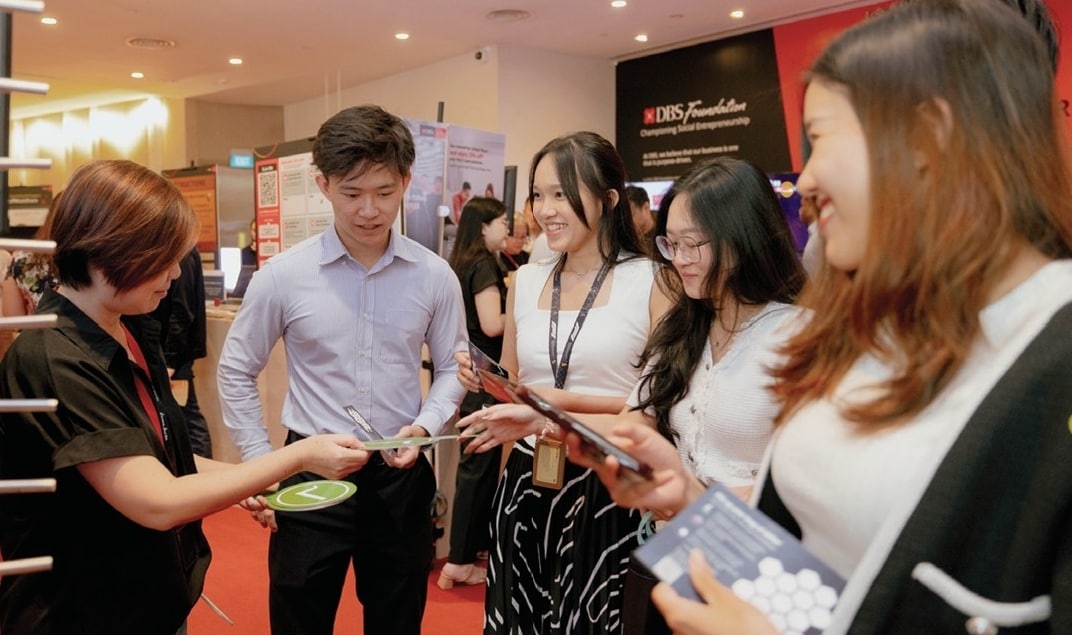
To support this transition, DBS uses Lunch and Learn sessions – small, facilitator-led lunchtime gatherings – where staff can discuss the tools openly. The bank also runs “hackathons” where staff propose how AI could fit into their specific workflows, with winning ideas piloted by the teams that invented them.

DBS engaging employees about GenAI, upskilling and career growth at an event.

The groundwork was laid a decade earlier. Nimish Panchmatia, DBS’ Chief Data and Transformation Officer, traces the bank’s transformation back to 2014, when DBS recognised that big tech would eventually encroach on traditional banking. The challenge was translating that strategic clarity into something employees could act on. “It’s really, really important that we take this big boulder of a strategy, break it down… into messages that resonate with the people on the ground.” A modular learning programme called DigiFY was built to do exactly that – to create the fluency and confidence among staff that tools like the CSO Assistant would one day require.

That long game has since been validated: in 2025, Global Finance named DBS the World’s Best AI Bank at its inaugural AI in Finance Awards. Today, DBS deploys more than 2,000 AI models across over 430 use cases, and in 2025 alone, its AI, machine learning and data analytics initiatives generated some S$1 billion in economic value. 

While the numbers reflect what the tools delivered, what made the tools land was something less visible: the trust of the people using them. “Every single change is only as successful as how much the employees embrace and are committed to it,” says Ying Yuan.

In Singapore, tripartism shapes how that trust is built.

The union has been “a very powerful voice galvanising employees through this change,” she says. By consulting early and often, the bank aims to assure staff that the new system is being built with them, not imposed on them. 

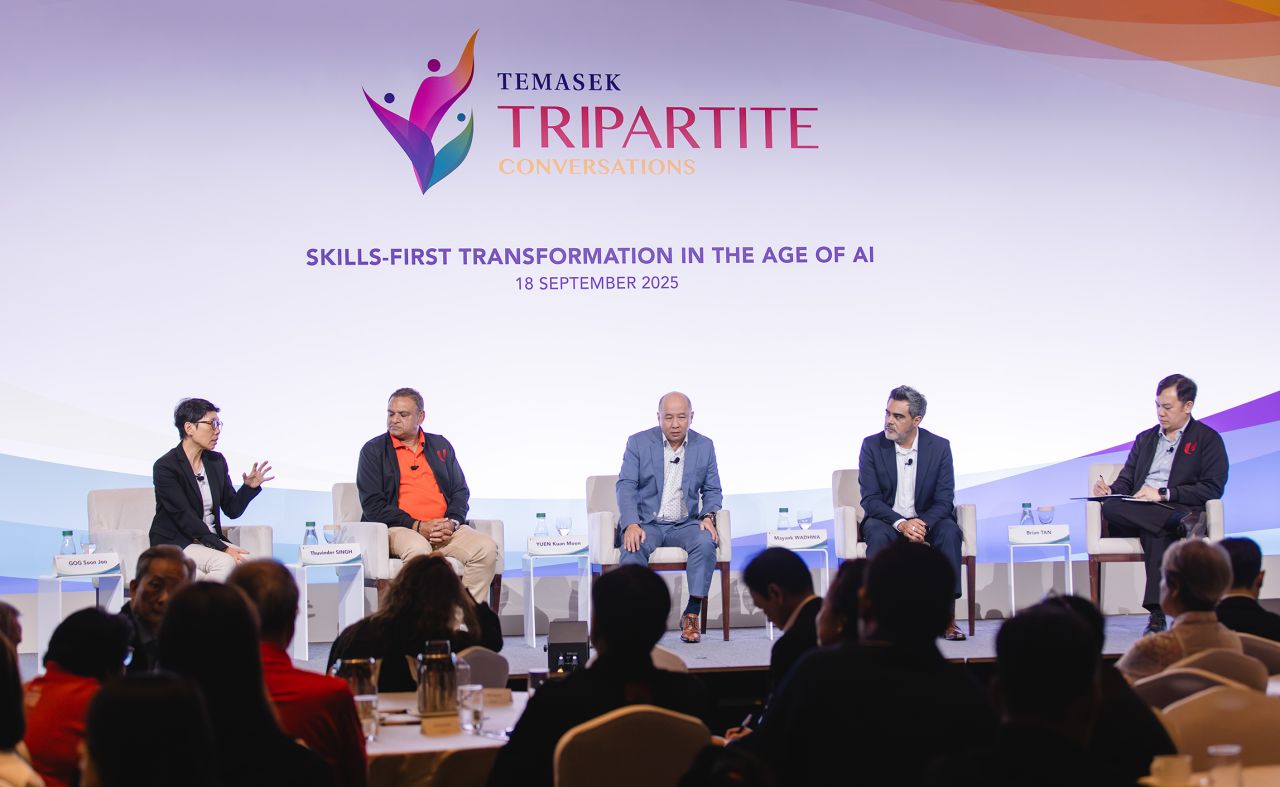
This model of trust-building through structured dialogue between employers, unions and institutions is one that Temasek actively cultivates across its Singapore-based portfolio companies, which employ more than 160,000 people locally – a footprint large enough to move the needle on workforce transformation in ways no single employer could. Critically, Temasek does not mandate change; it creates the conditions for it. Platforms like the Temasek Tripartite Conversations provide a forum for open dialogue on workforce issues and potential solutions. 

Panel discussion at Temasek Tripartite Conversations 2025.

This sits within a broader initiative: Temasek's Ecosystem Workforce Resilience, which drives practical action on reskilling, job redesign and flexible work to narrow the skills gaps created by rapid technological disruption.

A template for transition 

According to the World Economic Forum, approximately 59 per cent of the global workforce will need upskilling or reskilling by 2030. The challenge facing DBS is not unique to banking. It is the defining workforce question across every sector.

What the DBS experience offers is a tested model, one that demonstrates how organisations can harness technology while strengthening workforce resilience. Recognising that this challenge extends beyond any single company, Temasek established its Ecosystem Workforce Resilience (EWR) team to accelerate the adoption of workforce transformation practices across its portfolio and the wider economy.

Rather than addressing workforce disruption one organisation at a time, EWR takes an ecosystem approach, bringing together employers, unions, policymakers and workforce partners to scale solutions, share learnings and build collective resilience in the face of structural change.

In May 2025, for instance, Temasek’s HR Roundtable brought 30 HR practitioners from across its ecosystem together to learn from the DBS AI transformation journey and test how it might apply in other scenarios, from ports to utilities. The questions the room worked through were the same ones Kennedy’s managers had faced years earlier: which roles need a copilot, which need a new path forward, and how do you bring people with you through the change.

By enabling successful workforce transformation initiatives to travel across sectors, EWR helps shorten the path from innovation to adoption, allowing organisations to adapt faster while ensuring workers remain equipped to thrive in a changing economy.

At its core, DBS’s goal, and a broader ambition shared across the Temasek ecosystem, is to help build a workforce that is future-ready.

For Kennedy, all of this boils down to what the customer hears on the call. When the administrative noise eased, he became more present. “We can prioritise asking the right questions and empathising with customers’ emotions,” Kennedy says. “The skills we already have, we get to use more.”

In the end, technology enables — but people make the difference.

Building Workforce Resilience at Ecosystem Scale


Temasek's Ecosystem Workforce Resilience team (EWR) brings together Government, unions and Temasek Portfolio Companies (TPCs) to prepare Singapore’s workforce for structural shifts, including technological disruption, demographic change and evolving geopolitical realities.

As a strategic convenor with central awareness across the Temasek workforce ecosystem, EWR helps translate emerging workforce challenges into coordinated initiatives, enabling organisations to anticipate change rather than react to it.

The EWR team drives practical initiatives on reskilling, job redesign and workforce innovation, helping to narrow the skills gaps created by these shifts while strengthening workforce adaptability and long-term employability.

TPCs collectively employ a sizeable workforce of more than 160,000 people in Singapore, providing a meaningful platform to pilot, scale and transfer workforce solutions across industries.

Through knowledge sharing platforms, capability building initiatives and tripartite partnerships, EWR helps ensure that investment in people and capability development keeps pace with the rate of economic, technological and societal change, so workers are not left behind and that our TPCs remain competitive.

By strengthening workforce resilience at both the enterprise and ecosystem levels, EWR supports a broader objective: ensuring that Singapore’s workforce remains adaptable, competitive and prepared for the opportunities of the future. Explore how Temasek Portfolio Companies are translating these priorities into action and learn about our broader ecosystem strategy here.

Top

News & Insights

Select a type of content
    Please select Stories you are interested in.
    Please give us your consent.
    Please confirm that you are not a robot.

    Subscribe to our newsletter

    Stay up to date with our latest news, insights and stories

    Select a type of content
      Please select Stories you are interested in.
      Please give us your consent.
      Please confirm that you are not a robot.