Monsoon floods displacing 60,000 people in Jakarta. Wildfires engulfing Sydney and Melbourne in a shroud of toxic haze. Temperatures soaring to 44°C (111.2°F) in Lisbon.
Recent natural disasters and scorching heat waves underscore how vulnerable people in cities across the world have become to extreme climate events. Each year brings ever more intense and frequent peril to urban conglomerations. Despite this, migration to cities continues to accelerate worldwide, which in turn increases the built environment’s contribution to greenhouse gasses.
Today, the built environment contributes nearly 40% of carbon emissions. The United Nations estimates that the population in urban areas will grow from 4.2 billion in 2018 to 6.7 billion by 2050—roughly 70% of the world total. This will increase the challenge of reducing the carbon footprint of the built environment, which needs to halve by 2030 to align with global net-zero targets, underscoring the urgent action required to make urban buildings and infrastructure sustainable.
Uwe Krueger, head of industrials, business services, energy & resources, and head of EMEA at global investment company Temasek, says that effective and appropriate use of capital holds the key to “making cities of the future centers of vibrant, sustainable life instead of climate peril.”
He adds: “There is a critical need, and immense potential, for capital to enable the sustainable built environment of the future we want and achieve our net-zero ambitions.”
Turning Obstacles into Opportunities
To drive a better urban future, Mr. Krueger says the world needs to collectively pursue a mission surrounding “five Rs”: retrofit, repurpose, rebuild, redesign and rethink.
“We need to retrofit existing building structures with sustainable energy solutions, repurpose existing spaces for multiple uses, rebuild our buildings with sustainable materials, redesign them to incorporate sustainable solutions and rethink the way people travel, work and play,” explains Mr. Krueger.
While opportunities for innovation in the five Rs abound, Temasek is aware of the scale and variety of the challenges ahead:
- Growing energy demand within the built environment sector has outpaced the investment rate for energy efficiency and decarbonisation gains, as the United Nations Environment Program (UNEP) has warned. Capital providers like Temasek can play a catalytic role by accelerating the development of decarbonisation solutions for the sector.
- The built environment industry has a fragmented stakeholder base, with value chains spanning various building life stages. The construction sector, in particular, tends to be localized. This results in limited economies of scale, higher costs and lower adoption of sustainable solutions.
- Large city-scale sustainability projects tend to be challenging to execute, especially in relation to refreshing existing building stock, as they involve stakeholders with diverse vested interests. Imaginative ideas to retrofit legacy buildings, repurpose them for multiple uses and rebuild them with sustainable materials are urgently needed.
To tackle these challenges, says Mr. Krueger, it is important to take an ecosystem approach through strategic collaboration with like-minded partners and organizations to drive sustainable solutions: “We proactively seek partnerships to pave the way for opportunities in prototyping and implementing sustainability-oriented urban solutions.”
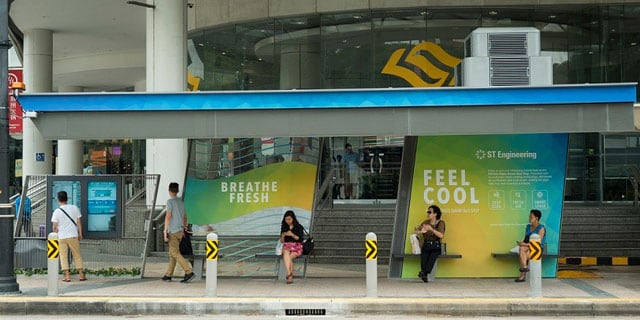
For example, Temasek partnered with utilities company SP Group, one of its portfolio companies, to distribute chilled water to 14 buildings in Singapore’s Tampines Central public housing estate through a network of underground insulated pipes, providing a much-needed air-conditioning respite from tropical heat with a smaller carbon footprint.
According to a study conducted by SP Group and Temasek, consolidating the 14 building cooling loads can result in 17% lower energy consumption—enough to power 1,665 three-room households for a year. Mr. Krueger notes this enables a 18% reduction in carbon emissions—equivalent to removing 2,250 cars from roads annually.