Produced in partnership with Bloomberg Media Group
Every morning, employees at oil-palm plantations across Malaysia and Indonesia survey their crops and check the land for leaky irrigation systems. For generations they traversed the snake-inhabited terrain on foot, covering five hectares per day in the tropical heat. Today, they survey their plantations with drones.
Each drone covers up to 2,500 hectares per day, capturing images that are later fed to computers and analysed using artificial intelligence. The computers review 10,000 hectares worth of data in just a few hours – a job that would have taken a group of 20 people two weeks to complete1.
Drones developed for precision agriculture embody another challenge of some smart agriculture technologies. There is concern that foreign governments could collect sensitive agricultural information in the markets in which these drones are deployed in5.
Meanwhile, Asia Pacific lags other regions in smart agriculture. Varied levels of economic development and the lack of access to financial services make securing the means to innovate challenging. Where financing is available, fragmented farming networks and informal land tenure agreements lower the incentives. According to the AFC report, agri-food tech investment per capita in 2018 stood at US$2.50 and US$1.80 for China and India respectively, significantly lower than the US$24.10 for the U.S.
Over the next ten years Asia will require some US$800 billion of investment in the sector to satisfy consumer demands and build a more secure, safe and sustainable supply chain, the report says. The scale of this transformation presents a significant commercial opportunity for investors as industry players develop and adopt new technologies to meet the requirements of the future.
An Industry Ripe for Disruption
Companies around the world are using disruptive new technologies to boost yields, reduce the environmental impact of farming, produce more nutritional food and shorten supply chains. A start-up in Norway, for instance, is using computer vision and machine learning to predict sea lice in fish farms6. In Holland, an Internet of Things start-up is using nano-satellites to monitor soil moisture, beehives and crops7. In Singapore, an urban farming company is growing 11 tonnes of vegetables in less than 50 square metres of space8. The potential is vast.
“Investors, corporates and governments across Asia can turn this into an opportunity,” said Richard Skinner, Asia Pacific Deals Strategy and Operations Leader at PwC Singapore. “Corporates can deploy these technologies and make a greater profit. Governments can transform their industry and move people from old-fashioned farming techniques to value-added ones, creating jobs and value for the region. Investors in agrifood and agritech have shown they can make strong returns.”
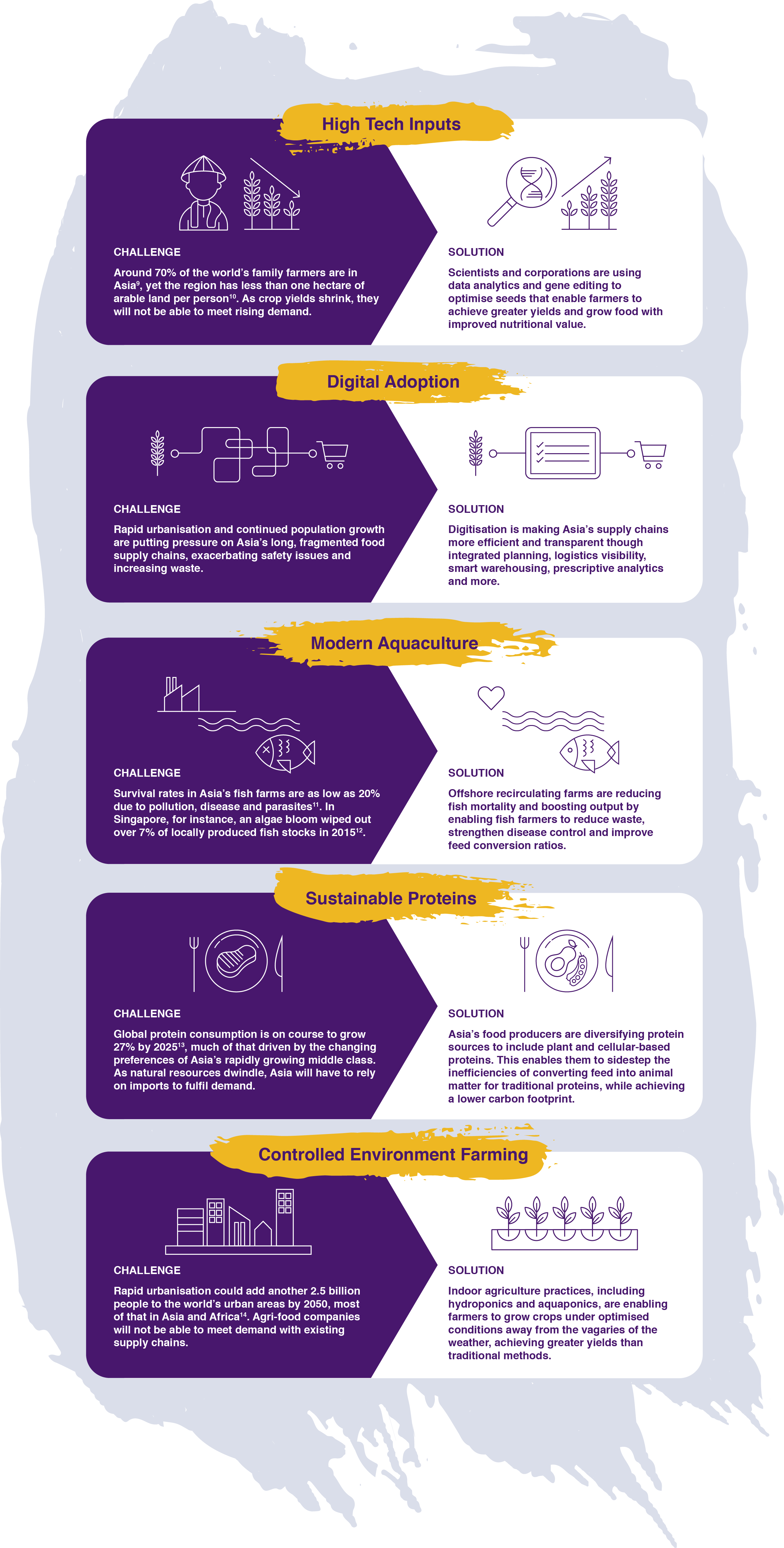
The Asia Food Challenge report lists five key areas where the application of new technologies could make a significant impact in Asia – and potentially the rest of the world – over the next decade:
Smart agriculture hubs will play a big role in making that happen. Major hubs in Tel Aviv and San Francisco are setting the global standard by providing a locus for collaboration and innovation16. Singapore’s Agri-Food Innovation Park, which will open in early 2021, aims to become a nexus for innovation across the entire value chain and, in the longer term, commercialise solutions in areas such as indoor farming, animal feed production as well as insect farms.
With the right ecosystems to attract capital, foster innovation and serve as testing beds for promising new technologies, the world’s agri-food companies can rise to the challenge of supporting future generations as they feed the next billion people.
As a long term investor rooted in Asia, Temasek is committed to working alongside its portfolio companies and partners across the agri-food ecosystem - to build a better, smarter and more sustainable world.
_____________________________