For a time, Hasisha Nazir was paid to pretend she was in trouble. As a freelance “simulated patient”, she would feign illnesses so medical students could practise diagnosing her. Outside the simulation, however, the financial anxiety was real.
Despite graduating with a business management degree nearly a decade earlier, the 33-year-old found herself stuck in the precarious loop of the gig economy. She bounced between contracts – working as a camp facilitator, television performer, and trainer – yet the dollars never stretched far enough for her to “live life well.”
“You’re always making sure that everything is within this much,” she says, holding her hands a few inches apart to demonstrate the narrow margin of her survival. “The grinding and hustling can be unpredictable… You don’t quite know what the month is going to be like.”
From stuck to moving again
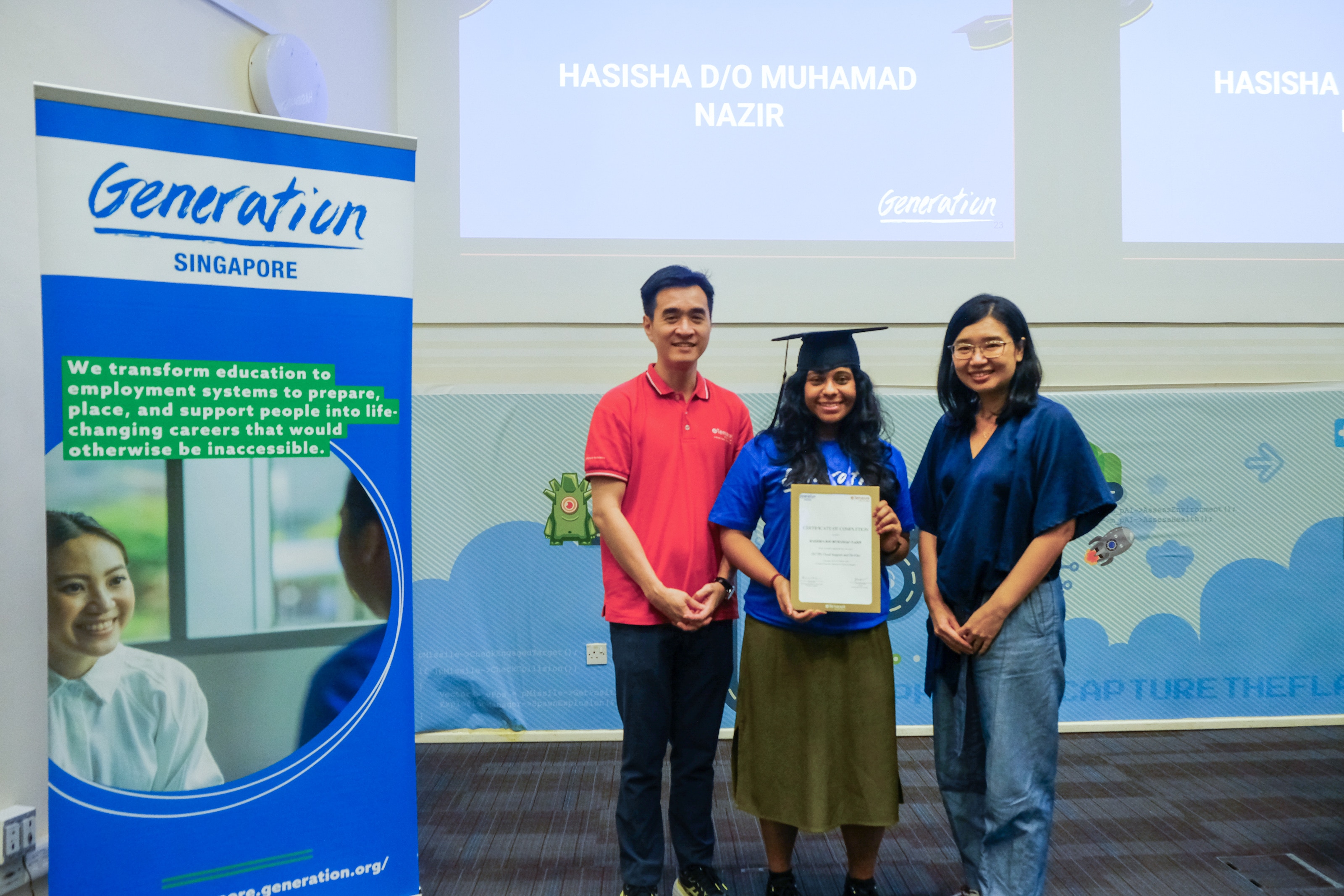
For Hasisha, the programme’s structure was the deciding factor. Unlike traditional models that require participants to shoulder the unsubsidised portion of fees and take time off work, SFS covers those costs and provides a monthly stipend – a financial floor that effectively removes the “gnawing fear” of unpaid bills.
It changed the calculus. When Hasisha found the course options online through Generation Singapore – the service provider for the initiative – the inclusion of the stipend meant she could finally take the leap.
“I saw the box, so I ticked it,” she laughs. “It removed so much noise. I could actually focus on learning.”
Tammy Tan, Vice President of the Community Stewardship team at Temasek, says that creating that kind of access matters because capability building only works when people are able to step into training in the first place.
“Our hope is to empower and upskill Singaporeans to better access the rapidly evolving technology sector, while also contributing to a more inclusive workforce,” she says.
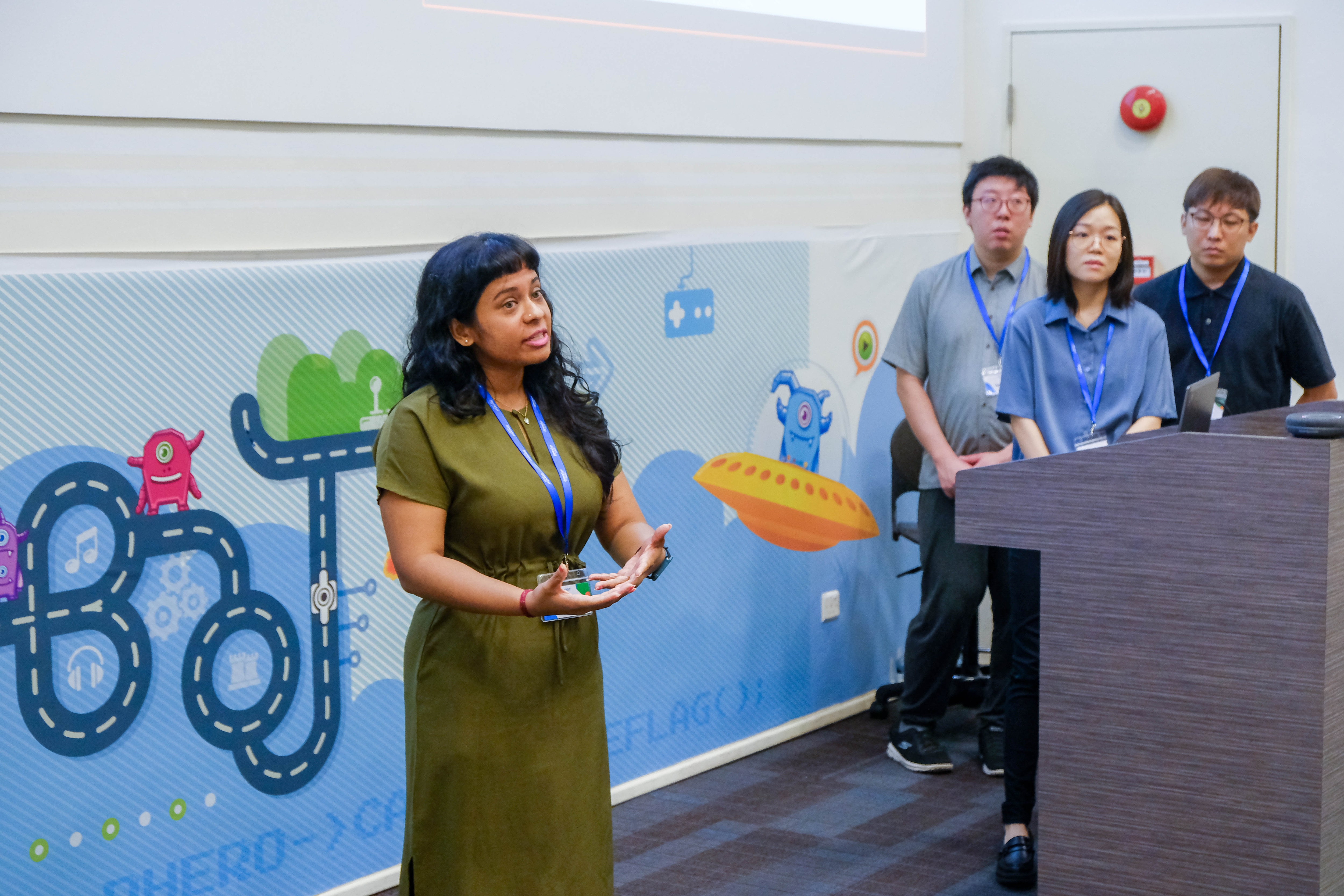
The box she ticked launched Hasisha into a rigorous 12-week hybrid training period in technology fields like full-stack development and cloud support and DevOps. She found herself grappling with Linux and Python, technologies that felt like a foreign language. She moved from a life of staging medical scenarios to writing code – a shift that was often overwhelming.
“It was a lot to learn in a short time, a lot to process,” she says. “The project work was daunting.”
But unlike her freelance days, she wasn’t facing the challenge alone. The programme included mentorship and career support, pairing her with a professional from Microsoft. Her mentor helped her sharpen her resume, prepare for real-world interviews, and encouraged her to view her non-traditional background not as a liability, but as evidence of adaptability.
The job matching support she received upon completion enabled her to land full-time employment. She now helps roll out software updates and tests deployments in real time, seeing classroom theory play out in the real world.
New world, new skills
Hasisha’s first full-time job has been a major milestone, guaranteeing her a steady income for the first time since graduation. “My mother was so happy,” she beams.
The stability allows her to dream beyond the following month’s bills. Today, she is making plans to invest and maybe buy a home in the coming years.
Her ambitions in tech have also grown: more courses, more upskilling, learning from other developers at the firm, even trying her hand at building security tools to help fight scams, inspired by YouTubers who take on cyber fraudsters.
“I want to understand systems to a level that I can make my own tools,” she says. “I’m not quite there yet, but it is a goal.”
Given how dramatically ticking that box on the screen has “opened up a new world” for her, Hasisha has been nudging others, including her siblings and friends, to consider a switch to technology. She is proof that the barrier to entry isn’t as high as it seems – provided the right ladder is there to help you climb.
Her journey reflects what Temasek hopes the SFS programme can unlock – upward mobility for Singaporeans who simply need a door to open at the right time.
As Hasisha puts it, “With the right support, everyone can learn. And it might just give you a new pathway that you have never had before.”
About Temasek's Community Contributions
Temasek’s journey in building social capital started over 20 years ago, when it adopted a deliberate and structured approach, anchored on the twin pillars of governance and sustainability, to give back to communities.
Since 2003, Temasek has been setting aside a portion of its net positive returns above its risk-adjusted cost of capital for community gifts.
These are approved by the Temasek Board and then donated to partners to achieve Temasek’s community objectives of Connecting People, Uplifting Communities, Protecting the Planet, and Advancing Capabilities.
Temasek Trust (TT) has been the primary beneficiary of Temasek’s gifts. TT disburses grants for programmes to be developed and delivered by Temasek’s non-profit ecosystem, including Temasek Foundation, Temasek Life Sciences Laboratory, Stewardship Asia Centre, and Mandai Nature.
In addition to Temasek Trust and our non-profit ecosystem, Temasek also works directly with partners from the Public, Private, and People sectors to advance our community objectives, where our philanthropic capital, network, and industry insights can make the most impact.